

Downsizing Lifestyle Explained for Sustainable Families
A downsizing lifestyle, more precisely called right-sizing, means choosing a smaller, intentionally designed home and having fewer possessions so you gain time, money, and real capacity for sustainable, self-reliant living. The short version: lower housing costs, less upkeep, and freed capital you can redirect into systems that actually build independence. If your housing costs exceed 30% of gross income — the threshold the National Association of Realtors and most financial planners flag as a warning sign — or you’re drawn to the tiny home and greenhouse solutions Gridwiseliving carries, this guide is written for you.
Table of Contents
- What does right-sizing actually mean for your household?
- What are the real benefits of downsizing your home?
- Which housing models work best for downsizers?
- How do you actually downsize, step by step?
- Which sustainability upgrades pair best with downsizing?
- What does downsizing actually save you, financially?
- How do you handle the emotional weight of letting go?
- Is downsizing right for your household right now?
- Key Takeaways
- Why right-sizing supports a genuinely self-reliant household
- Gridwiseliving products built for right-sizers
- Useful sources and further reading
What does right-sizing actually mean for your household?
Most people assume downsizing is just moving into something smaller. It isn’t. The mindset shift is from “less” to “right-size” — matching your home to your actual daily life, not the life you planned ten years ago.

Voluntary downsizing is proactive. It reallocates time and money before life forces a move, and it reduces the emotional and physical energy spent on unused rooms and possessions. That distinction matters: people who choose it on their own terms consistently report better outcomes than those pushed into it by financial pressure or health events.
Common motivations cluster around four areas: financial (cutting mortgage, taxes, insurance), lifestyle (less cleaning, more mobility), environmental (smaller footprint, lower energy use), and freedom (capacity to invest in self-reliance systems like solar or food production). Most downsizers are motivated by at least two of these simultaneously.
What are the real benefits of downsizing your home?
The gains are concrete and categorized, not vague promises.
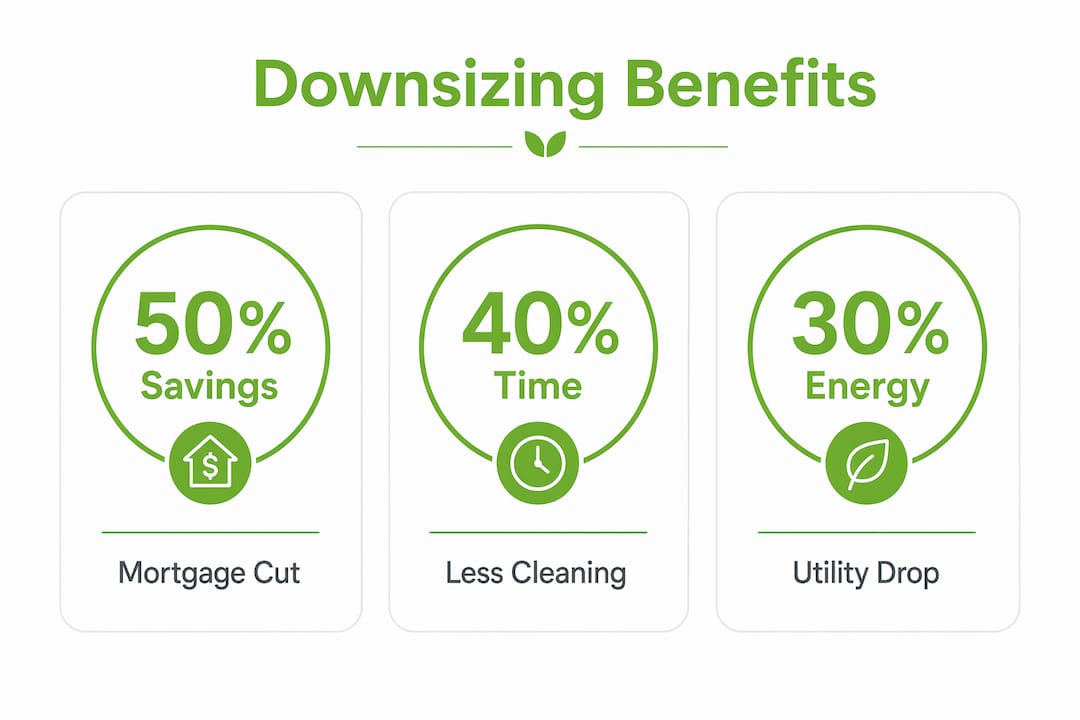
- Financial savings. Smaller homes mean lower mortgage payments, property taxes, insurance premiums, and utility bills. Monthly housing costs typically drop significantly, and a home sale can release substantial equity depending on appreciation.
- Time and maintenance. Fewer rooms, less lawn, fewer systems to repair. That’s reclaimed weekends, not just saved dollars.
- Emotional freedom. Less clutter, fewer obligations tied to a large property, more mental space.
- Environmental impact. Smaller spaces use less energy and generate less waste, cutting your household carbon footprint without lifestyle sacrifice.
- Self-reliance capacity. Freed equity and lower monthly overhead create the budget to invest in solar kits, greenhouse setups, water filtration, and food production systems.
A quick financial example: A family moving from a $2,800/month mortgage on a 2,400 sq ft home to a $1,400/month payment on a 1,200 sq ft home saves $1,400/month. Over one year, that’s $16,800 redirected toward a solar energy system, a greenhouse kit, or an emergency fund. Utility savings of $200–$400/month stack on top. Typical total monthly savings range from $500 to $2,000 or more, depending on your market and actual downsizing scope.
Pro Tip: Model your savings starting with the two highest-cost line items — mortgage and utilities — before touching anything else. Those two alone usually reveal whether downsizing pencils out for your household.
Which housing models work best for downsizers?
| Model | Typical size | Main pros | Main cons | Best for |
|---|---|---|---|---|
| Tiny home | Small square footage | Lowest cost, mobile options, minimal upkeep | Strict zoning in many counties, limited storage | Couples, minimalists, rural land owners |
| ADU (accessory dwelling unit) | Small to moderate size | Stays on existing property, rental income potential | Permit-heavy, construction cost | Empty nesters keeping their lot |
| Smaller single-family house | Moderate size | Familiar layout, standard financing, yard space | Still requires maintenance | Families needing guest rooms or hobby space |
| Condo or co-housing | Small to moderate size | No exterior maintenance, walkable locations | HOA fees, shared-wall noise, less control | Urban downsizers, retirees |
Zoning is the variable most people underestimate. Tiny homes on wheels are regulated as RVs in many U.S. counties, while foundation-built tiny homes must meet local building codes. ADUs require permits in virtually every jurisdiction; some cities have streamlined the process, others haven’t. Check with your local planning office before committing to either model.
For families who still need guest space or a dedicated hobby room, a smaller single-family house in the 1,000–1,400 sq ft range is usually the practical sweet spot. Tiny homes and ADUs shine for couples or individuals prioritizing cost minimization and land flexibility. Gridwiseliving’s tiny home options include expandable, fully equipped models designed for exactly this kind of right-sizing move.
How do you actually downsize, step by step?
A successful downsizing process typically runs several months from initial sorting to move-in day, with decluttering alone often requiring multiple weeks when done room by room.
- Decide. Write a one-paragraph vision statement: what does your ideal daily life look like in a smaller home? Set a target monthly housing budget and run a gap analysis against current costs.
- Plan. Measure every room in your current home and your target space. Map essential furniture into the new floor plan before deciding what to sell. List your home if selling; align the timeline with your purchase or lease.
- Purge. Use the four-box method — Keep, Donate, Sell, Discard — and start with oversized furniture first. Large pieces drive moving costs and set the pace; rehoming them early creates momentum. Skip the “maybe” box; it stalls everything.
- Sell or move. Time your sale to avoid carrying two housing costs simultaneously. Be cautious with long-term storage units — they become expensive holding patterns for things you’ll eventually discard anyway.
- Settle. Verify zoning and permit compliance for any tiny home or ADU before signing. Furnish with pieces that serve at least two functions: an ottoman with storage, a sofa bed, a drop-leaf dining table. Every item should earn its place.
For a detailed belongings checklist specific to tiny home moves, Gridwiseliving’s guide walks through the process room by room.
Which sustainability upgrades pair best with downsizing?
Smaller homes free capital that many homeowners redirect into durable self-reliance systems. The highest-ROI upgrades to prioritize:
- Solar energy kits. A complete off-grid solar system cuts utility bills and provides backup power. Pair with good insulation for maximum payback.
- Greenhouse kits. Year-round food production on a compact footprint. Gridwiseliving’s greenhouse catalog includes models from small DIY kits to larger polycarbonate structures suited to serious food production.
- Water filtration systems. Whole-home or point-of-use filters reduce dependence on municipal supply and lower long-term costs.
- Whole-home and portable generators. Critical for energy resilience, especially in areas with unreliable grid service.
- Microgreens and hydroponic seeds. Low-cost, high-yield food production that works even in a 400 sq ft space.
Understanding how off-grid home systems work before you invest helps you sequence upgrades correctly and avoid costly rework.
Pro Tip: Prioritize insulation and solar before any ornamental or aesthetic upgrades. Thermal efficiency and energy independence deliver measurable monthly savings; a new deck does not.
What does downsizing actually save you, financially?
| Category | Typical monthly savings | Notes |
|---|---|---|
| Mortgage or rent | — | Depends on market and loan balance |
| Utilities | $200–$400 | Based on 30% square footage reduction |
| Insurance | — | Smaller home, lower replacement value |
| Maintenance | — | Fewer systems, less lawn, less exterior |
| Total monthly | $1,400 | Before HOA or storage costs |
| One-time equity release | — | Depends on appreciation and local market |
Run a side-by-side budget comparing your current costs (mortgage, taxes, insurance, HOA, utilities, maintenance) against projected costs in your target home. If housing currently exceeds 30% of gross monthly income, the math almost always favors a move.
Common equity allocation scenarios: pay off high-interest debt first, then fund a solar system or greenhouse, then build a six-month emergency reserve. That sequence protects you before it enriches you.
How do you handle the emotional weight of letting go?
The sorting process is often harder than the move itself. Brett Tarlington’s research finds that the emotional difficulty of downsizing can exceed the stress of retirement. That’s not hyperbole — it’s a useful warning.
Practical strategies that work: stage sentimental items for last, not first. Schedule unhurried sessions of two to three hours maximum. Digitize photos, documents, and children’s artwork into a cloud service or hard drive before discarding physical copies. Involve every family member with a clear, defined role — not just “help me sort” but “you own the kitchen, I own the garage.”
For families, a shared vision statement and a simple item-ownership list prevent the arguments that derail most downsizing projects. When explaining the decision to relatives who don’t understand it, keep it simple: “We’re choosing a home that fits our life now, and using what we free up to build something more resilient.”
Is downsizing right for your household right now?
Work through this checklist honestly:
- Do housing costs exceed 30% of your gross monthly income?
- Are one or more rooms unused most weeks?
- Does maintenance feel like a second job?
- Do you want more self-reliance — food, energy, or both?
- Is your timeline flexible enough for a 3–6 month process?
If you answered yes to three or more, downsizing is worth modeling seriously. Start with a pilot purge of one room, run a budget comparison using the figures in the financial section above, scan your local market for smaller homes or ADUs, and consult Gridwiseliving for product fit on the self-reliance side.
Red flags that argue against moving immediately: a forced timeline (job loss, health crisis) with no financial cushion, unresolved medical needs that require specific home features, or local zoning that effectively prohibits tiny homes and ADUs in your target area. In those cases, stabilize first, then plan.
Key Takeaways
Right-sizing your home is the single most effective lever most families have for simultaneously cutting costs and building sustainable self-reliance — and the process is repeatable in 3–6 months with the right sequence.
| Point | Details |
|---|---|
| Define right-sizing first | Downsizing means matching your home to your actual life, not just moving somewhere smaller. |
| Financial impact is real | Typical monthly savings range from $500 to $2,000 or more; equity release can reach $200,000 or higher, depending on local market conditions. |
| Start with budget and floor plan | Measure your new space and model costs before sorting a single box. |
| Sequence your upgrades | Solar and insulation deliver measurable ROI; prioritize them before aesthetic improvements. |
| Gridwiseliving fits the next step | Tiny homes, greenhouse kits, solar systems, and generators are available to match common right-sizing goals. |
Why right-sizing supports a genuinely self-reliant household
At Gridwiseliving, we see the same pattern repeatedly: families who downsize thoughtfully don’t just spend less — they build more. The capital and time freed by a smaller home are what fund the greenhouse that cuts grocery bills, the solar kit that eliminates utility dependence, and the water filtration system that removes a single point of failure from daily life. That’s not a coincidence. It’s the logic of right-sizing applied to the whole household, not just the mortgage.
Our blog covers the practical side of this in depth, including why people choose tiny living and low-cost sustainable upgrades you can layer in as budget allows. The goal is always the same: durable, user-friendly products that support food and energy independence for real households.
Gridwiseliving products built for right-sizers
Freed equity and lower monthly overhead are only useful if you know what to do with them. Gridwiseliving offers a direct path from downsizing decision to self-reliance upgrade.
- Tiny homes: Expandable, fully equipped models for families right-sizing into compact, livable spaces.
- Greenhouse kits: From the compact Bella 8×12 ft DIY kit to larger polycarbonate structures, matched to your yard size and food production goals.
- Solar energy systems: Complete off-grid kits that convert freed equity into permanent utility savings.
- Generators and water filtration: Whole-home and portable options for energy and water resilience.
- Seeds and hydroponic bundles: Start food production immediately, even in a small space.
Use home equity to fund a solar system that pays back in reduced bills. Pair a greenhouse kit with your new smaller yard to cut grocery spend year-round. Browse Gridwiseliving’s full catalog or start with the greenhouse collection to find the right fit for your household’s next step.
Useful sources and further reading
The sources below informed this guide and are worth bookmarking for your planning process.
- Pros and cons of downsizing your home — Experian: clear breakdown of cost and equity implications.
- How to Downsize Your Home — iBuyer.com: timeline estimates, four-box method, and size benchmarks.
- Voluntary downsizing lifestyle — Living the Zero Life: Paul Stryer’s framework for proactive overhead reduction.
- Downsizing: agony and nostalgia — AFR: Brett Tarlington on the emotional dimension.
- Eco-friendly home construction guide — Better Quality Builders: practical context for sustainable building choices.
- Gridwiseliving blog: how to downsize belongings, benefits of self-sufficient home living, and tiny home communities.
One practical reminder: zoning rules for tiny homes and ADUs vary significantly by county and municipality. Before committing to either model, contact your local planning or zoning office directly. No guide — including this one — substitutes for a conversation with the authority that issues your permits.