

How to Downsize Belongings Before a Tiny Home Move
Downsizing belongings before a tiny home move is the deliberate process of reducing your possessions to match the physical and functional limits of a smaller living space. Most people underestimate how much they own until they face a 200-square-foot floor plan. The real challenge is not just volume. It is the emotional weight attached to objects tied to identity, guilt, and security. Rushing this process worsens decision quality and leads to regret. Starting months in advance, with focused sessions and a clear system, is the single most effective way to make the transition work.
What key categories should you downsize before moving to a tiny home?
The most effective way to declutter for tiny living is to attack specific categories, not random rooms. Sorting by category forces you to see the full volume of what you own. You cannot deny you have 14 spatulas when they are all on the same table.
Ten categories consistently account for the bulk of unnecessary possessions before a tiny home move:
- Duplicate kitchenware. Two colanders, three peelers, and four mixing bowls are common. Keep one of each.
- Towels and bedding. Most households own far more than they use. Two sets per person is the functional maximum for tiny living.
- Off-season and ill-fitting clothes. If it does not fit today or you have not worn it in 12 months, it does not earn a spot.
- Books. Physical books are heavy and space-intensive. Digitize where possible and keep only titles you will re-read.
- Holiday decor. Seasonal items occupy prime storage space for 11 months a year. Pare down to a single box.
- Electronics and cords. Orphaned cables and outdated devices accumulate fast. If you cannot identify what a cord connects to, discard it.
- Extra cleaning supplies. Duplicate products and half-empty bottles waste cabinet space. Consolidate to multi-purpose cleaners.
- Paper archives. Scan and digitize financial records, warranties, and documents. Physical paper piles are a hidden clutter source.
- Furniture that will not fit. Measure before you commit. A sectional sofa has no place in a 150-square-foot living area.
- Sentimental items. These are the hardest. Limit yourself to one dedicated memory box per person.
The One-Year Rule is the clearest benchmark for borderline decisions. If you have not used an item in the past 12 months, the odds are strong you never will. Apply it without exceptions to clothing, gadgets, and specialty kitchen tools.
Pro Tip: Take a photo of sentimental items you cannot keep. The memory survives even when the object does not.
What decluttering methods actually work for tiny living?
Proven methods remove the guesswork from downsizing. The right system reduces decision fatigue and keeps you moving forward when the process feels heavy.
The Four-Box Method
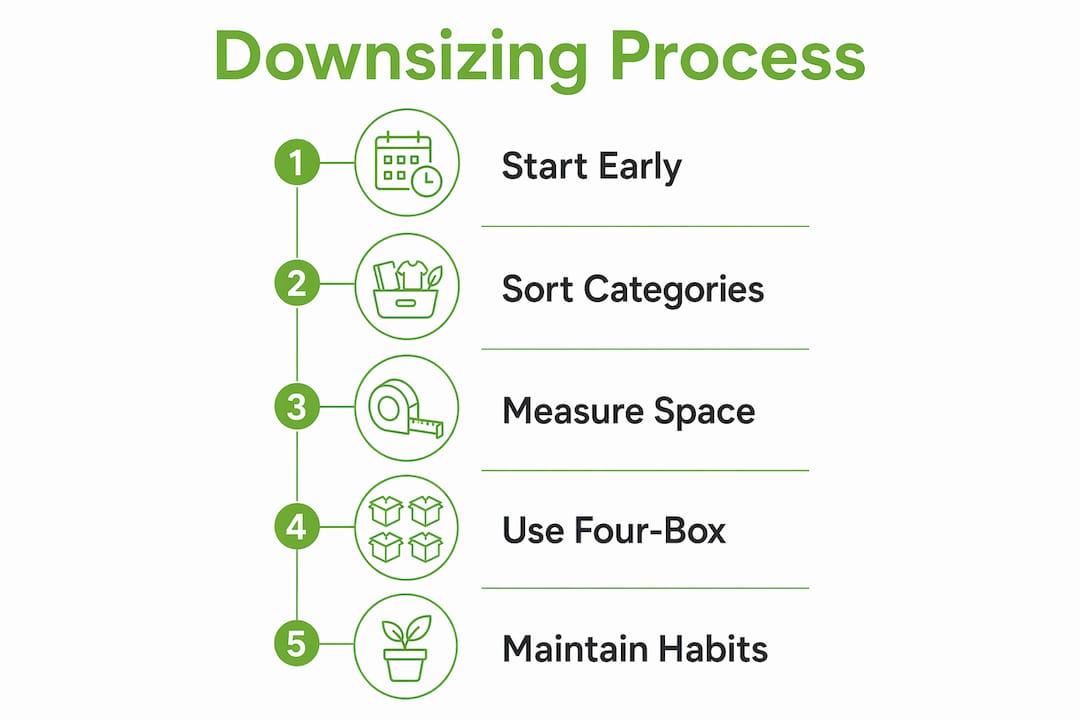
The Four-Box Method assigns every item to one of four destinations: Keep, Donate/Sell, Trash, or Relocate. The power of this method is that it forces a decision on every single object. Nothing gets set aside for “later.” Relocate is for items that belong in a different room or will go to a family member, not a holding category for indecision.

The 90-Day Test
Place uncertain items in a labeled box with today’s date. If you do not open the box within 90 days, donate the contents without reviewing them. This method works because it replaces emotional reasoning with behavioral evidence. You either needed the item or you did not.
Category sorting vs. room sorting
Sorting by category rather than by room gives you an honest picture of what you actually own. Pull every item of clothing from every closet, drawer, and storage bin into one pile. The visual volume is often shocking. Room-by-room sorting lets denial survive because you never see the full picture at once.
| Method | Best for | Key advantage | Watch out for |
|---|---|---|---|
| Four-Box Method | All categories | Forces immediate decisions | Can be slow with large volumes |
| 90-Day Test | Uncertain items | Uses behavior, not emotion | Requires discipline not to peek |
| Category sorting | Clothes, books, papers | Reveals true ownership volume | Needs dedicated floor space |
| One-Year Rule | Tools, gadgets, clothes | Simple, objective benchmark | Does not account for seasonal items |
Pro Tip: Work in 60-minute focused blocks rather than marathon sessions. Decision fatigue sets in fast, and poor choices follow. Stop before you are tired, not after.
How to measure your tiny home space before you start sorting
Measuring your future tiny home before you finalize any keeping decisions is non-negotiable. Accurate space mapping prevents the common mistake of keeping items that physically cannot fit, no matter how much you love them.
Most clutter hides in drawers and cabinets, not on open shelves. Measuring cabinet depths and interior dimensions reveals exactly how much storage you actually have. A standard kitchen cabinet is roughly 12 inches deep. Many tiny home cabinets run shallower. That difference eliminates entire categories of cookware.
The table below shows typical storage dimensions found in most tiny homes. Use these as a planning baseline before your final sort.
| Storage zone | Typical dimension | What fits |
|---|---|---|
| Kitchen cabinets | 10–12 inches deep | Plates, small pots, pantry items |
| Bathroom cabinet | 6–8 inches deep | Toiletries, first aid basics |
| Under-bed storage | 8–12 inches tall | Seasonal clothes, extra linens |
| Loft sleeping area | 36–48 inches ceiling height | Bedding, pillows only |
| Closet rod space | 24–36 inches wide | 20–30 hanging garments maximum |
Create a simple floor plan sketch with these measurements noted. Then walk through your current belongings and ask whether each item has a specific, measured home in the new space. If the answer is no, the item does not make the cut. This approach removes impulse keeping from the equation entirely.
Ceiling height matters more than most people expect. Tall bookshelves, armoires, and floor lamps often conflict with tiny home ceiling designs that prioritize loft space over vertical clearance. Measure twice, keep once.
What habits keep a tiny home clutter-free after you move in?
Moving into a tiny home does not end the work. The habits you build in the first 90 days after moving determine whether you maintain a minimalist lifestyle or gradually recreate the clutter you left behind.
The foundation is intentionality. Every item in a tiny home must earn its place through recurring actual use, not imagined future utility. “Just in case” thinking is the root cause of clutter in any home. In a tiny home, it fills your space within weeks.
Practical habits that prevent clutter from returning:
- One-in, one-out rule. Every new item that enters the home requires an existing item to leave. No exceptions.
- Monthly 15-minute sweeps. Walk through every zone once a month and remove anything that has not been used since the last sweep.
- Digital-first for documents and media. Paper and physical media are the fastest-growing clutter categories. Use cloud storage, e-readers, and streaming services instead.
- Immediate exit for unwanted items. Remove decluttered items from your home the same day you sort them. Items left in bags or boxes near the door often find their way back inside.
- Avoid buying storage before purging. Premature storage purchases encourage keeping unnecessary items. Buy organizers only after you know exactly what you are keeping.
Pro Tip: Before any purchase, ask yourself: “Where will this live in my home?” If you cannot name a specific spot, do not buy it.
The mindset shift that sustains tiny living is focusing on lifestyle goals rather than possessions. You are not giving things up. You are choosing what gets your limited space and attention. That reframe changes how you shop, how you receive gifts, and how you evaluate what belongs in your home.
Digitizing documents is one of the highest-return actions you can take before moving. A single filing cabinet can hold thousands of pages. A cloud storage account holds the same information in zero square feet. Scan and shred paper archives before moving day, not after.
Key Takeaways
Downsizing belongings before a tiny home move requires starting months early, sorting by category, measuring your space precisely, and building daily habits that prevent clutter from returning.
| Point | Details |
|---|---|
| Start months in advance | Early, focused 60-minute sessions prevent rushed decisions and emotional regret. |
| Sort by category, not room | Pulling all items of one type together reveals true ownership volume and prevents denial. |
| Measure before you keep | Cabinet depths, ceiling heights, and floor space determine what physically fits your new home. |
| Remove items immediately | Taking unwanted items out the same day prevents backsliding and stalled progress. |
| Build one-in, one-out habits | Every new item entering the home must displace an existing one to maintain minimalism long term. |
What I have learned from watching people move into tiny homes
The biggest mistake I see is treating downsizing as a packing problem rather than a decision problem. People spend weeks buying bins and labels before they have sorted a single drawer. The organizing happens after the purging, not before.
The second mistake is underestimating emotional attachment. Objects carry memory, identity, and guilt. A bread maker from a deceased parent is not just a kitchen appliance. Rushing past that reality produces either paralysis or regret. The right pace is slow enough to honor the emotion and fast enough to keep moving. Sixty-minute sessions work because they respect both.
What surprises people most after they move in is how little they miss. The items they agonized over for hours rarely cross their minds a month later. The freedom of a self-sufficient, intentional home replaces the comfort that objects used to provide. That is not a theory. It is what people report, consistently, after the transition.
Category-based sorting is the single most underused technique in this process. Most people sort room by room because it feels manageable. But room-by-room sorting lets you hide from the truth. When you pull every book from every room into one pile, you see 200 books. That number changes your decisions in ways that finding 40 books in a bedroom never would.
Start with the easiest categories first. Kitchen duplicates and expired pantry items build momentum without emotional cost. Save sentimental items for last, when your decision-making muscle is trained and your commitment to the lifestyle is firm.
— Gridwise
Gridwiseliving’s tiny homes are built for the life you are creating
Choosing the right tiny home structure makes every downsizing decision more concrete. When you know your exact floor plan, cabinet dimensions, and storage zones, you stop guessing about what fits and start making confident choices.

Gridwiseliving offers a range of expandable, fully equipped tiny homes designed with efficient storage built into every zone. The layouts are purpose-built for people who have already done the work of reducing their belongings to what truly matters. For those who want a broader selection, the full tiny homes collection includes prefab and luxury options with customizable features. Every model is built to support a practical, lower-cost lifestyle without sacrificing comfort. Knowing your home’s exact specs before you sort is the clearest advantage you can give yourself.
FAQ
How early should I start downsizing before a tiny home move?
Experts recommend starting several months before your move date. Shorter, focused sessions of around 60 minutes prevent decision fatigue and produce better choices than marathon sorting days.
What is the One-Year Rule in downsizing?
The One-Year Rule states that any item unused in the past 12 months should be discarded. It applies cleanly to clothing, gadgets, and specialty kitchen tools where usage patterns are easy to recall.
Should I buy storage organizers before I downsize?
No. Buying storage before completing your purge encourages keeping items you do not need. Purchase organizers only after you have finalized exactly what you are keeping.
What is the hardest category to downsize before a tiny home move?
Sentimental items are consistently the most difficult. Limit yourself to one memory box per person and photograph items you cannot keep to preserve the memory without the physical space.
How do I stop clutter from returning after I move into a tiny home?
Apply the one-in, one-out rule for every new purchase, remove unwanted items from your home the same day you sort them, and conduct a brief monthly sweep of every storage zone.