

U.S. Home Growers Cut Greenhouse Temps 10–20°F with Fan and Pad Sizing
Ventilation and shading solve most greenhouse heat problems on their own, and they should be the first two upgrades any grower makes. Dry-climate growers get a bigger lever: fan-and-pad evaporative cooling, which can pull temperatures down 10 to 20 degrees Fahrenheit when humidity is low. Humid-climate growers should lean harder on airflow and shade, saving mechanical or hybrid systems for when nothing else holds the line. The trade-off is simple: evaporative systems trade water and rising humidity for lower temperatures, while air conditioning trades a bigger electric bill for precise, humidity-independent control.
TL;DR:
- Natural ventilation and shading are essential first steps, with shading cloth outside the structure being the most cost-effective way to reduce heat.
- Fan-and-pad evaporative cooling can lower temperatures by 10 to 20 degrees Fahrenheit in dry environments but loses effectiveness in humid climates.
- Mechanical and hybrid cooling systems are necessary only when humidity is high or precise temperature control is required, and proper sizing is crucial for efficiency.
- Strategically placing exhaust fans on the leeward wall, using HAF fans to prevent hot spots, and controlling systems with staged automation improve cooling reliability.
- Evaporative systems consume water continuously and should be paired with humidistats to prevent excess humidity, especially in water-scarce regions.
Table of Contents
- How Do Ventilation and Air Exchange Keep a Greenhouse Cool?
- Which Shading Options Cut Heat Without Blocking Light?
- What Temperature Drop Can You Expect From Evaporative Cooling?
- When Do You Need Mechanical or Hybrid Cooling Systems?
- How Do HAF Fans Prevent Hot and Cold Pockets?
- What Controls Keep Automated Cooling Systems Reliable?
- How Much Water Does Evaporative Cooling Actually Use?
- Which Cooling Methods Fit Your Climate and Greenhouse Type?
- What Should You Check Before Buying Cooling Equipment?
- Where the Standard Cooling Advice Falls Short
- Get Your Greenhouse Cooling Setup Right the First Time
- Sources
- FAQ
How Do Ventilation and Air Exchange Keep a Greenhouse Cool?
Hot air rises and wants to leave through the highest point available. Open a ridge vent along with low sidewall vents and you get the “stack effect”: cool air enters low, warm air exits high, no motor required. Purdue’s extension guidance recommends sidewall and roof vent openings that together total roughly 15 to 20% of floor area, with ridge vents able to open as wide as 60 degrees for maximum draw.
Passive airflow has limits, though. Once temperatures climb past what natural convection can handle, forced ventilation takes over. The standard sizing rule from university extension programs is 8 to 10 cubic feet per minute per square foot of floor area, enough to keep interior air within about 5 degrees Fahrenheit of outside temperature. A 3,000 square foot greenhouse, for example, needs fans rated for roughly 24,000 to 30,000 cfm combined.
Statistic Callout: A 20-foot by 96-foot greenhouse (roughly 1,920 square feet) needs about 15,000 to 19,000 cfm of exhaust capacity to stay within that 5-degree window on a hot afternoon.
A few placement rules matter more than most growers expect:
- Mount exhaust fans on the leeward wall, opposite prevailing wind, so they pull instead of fighting it.
- Leave clear space in front of every intake shutter equal to 4 to 5 times the fan diameter or airflow chokes down before it ever reaches the plants.
- Exhaust fans cannot cool below outdoor ambient temperature; they only exchange air, so on a 98°F day, that’s your floor.
- Insect screens on intake vents can cut natural airflow by more than half, so growers using mesh should size up vent area or add supplemental fan capacity to compensate.
Most greenhouses end up running both systems: natural ventilation on mild days, fans kicking in once a thermostat crosses a set threshold.
Which Shading Options Cut Heat Without Blocking Light?
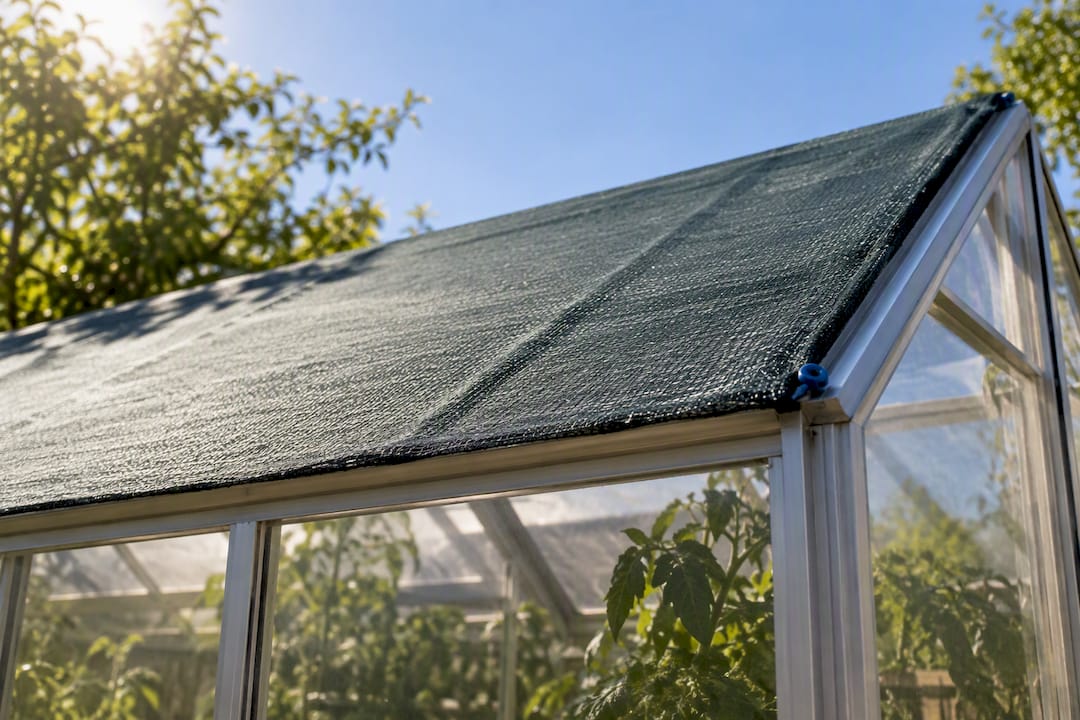
Shade cloth mounted outside the greenhouse structure beats interior shading almost every time, because it intercepts solar radiation before it converts to heat against the glazing. Standard woven shade cloth blocks a percentage of light proportional to its density, while aluminet reflective screens reflect infrared energy and typically knock down more heat per percentage point of shade than a basic knit fabric.
For most vegetable and flower crops, 30 to 50% shade strikes the right balance between temperature control and light for photosynthesis. Shade-loving plants like orchids or many houseplant varieties tolerate 50 to 70% without stunting growth.
- Fixed shade cloth works fine for growers who accept reduced winter light in exchange for simplicity.
- Roll-up or retractable screens let you dial shade in during heat waves and pull it back on overcast days, which matters more in regions with big daily temperature swings.
- Shade paint or whitewash, applied directly to glazing, is a low-cost seasonal fix, though it has to be reapplied and doesn’t adjust with the weather.
Growers building a shade frame from scratch can find useful PVC frame construction guidance for mounting cloth without drilling into structural framing, and a full breakdown of shade cloth options covers percentage selection in more detail.
Pro Tip: Install shade cloth on the outside face of the roof, not the walls. Roof glazing takes the most direct solar hit at midday, and shading it first delivers most of your temperature reduction for the least material.
What Temperature Drop Can You Expect From Evaporative Cooling?
Fan-and-pad systems, sometimes called swamp coolers for greenhouses, pull outside air through a water-saturated pad before it enters the growing space. Water evaporating off the pad absorbs heat from the air (the same latent-heat principle that makes sweat cool your skin), so the air arriving inside the greenhouse is measurably cooler and more humid than the air outside.
Performance depends heavily on humidity. Under dry, low-humidity conditions, a well-tuned fan-and-pad system delivers a 10 to 20 degree Fahrenheit reduction. In humid regions, the wet-bulb depression shrinks and evaporative cooling loses most of its punch, which is why the UGA/CAES extension guidance recommends prioritizing ventilation and shading in humid climates instead.
Sizing a pad system correctly comes down to match pad area to fan airflow. Extension research points to roughly 1 square foot of pad per 150 cfm of fan capacity to reach high evaporative efficiency, near 85%. Pump flow rates run about 1/3 gallon per minute per foot of pad for thin aspen pads, up to 3/4 gpm per foot for thicker cellulose pads.
Misting and fogging systems work differently, injecting water droplets directly into greenhouse air rather than evaporating it off a pad.
- Fog nozzles need droplet sizes under 50 microns; anything larger wets foliage instead of evaporating cleanly.
- Hard water leaves mineral deposits on leaves and clogs nozzles, so filtration isn’t optional.
- Wet foliage from oversized droplets raises fungal disease risk, especially in already-humid regions.
- Fogging pairs well with pad systems as a supplemental boost during extreme heat spikes rather than as a standalone system.
Run a humidistat alongside your thermostat so the pad doesn’t keep pumping once humidity climbs past what your crop tolerates, and check pads for algae buildup on a regular schedule. Come fall, pull pads out or cover them; leaving cellulose pads exposed to freeze cycles shortens their life fast.
When Do You Need Mechanical or Hybrid Cooling Systems?
Ventilation and evaporative cooling both hit a ceiling. When outdoor humidity is already high, or when a crop needs a tight temperature band regardless of weather, air conditioning or heat pump systems become the only reliable option. They cost more to install and run, but they don’t add moisture to the air, which matters for propagation rooms or high-value crops sensitive to fungal pressure.
Hybrid systems split the difference. Indirect evaporative cooling pairs a heat exchanger with an evaporative stage so cooled air never picks up extra humidity. Desiccant dehumidification and Maisotsenko-cycle (MEC) systems go further, pulling moisture out of the airstream before cooling it, which extends usable cooling range in climates where straight evaporative cooling falls flat.
- Air conditioning: highest energy cost, no humidity added, best precision.
- Indirect evaporative or MEC hybrids: moderate cost, extends evaporative cooling into humid climates.
- Desiccant-assisted systems: highest complexity and upfront cost, best humidity control margin.
Before committing to any of these, weigh installation cost against how many degree-days of extreme heat your region actually sees each year. For most home growers, it’s overkill; for commercial operations running sensitive crops, it can be the deciding factor.
How Do HAF Fans Prevent Hot and Cold Pockets?
Warm air stratifies, collecting near the roof peak while cooler air pools at bench height, and that temperature gradient creates uneven growing conditions even when your overall ventilation is working. Horizontal airflow (HAF) fans solve this by keeping air moving in a continuous oval pattern around the perimeter of the house, rather than letting layers settle.
Mount HAF fans about two thirds of the way up the wall, spaced to create a continuous loop rather than fans fighting each other. Run them at low speed continuously, even overnight, rather than cycling them on and off with the thermostat.
- Aim airflow along walls and over the canopy, never straight at foliage, since direct fan blast stresses leaves and dries them unevenly.
- Continuous circulation reduces localized hot spots that a single thermostat sensor might miss entirely.
- Even air movement also cuts fungal disease pressure by keeping leaf surfaces from sitting damp.
Pro Tip: If you only have budget for one circulation fan, place it to break up the stagnant air pocket near your thermostat sensor. An inaccurate sensor reading throws off every other cooling system tied to it.
What Controls Keep Automated Cooling Systems Reliable?
A cooling system without staged controls either runs constantly or not enough, both of which waste energy or stress plants. Set up your controls in sequence, so cheaper interventions trigger first and more expensive ones only kick in when needed.
- Set vents to open first, typically around 75 to 80°F, letting passive airflow do the early work.
- Trigger exhaust fans once temperature reaches roughly 85°F, staging additional fans in if a single stage isn’t holding the line.
- Bring evaporative pad pumps online last, gated by a humidistat so pads don’t run once relative humidity climbs above your crop’s comfort range.
- Log temperature, humidity, and vapor pressure deficit (VPD) continuously so you can spot patterns and adjust setpoints instead of guessing.
Automatic vent openers come in two flavors: wax or piston-driven openers that need no electricity, and electric actuators tied into a full control system. Wax openers are inexpensive and reliable but react slowly during fast temperature spikes, so keep a manual override on hand for sudden heat waves. Whichever type you run, check hinges and pistons each season, since a stuck vent opener is one of the most common causes of a cooked crop.
How Much Water Does Evaporative Cooling Actually Use?
Pad systems consume water continuously while running, and the honest answer is that usage scales directly with pad size and runtime, not a fixed daily number you can plan around blind. Budget pump capacity based on your pad length (roughly 1/3 to 3/4 gallon per minute per foot, depending on pad thickness), and expect to top off the reservoir regularly during peak summer heat.
- Filter circulating water and clean sumps on a schedule to prevent algae from clogging pad media.
- Use a humidistat to shut pumps off once indoor relative humidity climbs too high, rather than running pads on a timer alone.
- Sequence pumps to run intermittently with fans rather than continuously, cutting both water use and disease risk from sustained high humidity.
- In water-scarce regions, lean harder on shade cloth, ventilation, and thermal mass (water barrels, concrete) instead of running pads nonstop.
Which Cooling Methods Fit Your Climate and Greenhouse Type?
Match your cooling strategy to your local humidity before spending money on equipment. A method that performs brilliantly in Arizona can underperform badly in Florida.
- Dry climates (Southwest, high desert, interior West): shading plus ventilation plus a properly sized fan-and-pad system is the standard combination, and it’s genuinely hard to beat for cost per degree of cooling.
- Humid climates (Southeast, Gulf Coast, mid-Atlantic summers): maximize shade and ventilation area first; evaporative cooling loses effectiveness here, so mechanical or hybrid systems earn their keep for crops that need tight control.
- Hobby growers: start with shade cloth and passive ventilation upgrades before spending on fans or pads. These two moves alone solve most backyard overheating problems.
- Commercial operations: stage cooling systems (vents, fans, pads, mechanical backup) and consider professional design help, since undersized systems on a large structure fail fast and expensively.
Greenhouse siting also plays into this decision. A structure placed with poor orientation or wind exposure fights you before you’ve spent a dollar on equipment.
What Should You Check Before Buying Cooling Equipment?
Greenhouse models with roof vents and pre-cut mounting points save you a weekend of retrofitting when you decide to add exhaust fans or shade frames later. Check for that compatibility before you buy, not after.
Running fans and pumps off-grid gets easier with a properly sized solar energy system, which offsets the power draw evaporative cooling and circulation fans add to your electric bill. For pad systems, a dedicated water storage tank gives you reliable makeup water instead of running a hose from the house every afternoon.
A basic seasonal maintenance list: clean or replace pads before each cooling season, winterize pumps and drain lines before first frost (see our greenhouse winterizing checklist), and test automatic vent openers monthly during peak summer to catch a stuck piston before it costs you a crop.
Where the Standard Cooling Advice Falls Short
Most greenhouse cooling guides treat every method as equally viable and let readers sort out priority on their own. That’s backwards. Shading and ventilation cost the least and solve the most common problem, which is glazing acting like a magnifying glass on a sunny afternoon. Every dollar spent there returns more cooling per dollar than the next upgrade on the list.
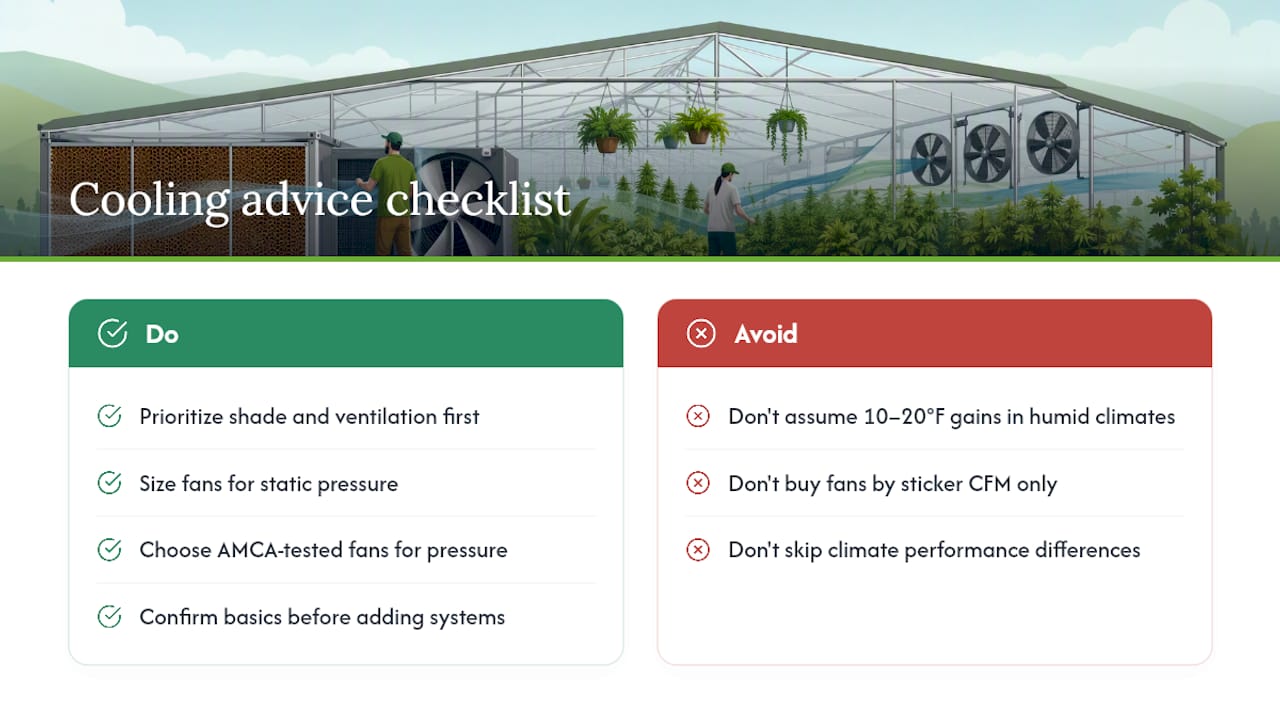
Evaporative cooling gets oversold to growers in humid states who read about the 10 to 20 degree Fahrenheit swamp cooler numbers without registering that those figures assume low humidity. A pad system in coastal Georgia won’t perform like one in Nevada, and growers who skip that distinction end up disappointed with equipment that was never going to work for their climate in the first place.
The other blind spot is sizing. Extension research consistently shows installed fans deliver only 60 to 70% of rated airflow once static pressure from pads and screens is factored in, unless you buy AMCA-tested fans rated for that pressure. Buying based on the sticker cfm number alone is a common, avoidable mistake. Start with shade and ventilation, size your fans with pressure in mind, and only add evaporative or mechanical systems once you’ve confirmed the basics aren’t enough.
— Gridwise
Get Your Greenhouse Cooling Setup Right the First Time
Gridwiseliving’s edge is simple: you get a curated selection built around durability and ease of use, so you’re not stuck retrofitting a bargain structure with vents and mounts it was never designed for. Our greenhouse collection includes models with roof vents and swing doors already built in, which means adding fans, shade frames, or pad systems later doesn’t turn into a construction project.
If you’re planning a pad system, pair your greenhouse with a water storage tank sized for your climate, and offset the power draw from fans and pumps with a solar energy system instead of adding to your utility bill. Not sure which combination fits your square footage or your region’s humidity? Reach out to Gridwise support for help matching equipment to your setup, and check the Gridwise blog for installation and seasonal maintenance guides before you commit to a purchase.
Sources
- Fan and pad evaporative cooling systems (UMass fact sheet)
- Greenhouses: Heating, Ventilation, and Cooling (UGA/CAES field report)
- Fan and Pad Evaporative Cooling Systems (UConn IPM)
FAQ
What Is the Most Effective Way to Cool a Greenhouse?
For most growers, shading plus ventilation solves the majority of overheating problems before any other equipment is needed. In dry climates, adding a properly sized fan-and-pad system delivers a 10 to 20 degree Fahrenheit reduction on top of that.
Will a Swamp Cooler Work in a Greenhouse?
Yes, but performance depends heavily on your local humidity. Fan-and-pad (swamp cooler) systems work best in dry climates, while high humidity sharply reduces their cooling effect, making ventilation and shading the better priority in humid regions.
How Do Amish Growers Heat and Cool Greenhouses Without Grid Power?
Amish greenhouse operations commonly rely on passive design, thermal mass like water barrels, and manually operated vents rather than electric fans or pumps. That same low-tech approach, orientation, shading, and natural ventilation, works well for any grower wanting to reduce reliance on powered cooling equipment.
What Is the Best Cooling System for a Backyard Greenhouse?
There’s no single best system; it depends on your climate and greenhouse size. Most backyard growers start with shade cloth and ridge vents, then add a small exhaust fan sized at 8 to 10 cfm per square foot of floor area if passive ventilation isn’t keeping pace with summer heat. A greenhouse from Gridwiseliving’s collection with roof vents already built in makes that upgrade path simpler.
How Much Does Evaporative Cooling Raise Humidity Inside a Greenhouse?
Evaporative cooling always adds moisture to the air since it works by evaporating water into the airstream. That’s why pairing a fan-and-pad system with a humidistat matters, so pumps shut off once relative humidity climbs past what your crop tolerates.