

$28,000–$185,000 Tiny House Costs 2026: All-In Budgets for U.S. Buyers
A tiny house in 2026 runs anywhere from $28,000 for a bare DIY shell to $185,000 for a permitted, foundation-built model, with most buyers landing between $75,000 and $135,000 for a turnkey home on wheels. The three factors that move that number more than anything else are your build path (wheels versus foundation), how much site work your land needs, and how far you push finishes. THOWs typically finance like RVs; foundation builds qualify for conventional mortgages, which changes your monthly math substantially.
TL;DR:
- The true total cost of a tiny house in 2026 can range from $28,000 for a DIY shell to $185,000 for a foundation-built model, often costing more than initial sticker prices.
- Financing options differ significantly: RV-classified tiny homes on wheels usually qualify for RV loans with shorter terms and higher interest, while foundation builds may secure traditional mortgages and have stronger resale value.
- Location influences costs, with high-cost states like California reaching up to $185,000 and cheaper Midwest or Southeast regions averaging around $65,000 to $115,000, depending on local regulations and terrain.
- Hidden expenses such as site prep, utility hookups, permits, and transport can add thousands to your budget if not itemized and planned for in advance.
- Building a tiny home on land and ensuring code compliance significantly enhances its resale value and eligibility for financing compared to mobility-focused models on wheels.
Table of Contents
- Tiny House Cost 2026: Price Breakdowns By Build Path
- What Drives Your Tiny House Budget Up Or Down
- How Much a Tiny Home Costs By State
- Financing, Insurance, and What Your Tiny Home Will Be Worth Later
- Building Your All-In Tiny House Budget
- Cutting Your Monthly Costs After Move-In
- When Tiny Actually Makes Financial Sense
- Equip Your Tiny Home For Real Self-Reliance
- Sources
- FAQ
Tiny House Cost 2026: Price Breakdowns By Build Path
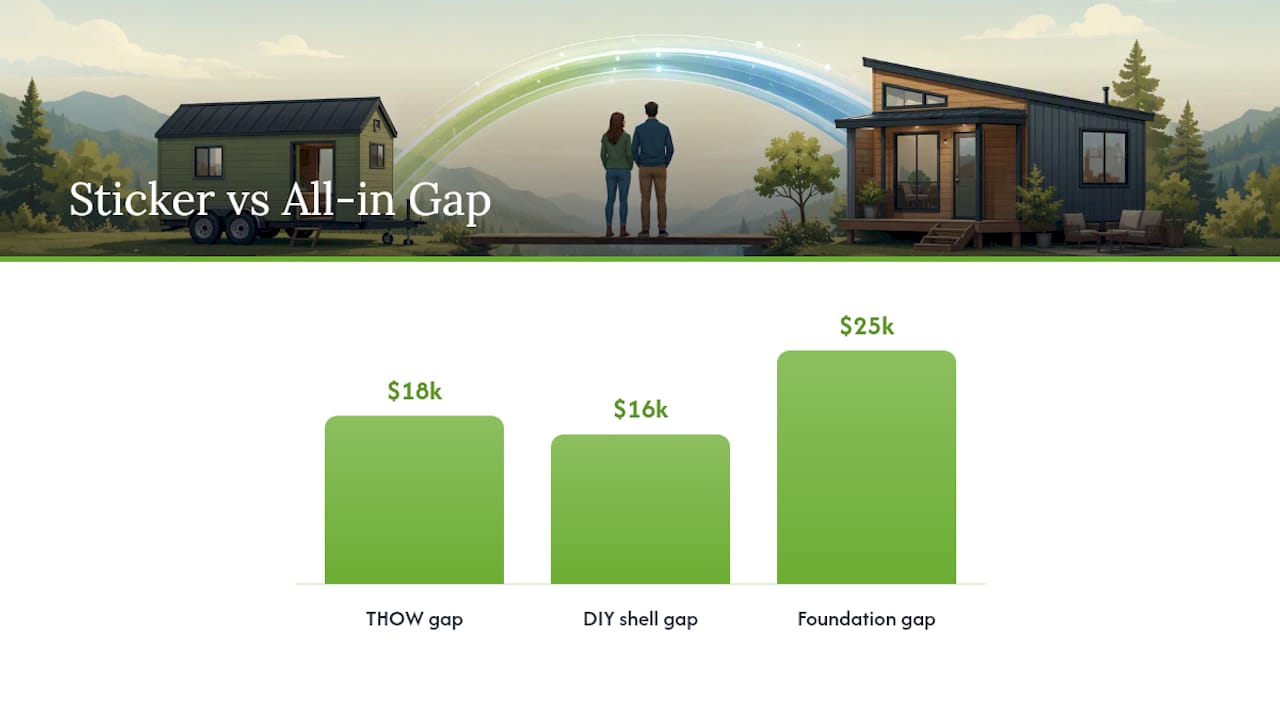
The sticker price on a builder’s website almost never reflects what you’ll actually pay. Industry data for 2026 puts all-in tiny house costs, once transport, hookups, permits, and site prep are counted, anywhere from $28,000 to $185,000 depending on which path you choose, with sticker prices commonly covering only 55% to 70% of the true all-in total. That gap catches almost every first-time buyer off guard.
Here’s how the major build paths break down:
- DIY shell kit: costs typically start from tens of thousands of dollars all-in. You’re buying a framed, weathertight shell and finishing the interior yourself. Labor savings are real, but so is the time commitment. Most DIYers underestimate electrical and plumbing rough-in costs.
- Turnkey tiny home on wheels (THOW): $75,000 to $135,000 all-in, with a broad market range of $70,000 to $150,000 once you include delivery, hookups, and site prep. This is the most common path for buyers who want move-in-ready without building a house from scratch.
- IRC/foundation build: usually costs well over one hundred thousand dollars all-in. Built to residential code on a permanent foundation, these qualify for conventional financing and appraise more like a normal house. Permitting and inspections add cost and time you won’t face with a THOW.
- Park model: often costs in the range of tens of thousands to slightly over one hundred thousand dollars all-in. Larger than a typical THOW (often up to 400 square feet), classified under RV standards (ANSI A119.5), and usually destined for a long-term site in a park or community rather than road travel.
- Prefab/modular tiny home: typically costs tens of thousands to over one hundred thousand dollars all-in. Built in a factory and trucked to your lot, prefab splits the difference between DIY savings and turnkey convenience, though crane-set costs at delivery can surprise buyers.
Per-square-foot costs on tiny homes run noticeably higher than a conventional house, often $200 to $400 per square foot compared to $150 to $200 for standard new construction. Compact kitchens, custom-built storage, and marine-grade or RV-grade fixtures all cost more per unit of space than mass-produced components sized for a 2,000-square-foot floor plan.
Three quick scenarios show how sticker price and final cost diverge. A builder quotes a THOW at $68,000. Add delivery ($3,000), a gravel pad and utility hookups ($9,000), permits ($1,500), and appliances not included in the base build ($4,500), and the real total lands near $86,000. A DIY shell purchased for $32,000 often reaches $48,000 once a buyer accounts for insulation upgrades, a proper subfloor, and a full electrical panel. A foundation build quoted at $140,000 frequently closes near $165,000 after septic tie-in, driveway grading, and code-required inspections.
What Drives Your Tiny House Budget Up Or Down
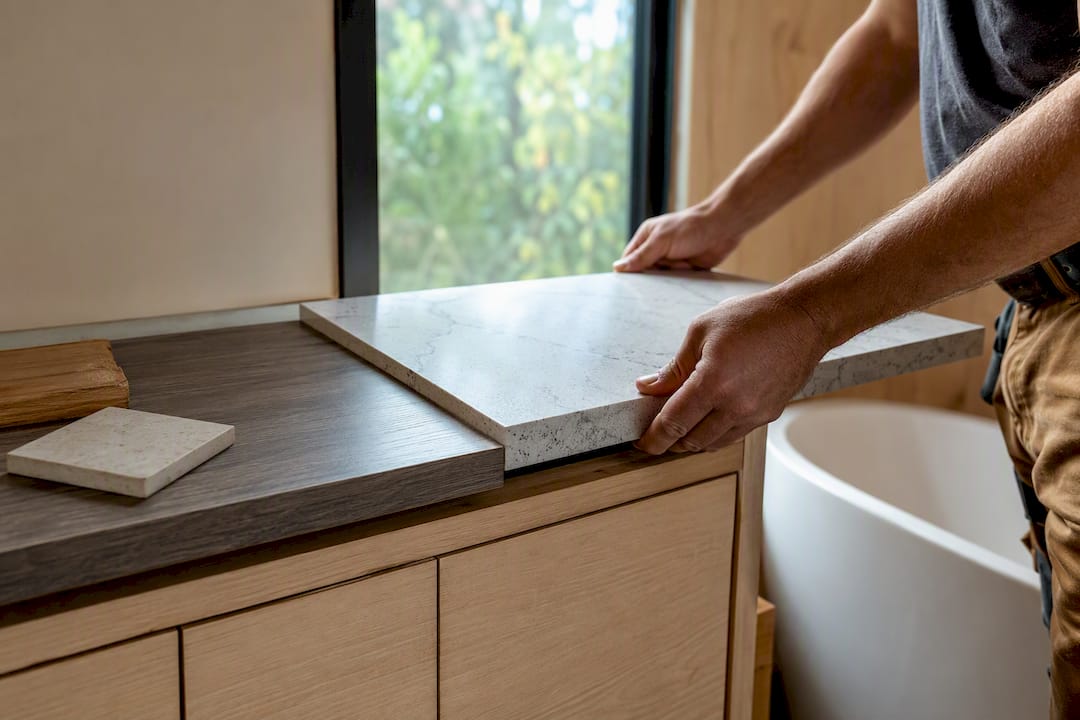
Size and complexity move cost faster than almost anything else. A simple 200-square-foot loft design with one bathroom costs far less than a 350-square-foot single-story layout with two zones of plumbing. Finish choices swing budgets by tens of thousands: laminate countertops and a standard shower stall versus quartz counters, a soaking tub, and site-built cabinetry can add $15,000 to $25,000 to an otherwise identical floor plan.
Trailer versus foundation changes what’s actually included in your quote. A trailer-based build usually bundles the chassis, axles, and hitch into the base price, but often excludes registration, VIN inspection, and any state-required weight certification. A foundation build’s quote frequently omits excavation, footings, and the concrete work itself, treating those as a separate site-prep line that buyers discover only after signing.
Here’s where hidden costs typically hide in a quote:
- Delivery and setup. THOW transport runs $3 to $10 per mile beyond a builder’s free radius, and long hauls across state lines add up fast.
- Site prep and grading. Clearing, leveling, and a gravel or concrete pad commonly run $3,000 to $15,000 depending on terrain.
- Utility hookups. Connecting to water, sewer, and electric service, or drilling a well and installing a septic system, is one of the most frequently underbudgeted categories in the entire project.
- Permits and inspections. Fees vary by county, but foundation builds almost always require more inspections than a THOW parked on private land.
- Sales tax. Applied to the unit price in most states, which means a higher-spec build carries a proportionally larger tax bill.
Pro Tip: Ask every builder for an itemized quote that separates the unit price from delivery, hookups, and permits. If a quote lists only one lump number, that’s your cue to ask what’s excluded, because something always is.
How Much a Tiny Home Costs By State
Where you build changes your budget as much as what you build. Transport distance, climate-driven construction requirements, and local labor rates all stack on top of the base build price, and some states are running noticeably higher or lower than the national range for 2026.
- High-cost regions (California, Northeast): Expect $95,000 to $185,000 all-in for turnkey or foundation builds. Stricter energy codes, higher labor rates, and longer permitting timelines push costs up, and coastal wind or seismic requirements can add engineering fees.
- Mid-cost regions (Colorado, Oregon): Typically $80,000 to $140,000. Snow-load requirements and mountain-terrain site prep add cost, but labor markets are less inflated than the coasts.
- Lower-cost regions (Midwest, Southeast): Often $65,000 to $115,000. Flatter terrain reduces site-prep costs, and several Midwest and Southeast markets report some of the most affordable tiny homes in 2026 state comparisons.
Local zoning rules matter as much as regional pricing. Some counties will not permit a THOW as a permanent dwelling at all, forcing buyers toward a foundation build if they want year-round legal residency on their own land. Before you commit to a build path, check your county’s accessory dwelling unit and minimum-square-footage rules. Gridwiseliving’s tiny home zoning checklist walks through exactly what to verify with your local planning office before you sign a builder contract.
Financing, Insurance, and What Your Tiny Home Will Be Worth Later
Your build path determines what kind of loan you can actually get. THOWs classified as RVs typically qualify for RV loans or unsecured personal loans, both of which carry shorter terms and higher interest rates than a mortgage. Foundation builds, on the other hand, can qualify for conventional mortgage products once they’re permanently affixed and meet local code, which opens the door to lower rates and longer amortization. Some builders also offer in-house financing, worth comparing against a bank rate before you assume it’s the better deal.
Insurance follows the same split. A THOW usually gets covered under an RV policy, while a foundation-built tiny home needs a dwelling policy similar to a standard homeowner’s policy. Annual premiums for THOWs commonly land in the few-hundred-dollar range, while foundation builds run closer to standard homeowner’s insurance costs, generally higher because the structure and its contents are appraised as real property. Gridwiseliving’s tiny house insurance guide breaks down which classification applies to your build.
Resale is where the two paths diverge most sharply. Tiny homes on wheels typically depreciate like RVs rather than appreciating like real estate, since they aren’t tied to land and don’t build equity the way a fixed structure does. Foundation-built, code-compliant tiny homes on owned land have meaningfully stronger resale prospects, particularly when the seller has documentation to back up the build:
- Stamped plans or a certificate of occupancy proving code compliance
- Utility and energy-performance records showing actual monthly costs
- Warranties and serial numbers for major systems and appliances
Building Your All-In Tiny House Budget
The fastest way to avoid a budget blowup is to build your number from the ground up, not from a builder’s sticker price. Line up these categories before you sign anything:
- Base unit price from your builder or kit supplier.
- Transport/delivery to your site, including any escort or permit fees for oversize loads.
- Foundation or trailer prep, including footings, piers, or a trailer inspection and registration.
- Site work, covering grading, a driveway, and clearing.
- Utility hookups, including well, septic, or municipal water and sewer tie-ins.
- Permits and inspections required by your county.
- Furnishings and appliances not included in the base build.
- Contingency, typically 15% to 20% of your subtotal, to absorb the site-specific costs a sticker price never shows.
A worked example makes this concrete. Start with a $75,000 turnkey THOW. Add $4,000 for delivery, $8,000 for a gravel pad and hookups, $2,000 for permits, and $6,000 for appliances and furnishings, bringing your subtotal to $95,000. Financed over 15 years at a typical RV-loan rate, that translates to a monthly payment in the neighborhood of $850 to $950, before insurance and any lot rent. For more ways to trim that number without cutting corners on durability, see Gridwiseliving’s guide on building a tiny home on a budget.
Cutting Your Monthly Costs After Move-In
Your tiny house budget doesn’t end at closing. What you spend to run the place every month depends heavily on how self-sufficient your setup is. That’s where a few targeted upgrades pay for themselves fast.
- A right-sized solar energy system can offset or eliminate a grid electric bill entirely, especially valuable for off-grid parcels where running utility lines would cost more than the panels themselves.
- A backup generator covers you during outages or seasonal grid instability, which matters more on rural tiny-home lots than in a subdivision.
- Water storage and water filtration reduce dependence on a municipal hookup or a well pump that fails at the worst possible time.
- Pair your lot with a compact greenhouse or raised garden bed to grow a meaningful share of your own produce, cutting grocery spending while making better use of a small footprint.
Documenting these upgrades pays off twice: once in lower monthly bills, and again at resale, since buyers pay more for a tiny home with proven energy performance and utility records. Gridwiseliving’s breakdown on renting versus tiny home costs is worth a read if you’re still weighing whether tiny living beats your current rent.
When Tiny Actually Makes Financial Sense
Tiny homes make the strongest financial case when you already own land, plan to stay put, and can document the build to code. That’s when equity and resale actually work in your favor. If you’re chasing mobility or a lower cost of entry without land, you’re buying a lifestyle, not an investment, and that’s fine as long as you go in knowing it.
Before committing, run through this: Do you own or have secured land? Do you need the home to move, or will it sit permanently? Have you prequalified for financing based on THOW versus foundation classification? Answer those honestly, then call your local planning office, get prequalified, and inventory what off-grid gear you’ll actually need before your build starts.
— Gridwise
Equip Your Tiny Home For Real Self-Reliance
A practical next step once your tiny house budget is set is focusing on durability and self-reliance, which matter in 400 square feet more than almost anywhere else. A tiny home has less room for error on power, water, and food production, so every system you install has to work hard and last. Gridwiseliving’s curated lineup of solar energy systems and generators is built around exactly that problem: dependable power for a small footprint, whether you’re fully off-grid or just want backup for outages.
Water independence matters just as much. Gridwiseliving’s water storage and water filtration options cut your dependence on a hookup that might not reach your lot, and a compact greenhouse or set of garden beds helps you put more of your own food on the table without needing acreage. Browse the collections, match your gear to your build path, and check what’s currently in stock for your setup.
Sources
Verify local rules and cost figures directly: Census construction data, the FRED national house price index, and Gridwiseliving’s financing primer for loan-type comparisons.
- Tiny House Cost 2026 — The Real All-In Numbers (Not Sticker) · PERCH
- Do tiny homes appreciate in value? · Zillow Research
FAQ
How much does a 1,000-square-foot tiny house cost?
A 1,000-square-foot home stretches past most tiny house definitions (typically under 400 square feet), and at that size you’re closer to a small conventional or modular home, often $150,000 to $250,000 depending on region and finish level.
Are tiny homes still popular in 2026?
Yes. Demand remains strong heading into 2026, driven largely by buyers looking for lower-cost paths to homeownership and reduced monthly overhead compared to conventional housing.
Which state is the most affordable to buy a tiny home?
Midwest and Southeast states generally offer the lowest all-in costs, thanks to lower labor rates, flatter terrain that cuts site-prep costs, and more permissive zoning in many rural counties.
What states will pay you to build a tiny house?
No state currently offers a direct cash incentive specifically for building a tiny house; check your county planning office and state housing agency for any local accessory dwelling unit or affordable-housing programs, since availability changes and varies by jurisdiction.
Does a tiny house on wheels hold its value?
Generally no. A THOW typically depreciates like an RV rather than appreciating like real estate, while a foundation-built, code-compliant tiny home on owned land holds value far better.