

Match Your Build: Tiny House Financing for Wheels or Foundation in the U.S.
If your tiny house sits on wheels with RVIA certification, an RV loan is your fastest route. If it’s headed for a permanent foundation on land you own, aim for FHA Title II or a conventional mortgage. Lenders finance the asset’s classification, not the “tiny house” label, and that single fact decides everything about your rate, term, and paperwork.
TL;DR:
- Financing options depend on whether your tiny house is on wheels with RVIA certification, on owned land that qualifies as real property, or is an uncertified kit.
- RV loans and chattel financing typically have higher interest rates and require good credit scores around 660, with a common down payment of 10% to 20%.
- Mortgage options like FHA Title II or conventional financing become available only if your unit is classified as real property and on owned land, often with lower interest rates.
- Zoning restrictions and proper certification are crucial, as many land parcels or local rules can block mortgage approval or building permits.
- Having comprehensive documentation, such as certification labels, electrical and plumbing specifications, and insurance quotes, can significantly speed up the loan approval process.
Table of Contents
- How Does Tiny House Financing Actually Work?
- What Credit Score and Documents Do Lenders Expect?
- How Do You Choose the Right Loan Path?
- Where Can You Find Tiny House Loans?
- What Do Monthly Payments Actually Look Like?
- Does Zoning Control Whether You Can Get a Mortgage?
- What Helps a Tiny House Loan Application Move Faster?
- When Does Financing Make More Sense Than Paying Cash?
- Ready to Build? See Gridwiseliving’s Tiny Home Options
- Sources
How Does Tiny House Financing Actually Work?
Lenders don’t have a “tiny house loan” product. They lend against what the unit legally is: a recreational vehicle, a manufactured home, a modular structure, or real property attached to land. That classification, set by certification and foundation status, determines which of five paths you can even apply for.
- RV or chattel loans. These apply to tiny homes on wheels (THOWs) built to RVIA or ANSI standards. Lenders treat them like recreational vehicles, so rates run roughly 7.5% to 12% over terms of 10 to 20 years, and you’ll typically need a credit score near 660 and a 10% to 20% down payment. This is the most common path for wheeled units, according to Perch’s financing breakdown.
- FHA Title I. This finances manufactured homes, including the lot, with lower down payment requirements than a conventional mortgage. It carries program caps on both the home-only amount and the combined home-plus-lot amount, details HUD’s FHA program page lay out directly.
- FHA Title II or a modular mortgage. Once your unit sits on owned land, meets IRC or state modular code, and gets classified as real property, Title II opens up genuine mortgage terms, often 6.5% to 8% over 15 to 30 years.
- Conventional mortgage. Available once the structure meets permanent foundation requirements and local building code, this is usually the cheapest money over the life of the loan.
- Personal loans and builder financing. Fast, flexible, and useful for uncertified kits or mid-build gaps, but expect 8% to 16% rates over just two to seven years.
What Credit Score and Documents Do Lenders Expect?
Every path has a different bar, and knowing yours before you apply saves weeks of wasted underwriting.
- FHA Title I and Title II: credit scores around 580 or higher, with down payments as low as 3.5%.
- Conventional mortgage: typically 620 or higher, with 10% to 20% down depending on the lender.
- RV, chattel, and personal loans: usually 660 or higher, often with little to no down payment on unsecured personal loans.
- Debt-to-income ratio below 43% for most paths, though some RV lenders flex higher with strong credit.
- Documents to gather: certification labels (RVIA plate or HUD data plate), title or lot paperwork, builder contracts, two years of tax returns, recent pay stubs, and any appraisal or inspection records already on file.
Pro Tip: Ask your builder for the certification documentation before you sign anything. A tiny house kit without RVIA, HUD, or state modular sign-off is close to unfinanceable through anything but an unsecured personal loan, so confirming this on day one saves you from a dead-end application.
How Do You Choose the Right Loan Path?
Work through this order, and don’t skip steps because a lender “sounds confident.”
- Classify your unit: wheels and RVIA certification, HUD manufactured code, or modular/stick-built on foundation.
- Confirm your land status: do you own it, lease it, or need to buy it as part of the deal?
- Verify certification paperwork exists and matches what the lender requires for that path.
- Shortlist two or three candidate loan types based on steps one through three.
- Get prequalified with at least two lenders to compare real rate quotes, not advertised ranges.
Watch for red flags along the way: uncertified kits marketed as “finance ready,” park-model chattel loans with balloon payments buried in the fine print, and any lender that won’t disclose fees before you apply. When you talk to lenders or builders, ask directly who handles titling, what comparable sales they use for appraisal, and whether they’ll counsel you on zoning before underwriting begins.
Where Can You Find Tiny House Loans?
Start with lenders who actually write these loans regularly, not just banks that technically could.
- Credit unions and community banks often carry more flexibility on manufactured and modular loans than big national chains.
- Specialty manufactured-home lenders like 21st Mortgage focus heavily on Title I and chattel products.
- Major mortgage lenders such as Rocket Mortgage handle conventional and FHA Title II loans once your unit qualifies as real property.
- Online personal loan lenders like LightStream are common for builder-phase financing or smaller gaps.
- Before signing with anyone, check their registration on NMLS Consumer Access and confirm your state regulator has no complaints on file.
Local CDFIs and small community banks sometimes write niche tiny-house loans that never show up in national advertising, so a phone call is worth the ten minutes.
What Do Monthly Payments Actually Look Like?
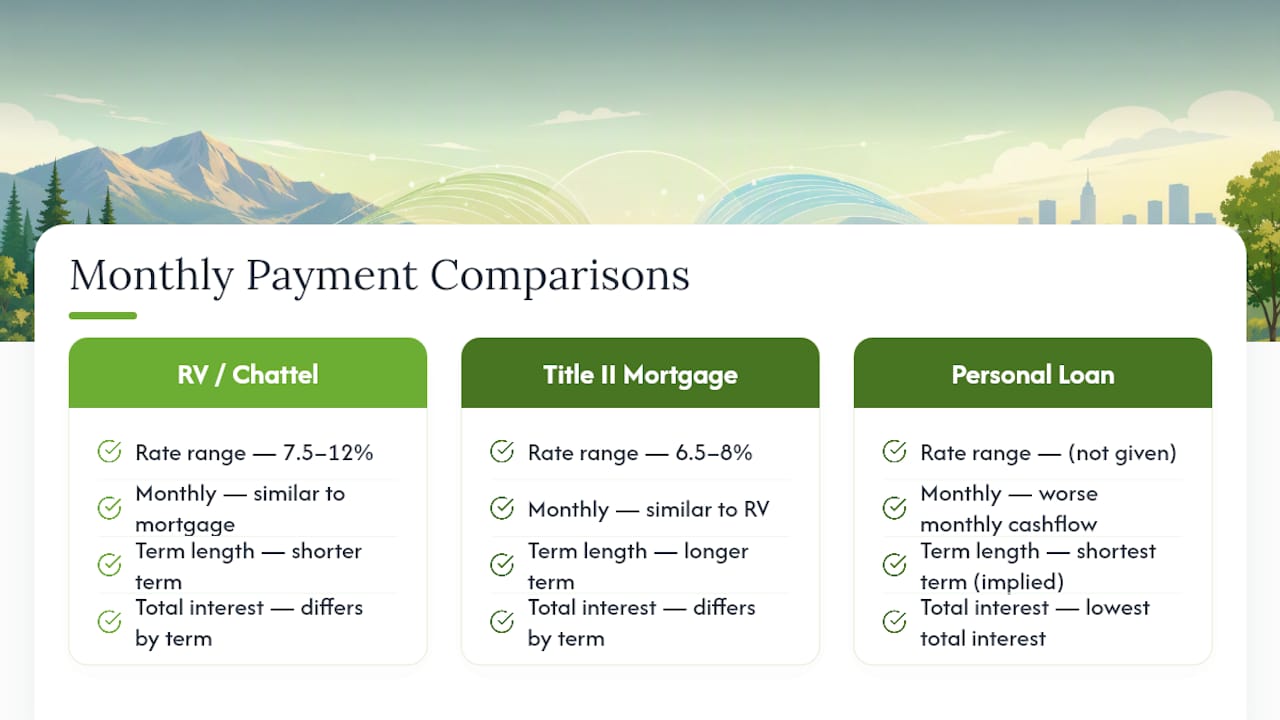
The math changes dramatically depending on which path you land in. A $60,000 loan tells three very different stories.
The RV loan and mortgage carry similar monthly payments but wildly different lifetime costs because of the term length. Rate ranges of roughly 7.5% to 12% for RV and chattel loans versus 6.5% to 8% for mortgage-style Title II financing explain why land ownership is the single biggest lever in this whole decision. Personal loans win on total interest paid but lose badly on monthly cashflow.
Does Zoning Control Whether You Can Get a Mortgage?
Owning land almost always opens the door to mortgage financing that leasing never will, because the structure can be classified as real property instead of personal property. But owning land doesn’t guarantee you can place a tiny house on it. Many buyers get approved for a loan and then discover their county won’t permit the unit at all.
Run these checks locally before you apply for anything:
- Confirm zoning allows a dwelling of your square footage, sometimes there’s a minimum size requirement that rules out smaller builds.
- Verify foundation and engineering requirements match what your lender needs for real-property classification.
- Check utility and septic access, since some parcels look buildable but lack approved hookups.
- Ask the planning department about permit timelines before you lock a closing date.
Gridwiseliving’s zoning checklist for 2026 walks through exactly which offices to call and what to ask, and NerdWallet’s reporting confirms that zoning, not financing, is usually what stalls a purchase.
What Helps a Tiny House Loan Application Move Faster?
Underwriters move faster when the paperwork answers questions before they’re asked. A few things that consistently speed approval:
- Finished electrical, plumbing, and insulation systems with documentation, not verbal assurance from the builder.
- Clear product specs and certification labels attached to the application, not promised “later.”
- Energy setup details, since a documented solar or generator system can support lower operating-cost projections lenders sometimes factor into affordability.
- Insurance quotes gathered early, since tiny house insurance requirements often mirror what a lender wants to see anyway.
When Does Financing Make More Sense Than Paying Cash?
Financing earns its cost when you own the land, the unit is fully certified, and your income is steady enough to comfortably absorb a fixed payment. That’s a straightforward case for FHA Title II or a conventional mortgage. Where Gridwiseliving usually steers buyers toward cash or a phased approach is uncertified kits, leased land, or zoning that hasn’t cleared yet. In fact, many tiny homeowners carry no mortgage at all, compared to 29% of U.S. homeowners overall, and that gap tells you something about how often the pieces just don’t line up cleanly for a loan.
— Gridwise
Ready to Build? See Gridwiseliving’s Tiny Home Options
Gridwiseliving’s tiny home collection is built with the exact documentation lenders ask for already in hand: certification paperwork, finished electrical and plumbing specs, and clear product records that cut weeks off underwriting compared to a custom uncertified kit.
Every model comes with the kind of paper trail that turns a maybe into an approval, whether you’re applying for an RV loan, a Title II mortgage, or a personal loan to bridge the build phase. Pairing your unit with a documented solar energy system can also help you show a lender realistic, lower operating costs on paper, not just a promise. Browse the tiny homes collection to compare models by size and features, and start your financing conversation with a builder who already has the certification and specs a lender wants to see.
Sources
- How to Finance a Tiny House 2026 — All 6 Real Paths | Perch
- How to buy a tiny house | NerdWallet
- FHA resources | HUD
- RV Industry Association (RVIA)
- NMLS Consumer Access