

4 Steps to Save Open-Pollinated Seed at Home: Isolation and Storage
Open-pollinated seeds come from plants fertilized through natural methods, wind, insects, birds, or self-pollination, and they breed true to type when grown away from cross-pollinating relatives. That means you can save seed from this year’s harvest and grow the same variety again next season. Hybrids trade that ability for uniformity, so choose open-pollinated if seed saving, regional adaptation, or flavor matter more to you than picture-perfect consistency.
TL;DR:
- Open-pollinated seeds reproduce true to type only when isolated from cross-pollination, enabling consistent seed saving and regional adaptation over time.
- Self-pollinating crops like tomatoes and beans are easiest for beginners to save seed from, while cross-pollinated crops such as squash and corn require isolation techniques.
- Protect seed integrity by localizing varieties through bagging blossoms or spatial separation, with greenhouses providing controlled environments for maximum purity.
- Saving seed from open-pollinated varieties supports biodiversity, reduces environmental impact, and maintains genetic diversity crucial for resilient food systems.
- Most open-pollinated seeds are unpatented and freely saveable, but check seed packets for protection claims if intending to sell or share widely.
Table of Contents
- What Does Open-Pollinated Mean for Seed Saving?
- Open-Pollinated vs Hybrid Seeds: Which Fits Your Garden?
- Benefits and Limitations of Open-Pollinated Seeds
- Which Crops Are Easiest and Hardest to Save Seed From?
- How to Save Seeds Step by Step
- How Do You Prevent Cross-Pollination in a Home Garden?
- Where to Buy Open-Pollinated Seeds
- Gridwise Perspective: Practical Proof Points
- How Open-Pollinated Seeds Protect Biodiversity
- Environmental and Ecological Benefits of Open-Pollinated Seeds
- Pest and Disease Considerations for Open-Pollinated Crops
- Choosing Open-Pollinated Varieties for Your Climate
- Legal and Patent Considerations for Seed Savers
- The Gridwise Take on Seed Saving
- How Gridwise Can Help You Save Better Seed
- Sources
- FAQ
What Does Open-Pollinated Mean for Seed Saving?
Plants pollinate through a handful of natural channels: self-pollination (tomatoes, beans, peas fertilize themselves before the flower even opens), and cross-pollination carried by wind, bees, or other insects (corn, squash, most brassicas). Open-pollinated varieties reproduce through any of these routes without human intervention in a lab, and as long as pollen stays within the same variety, the offspring “breed true,” meaning they closely resemble the parent plant in size, color, flavor, and timing.
That genetic variability isn’t a flaw. It’s what lets a variety slowly adjust to your soil, your rainfall pattern, and your pest pressure over several seasons of replanting saved seed.
A few distinctions worth pinning down:
- Open-pollinated is a pollination method, not an age or origin claim.
- Heirlooms are almost always open-pollinated, but not every open-pollinated variety is an heirloom — plenty are newer releases bred and stabilized by modern seed companies.
- “Non-GMO” and “open-pollinated” often overlap on seed packets but aren’t interchangeable terms.
Open-Pollinated vs Hybrid Seeds: Which Fits Your Garden?
F1 hybrids are bred by crossing two distinct parent lines to concentrate specific traits, disease resistance, early maturity, uniform fruit size into one predictable plant. That predictability is real value for a gardener who wants every tomato to ripen on schedule. The catch: seed saved from a hybrid won’t reliably reproduce those traits in the next generation, so you’re buying new seed every year.
Open-pollinated seeds flip that trade. You give up some uniformity in exchange for the ability to save seed indefinitely and let a variety adapt to your specific growing conditions over time.
Use this rough split to decide:
- Choose hybrids when uniformity and disease resistance matter most, like broccoli or certain brassicas where hybrids genuinely outperform open-pollinated types in yield and consistency.
- Choose open-pollinated when you want to save seed, build a self-reliant garden, or grow crops (tomatoes, beans, peppers, lettuce) where variety and character matter more than factory-line consistency.
- New gardeners often lean hybrid for dependability their first few seasons, then shift toward open-pollinated once they’re comfortable with the basics.
Benefits and Limitations of Open-Pollinated Seeds
Saving seed year after year eliminates a recurring cost, and it hands you something hybrids can’t: a variety that’s slowly becoming yours, shaped by your climate and your selections. Regional adaptation is a genuine, documented advantage, not marketing language. It also opens the door to heirloom varieties you’ll rarely find bred into commercial hybrid lines.
The limitations are just as real. Open-pollinated crops can show more variation in size, timing, and appearance, which frustrates gardeners who want uniform harvests for market sales or canning schedules. Some crops (again, certain brassicas) simply perform better as hybrids.
A practical way to weigh it:
- If you’re growing for flavor and self-sufficiency, open-pollinated wins on cost and seed independence.
- If you’re growing for a farmers market stand needing uniform product, hybrids may serve you better for specific crops.
- If you’re new to seed saving, mix both: hybrids for crops where uniformity matters, open-pollinated for beginner-friendly, self-pollinating vegetables.
Which Crops Are Easiest and Hardest to Save Seed From?
Start with self-pollinating crops. Tomatoes, beans, peas, and lettuce fertilize themselves before the flower opens, so cross-pollination is rare even in a crowded backyard bed. Extension horticulturists specifically recommend these as first projects for anyone new to seed saving.
Squash, cucumbers, melons, and corn sit at the other end of the difficulty scale. Bees carry pollen between varieties over long distances, and corn releases pollen into the wind, so two varieties planted even a few hundred feet apart can cross without you noticing until next year’s harvest looks wrong. Isolating these crops reliably requires bagging blossoms or hundreds of feet of spatial separation.
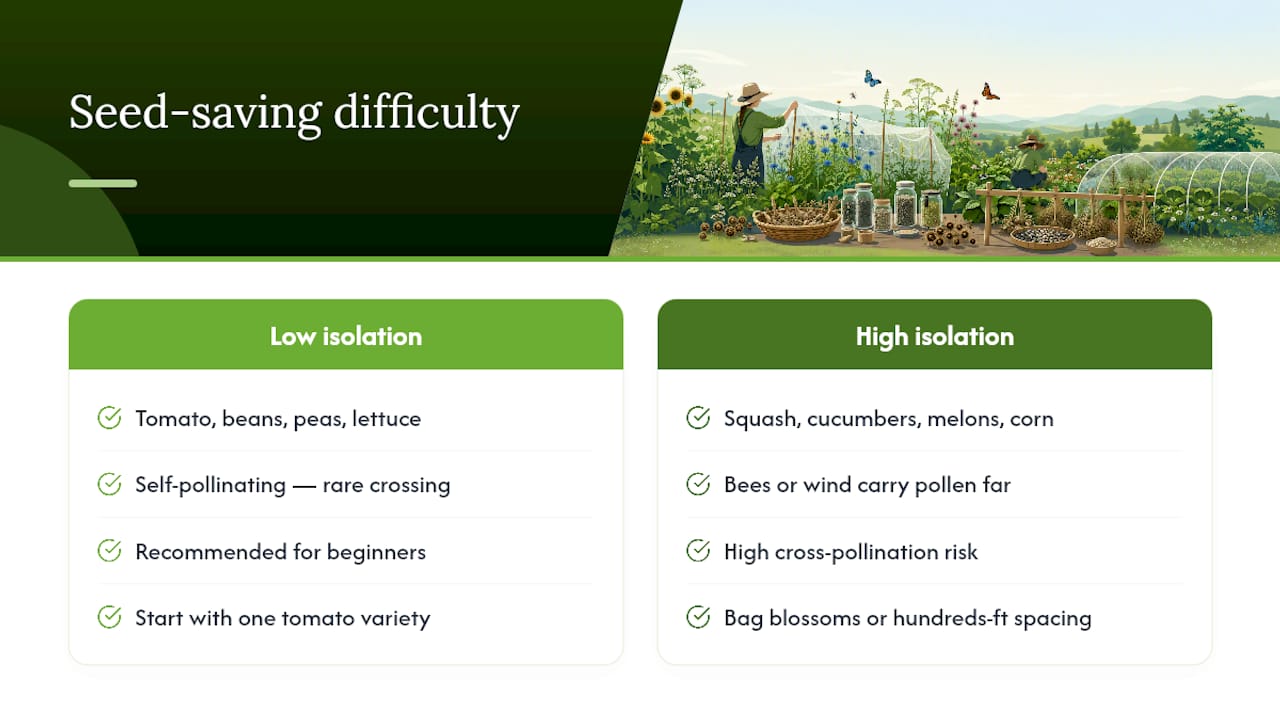
Your first seed-saving project should be a single tomato variety you already grow well. Master that before tackling anything the bees can reach. Our beginner seed guide covers varieties that forgive mistakes.
How to Save Seeds Step by Step
Seed saving breaks down into four stages, and getting the timing right matters more than any fancy equipment.
- Let seeds fully mature before harvest. Tomato and pepper seeds should come from fruit that’s fully ripe, even slightly overripe. Beans and peas need dry, rattling pods still on the plant.
- Extract and clean. Fruit crops like tomatoes need a short fermentation: scoop the pulp and seeds into a jar with a little water, let it sit two to three days until a moldy film forms on top, then rinse the good seeds that sink. Pod crops just need shelling by hand.
- Dry thoroughly. Spread seeds on a paper plate or screen (never paper towels, which stick) in a well-ventilated spot out of direct sun for one to two weeks. Seeds should feel brittle, not bendable, before storage.
- Label and store. Cool, dark, low-humidity conditions extend viability for years. Our seed storage guide covers the bend test for checking dryness before you seal anything away.
Pro Tip: Run a quick germination test on ten seeds between damp paper towels before you commit a whole bed to old stock. If fewer than seven sprout within a week or two, plant more densely or rotate in fresher seed.
Rotate seed stock every two to four years for most vegetables, since viability drops gradually even in good storage. If you started plants indoors this year, our indoor seed-starting guide pairs well with this process for extending your growing calendar.
How Do You Prevent Cross-Pollination in a Home Garden?
Bagging individual blossoms with lightweight fabric or paper bags before they open, then hand-pollinating and re-bagging, gives you near-certain purity for a handful of prized plants. It’s labor-intensive, so reserve it for varieties you really want to preserve.
Staggered planting works for crops like corn: plant two varieties three or four weeks apart so their pollen-shedding windows don’t overlap. Spatial isolation, several hundred feet for wind-pollinated crops, less for insect-pollinated ones if you use physical barriers, is the low-effort default when you have the room. A greenhouse gives you a controlled shortcut, letting you isolate a variety completely without measuring property lines.
- Bag blossoms for a handful of high-value plants, not your whole garden.
- Stagger bloom windows for corn and other wind-pollinated crops.
- Use a greenhouse compartment when spatial isolation isn’t realistic on a small lot.
Pro Tip: Absolute purity isn’t always achievable in a suburban yard with neighbors growing squash forty feet away. Accept some crossing risk on crops you’re not actively trying to preserve, and reserve strict isolation for your one or two priority varieties.
Where to Buy Open-Pollinated Seeds
Read the seed packet before you read the marketing. “Open-pollinated” tells you the seed can be saved; “heirloom” tells you it’s an older, historically stable variety; “non-GMO” is a separate claim about genetic engineering that applies to nearly all home garden seed regardless of pollination type. Our non-GMO labeling explainer breaks down what that label actually guarantees.
A trustworthy seller publishes germination rates, variety history, and grow-out notes, not just glossy photos.
- Look for a stated germination percentage and packing date on every packet.
- Favor sellers who describe a variety’s origin and growing habits in detail.
- Buy small trial packets of new varieties before committing a full bed to them.
Gridwise Perspective: Practical Proof Points
A greenhouse solves two seed-saving problems at once: it isolates blossoms from stray pollen drifting in from a neighbor’s garden, and it gives you a stable, dry environment to finish curing seed before storage. Our greenhouse growing guide walks through how enclosed growing space extends both your season and your seed purity. Pair that with a dedicated cool, dark storage routine and you’ve solved the two biggest threats to viable, true-to-type seed.
How Open-Pollinated Seeds Protect Biodiversity
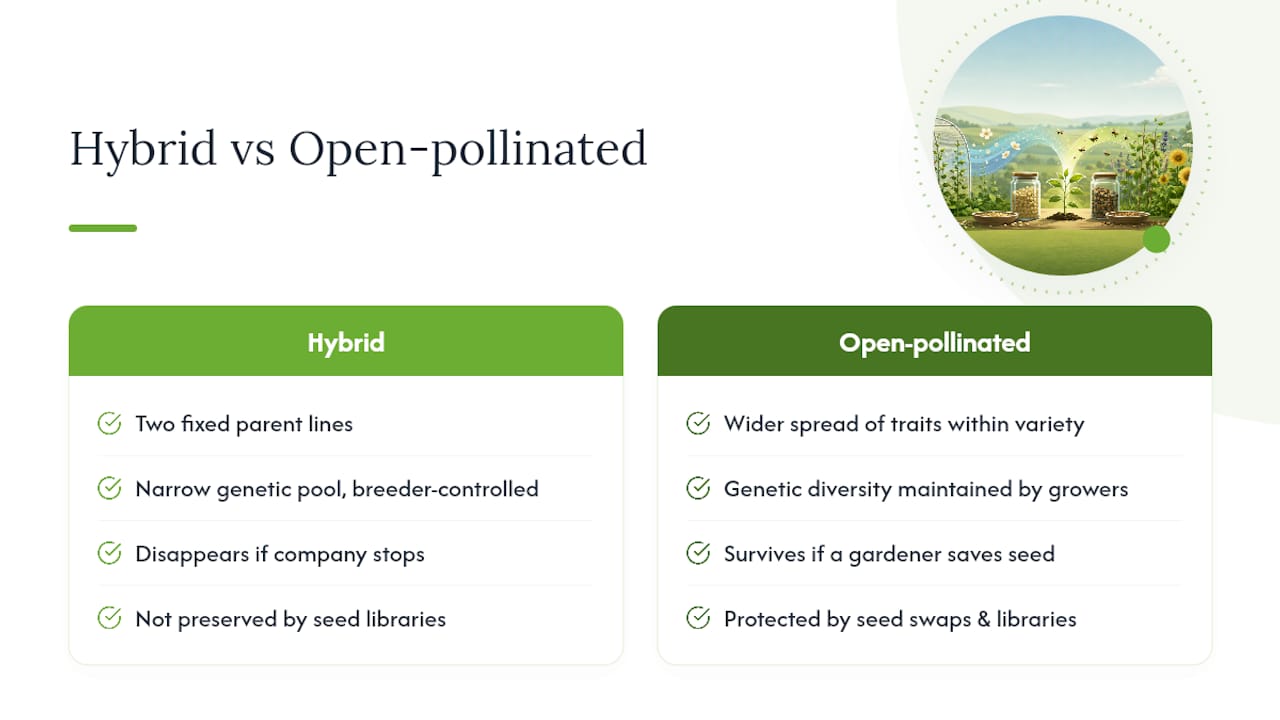
Every hybrid seed sold traces back to two fixed parent lines, which means the genetic pool behind most commercial hybrids is relatively narrow and controlled by whoever bred them. Open-pollinated varieties work differently. Each one carries a wider spread of genetic traits within the same variety, and that diversity is what heirloom preservation networks and seed libraries have spent decades protecting.
Thousands of regionally adapted tomato, bean, and squash varieties exist today only because generations of gardeners kept saving and replanting open-pollinated seed rather than switching entirely to hybrids. A hybrid variety that falls out of commercial favor simply disappears when the seed company stops producing it, because no one can recreate it from saved seed. An open-pollinated variety survives as long as one gardener keeps growing it out.
That’s the practical stake for home growers: every open-pollinated seed you save and share is a small act of preservation. Seed swaps, local seed libraries, and heirloom seed banks depend entirely on gardeners doing exactly this, season after season, with varieties that might otherwise vanish from cultivation. A single grandmother’s bean variety, passed down through one family’s saved seed for sixty years, represents genetic material that doesn’t exist anywhere in a commercial catalog.
This matters beyond nostalgia. A wider genetic base across food crops gives the overall food system more raw material to draw on when a new pest or disease shows up. Narrow genetics, the kind you get when everyone grows the same few hybrid varieties, leave crops more uniformly vulnerable. Diversity at the seed level is a buffer, even if it’s one most gardeners never think about while they’re just trying to grow a decent tomato.
Environmental and Ecological Benefits of Open-Pollinated Seeds
Growing open-pollinated varieties cuts down on one thing most gardeners don’t calculate: the annual carbon and packaging footprint of buying new seed every single year. Save your own seed and you eliminate repeat shipping, plastic packet waste, and the manufacturing overhead behind commercial seed production, season after season, for the varieties you’ve already stabilized in your own garden.
Open-pollinated crops also tend to support more diverse pollinator activity. Because many open-pollinated vegetables rely on insects for pollination rather than the controlled, often hand- or machine-pollinated processes used for some hybrid seed production, a garden full of open-pollinated squash, cucumbers, and beans doubles as forage for local bee populations. That’s a two-way relationship: the pollinators need the flowers, and the flowers need the pollinators to produce viable seed at all.
There’s a soil health angle too, though it’s indirect. Gardeners who commit to seed saving tend to also commit to longer-term soil building, since a poorly nourished plant produces weaker seed. That feedback loop pushes many open-pollinated growers toward compost, cover cropping, and reduced synthetic inputs, not because the seeds demand it, but because seed quality rewards it.
None of this makes open-pollinated seeds an automatic environmental win over hybrids in every case; a hybrid grown efficiently with fewer pesticide inputs due to built-in disease resistance has its own ecological case. But for a home gardener optimizing for self-reliance and a smaller footprint over time, saving your own open-pollinated seed removes one recurring input from the yearly cycle entirely.
Pest and Disease Considerations for Open-Pollinated Crops
Open-pollinated varieties generally lack the engineered disease resistance bred into many modern hybrids, which is the honest tradeoff for their adaptability. A hybrid tomato might carry resistance codes for verticillium wilt or fusarium built directly into its genetics. Most open-pollinated heirlooms don’t carry that same layered resistance, so they can be more vulnerable in gardens with a known history of soil-borne disease.
That doesn’t mean open-pollinated crops are fragile. Over repeated seasons of saving seed from your healthiest, most vigorous plants, you’re running an informal breeding program, selecting for exactly the resilience your garden needs. A gardener who consistently saves seed only from plants that shrugged off a blight outbreak is, over several years, nudging that variety toward better resistance in that specific location.
The practical pest risk is different from the disease risk. Because open-pollinated crops flower and set seed over a longer, less synchronized window than many hybrids bred for uniform timing, they can be exposed to pest pressure across a wider stretch of the season. Squash vine borers, cucumber beetles, and aphids don’t care whether your plant is open-pollinated or hybrid, but a longer bloom window means more opportunities for pest populations to build.
Crop rotation, healthy soil biology, and resisting the urge to save seed from your weakest-looking plants do more for long-term resilience than any single product. If disease pressure in your specific garden is severe, a hybrid bred for resistance to that exact pathogen may simply be the more practical choice for that one crop, even while you save open-pollinated seed everywhere else.
Choosing Open-Pollinated Varieties for Your Climate
Regional adaptation is where open-pollinated seed genuinely earns its reputation. A variety that’s been grown and reselected for multiple generations in a short-season, high-altitude climate will typically outperform a generic catalog variety planted in that same tough environment, simply because it’s already been through the filter of surviving there.
The practical move is to seek out varieties with a documented growing history in a climate similar to yours, rather than assuming any open-pollinated seed is automatically well suited to your conditions. Seed libraries and regional seed swap networks are often the best source for this kind of locally proven variety, since the seed you’re getting has already been filtered by growers facing your same frost dates, humidity, or dry spells.
If you can’t find a regionally proven variety, start with a widely adaptable open-pollinated type and begin your own informal selection: save seed each year from the plants that performed best in your specific soil and weather, and within three or four seasons you’ll have a strain that’s meaningfully more suited to your yard than the seed you started with. A greenhouse helps here too, buffering early-season plants from a late frost long enough to get seed-saving candidates established before outdoor conditions turn hostile.
Legal and Patent Considerations for Seed Savers
Most open-pollinated and heirloom varieties carry no patent protection, which is a core part of why they remain freely shareable. You can save, replant, trade, and even sell seed from an open-pollinated variety without running into the legal restrictions that increasingly apply to patented hybrid seed.
Many modern F1 hybrids, and some open-pollinated varieties bred and released by commercial seed companies, are protected under plant variety protection statutes or utility patents. That protection can legally restrict saving and replanting seed from that specific variety, regardless of whether it happens to be open-pollinated or hybrid. Reading the fine print on a seed packet or catalog listing matters here: patent status is about the specific variety and its breeder’s legal claim, not simply about whether the seed is open-pollinated or hybrid.
For the average home gardener saving seed for personal use, this rarely becomes an issue in practice, since enforcement typically targets commercial seed production and resale rather than a backyard grower saving beans for next year. But if you plan to sell saved seed, trade it widely, or use it in a community seed library, checking whether a variety carries any patent or plant variety protection designation is worth the five minutes it takes. Older heirlooms and traditionally bred open-pollinated varieties are almost always safe ground.
The Gridwise Take on Seed Saving
Most seed-saving advice online overcomplicates the entry point. Articles pile on isolation distances, hand-pollination techniques, and fermentation chemistry before a beginner has saved a single seed successfully. That’s backwards. The research is clear that self-pollinating crops, tomatoes, beans, peas, need almost none of that complexity, and mastering those first builds the judgment to handle harder crops later.
What we think gets underweighted is storage. Gardeners obsess over which variety to grow and barely think about where seed sits for the eleven months between harvests. A seed dried properly but stored in a humid garage loses viability just as fast as one saved carelessly. If self-reliance is the actual goal, purity in the garden and discipline in the pantry matter equally.
A practical approach is to not chase perfect isolation on every crop you grow. Pick one or two varieties worth protecting, isolate those properly, and let the rest cross a little. A garden with some genetic mixing and consistently viable seed beats a garden with strict purity rules and half-dead seed packets every time.
— Gridwise
How Gridwise Can Help You Save Better Seed
A greenhouse buys you the one thing home seed saving struggles to guarantee on its own: distance from stray pollen. Our greenhouse collection gives you enclosed, controlled growing space to isolate a prized tomato or pepper variety, extend your season enough to fully mature seed crops before frost, and dry harvested seed in a stable, dust-free environment instead of a windy porch. Models like the 10x32ft aluminum polycarbonate greenhouse give you enough room to run isolated compartments for two or three varieties at once, with roof vents that help regulate the humidity swings that ruin drying seed.
Pair that with feeding your seed-saving plants right. Our organic cottonseed meal fertilizer supports the steady, disease-resistant growth that produces the strongest, most viable seed to save. Browse the greenhouse collection to find a size that fits your yard, and start this season’s seed-saving project with an isolated space built for it.
Sources
- Open‑pollinated vs. hybrid: An important distinction when saving seeds — University of Illinois Extension
- The difference between open‑pollinated seeds and F1 hybrids — Garden Organic
- What does open pollinated mean and is open pollination better — Gardening Know How
- Which are better? Hybrid or open‑pollinated seeds? — GrowVeg
FAQ
What Do Open-Pollinated Seeds Mean?
Open-pollinated seeds come from plants fertilized naturally by wind, insects, or self-pollination, and they breed true to type when isolated from cross-pollinating relatives, meaning saved seed grows into a plant much like its parent.
Are Open-Pollinated Seeds Good for Beginners?
Yes, especially self-pollinating crops like tomatoes, beans, and peas, which extension experts specifically recommend as first seed-saving projects because they rarely cross with other varieties.
Where Can I Buy Open-Pollinated Seeds?
Look for sellers who list germination rates, packing dates, and variety history on every packet, and start with small trial packets before committing a full bed to an unfamiliar variety.
What Is the Difference Between Open-Pollinated and Hybrid Seeds?
Open-pollinated seeds can be saved and replanted with predictable results, while F1 hybrids offer more uniformity and vigor but don’t reliably breed true in the next generation, so hybrid seed typically gets repurchased each year.
Can I Legally Save Seed From Any Open-Pollinated Variety?
Most open-pollinated and heirloom varieties carry no patent restrictions, but some commercially bred open-pollinated releases may carry plant variety protection, so check the packet or catalog listing if you plan to sell or widely trade saved seed.