

Most Garden Seed Packets Are Non GMO, What Home Gardeners Need to Know
Non-GMO seeds are seeds produced without genetic engineering. No lab technician inserted foreign DNA into them; they came from plants that were pollinated the old-fashioned way, by wind, insects, or a person with a small paintbrush. Here’s the part that surprises most new gardeners: the overwhelming majority of seeds sold at garden centers and seed catalogs are already non-GMO, whether or not the package says so. The label is usually reassurance, not a meaningful safety distinction. And it’s a different thing entirely from organic, heirloom, or hybrid.
TL;DR:
- Most seeds sold at garden centers are already non-GMO because they are produced through natural pollination, not genetic engineering.
- Hybrid seeds are controlled crosses that do not qualify as GMOs, but their seeds won’t reliably reproduce the same plants in future seasons.
- Organic certification naturally excludes GMOs, but a seed can be organic and hybrid or heirloom simultaneously, making the labels distinct.
- The non-GMO label mainly reflects production standards and does not guarantee the seed is free of genetic material from GMO crops or grown without pesticides.
- Choosing seed types should prioritize your goal, such as seed saving, disease resistance, or climate fit, rather than focusing solely on non-GMO labels.
Table of Contents
- Non-GMO Seeds Meaning vs. Hybrid, Heirloom, and Organic: A Quick Comparison
- Certified Organic and Non-GMO: Where They Overlap and Where They Don’t
- Heirloom and Open-Pollinated Seeds: The Seed-Saver’s Choice
- Hybrid Seeds: Not GMOs, Just Careful Matchmaking
- How Non-GMO Labeling and Verification Actually Work
- Choosing Seeds for Your Garden: A Practical Checklist
- Real Seed Decisions: Three Quick Scenarios
- Where the Non-GMO Seed Movement Actually Came From
- Myths About Non-GMO Seeds That Won’t Go Away
- Weighing the Real Benefits and Drawbacks of Non-GMO Seed
- How Non-GMO Standards Differ Around the World
- Biodiversity: The Argument for Non-GMO and Heirloom Seed Together
- Gridwise Perspective: Seed Choice Is Half the Equation
- Sources
Non-GMO Seeds Meaning vs. Hybrid, Heirloom, and Organic: A Quick Comparison
These five terms get thrown around interchangeably, but they answer completely different questions. GMO and non-GMO describe how the plant’s genes got there. Hybrid and heirloom describe how the plant was bred. Organic describes how it was grown. A seed can be non-GMO and still be a hybrid. It can be heirloom and organic at the same time. Understanding non-GMO crops starts with separating these categories in your head.
- GMO: genetically engineered in a lab, with genes inserted directly into the plant’s DNA. Not sold to home gardeners for common vegetable crops.
- Non-GMO: no genetic engineering involved, whether the seed is a hybrid or heirloom variety. This describes almost every packet you’ll find at a nursery.
- Hybrid (F1): two distinct parent plants cross-pollinated deliberately to combine specific traits. Seed saved from hybrids won’t grow “true” to the parent.
- Heirloom/open-pollinated: older varieties maintained by generations of gardeners, pollinated naturally, and stable enough that saved seed reliably reproduces the same plant.
- Organic: a certification about growing practices, covering fertilizer, pest control, and soil management, not the plant’s genetic origin.
The gardener consequence: if you want to save seed year after year, hybrid status matters more than GMO status ever will.
Certified Organic and Non-GMO: Where They Overlap and Where They Don’t
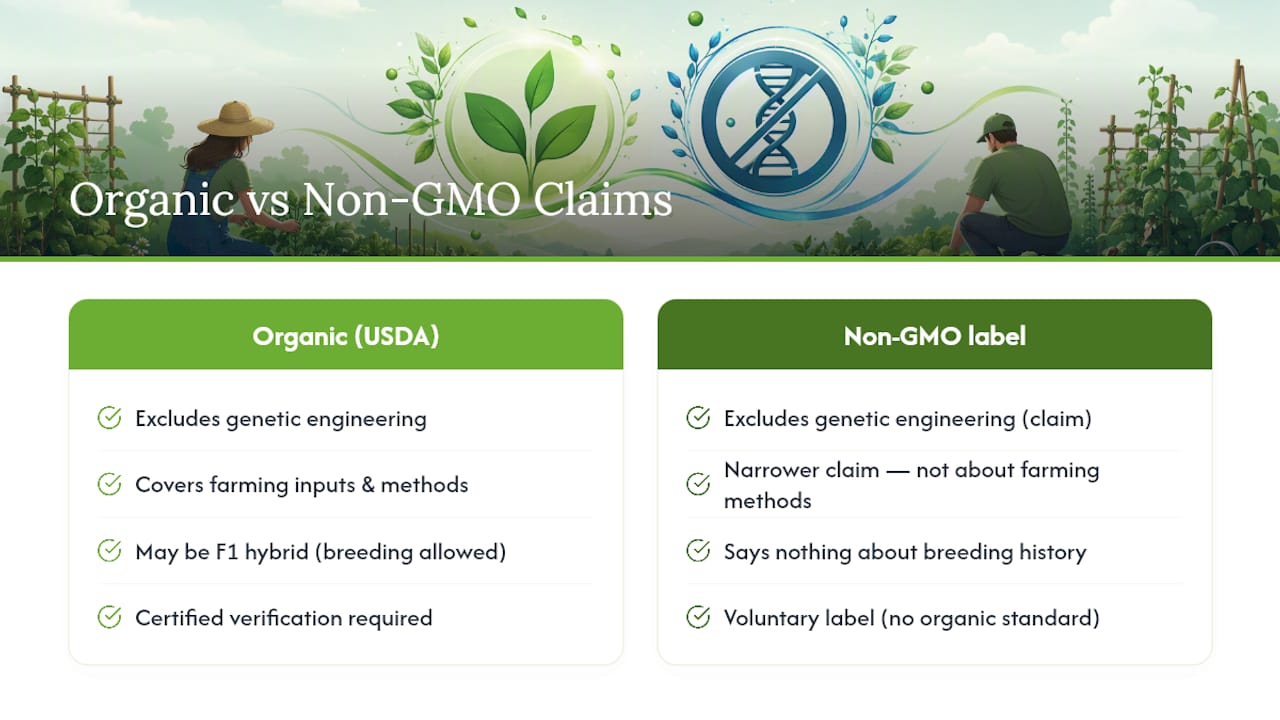
The USDA’s National Organic Program excludes genetic engineering from certified organic production. That means organic certification already rules out GMOs, and a certified organic seed can substantiate a non-GMO claim without needing a separate non-GMO label.
But organic certification is about farming inputs and methods, not about whether a variety is heirloom or hybrid. A certified organic tomato seed can absolutely be an F1 hybrid. Organic tells you how the seed crop was grown; it says nothing about its breeding history. For most home gardeners, buying organic seed gets you the non-GMO assurance as a side effect, but non-GMO labeling by itself is a narrower claim. A packet can say “non-GMO” without meeting any organic growing standard at all.
Heirloom and Open-Pollinated Seeds: The Seed-Saver’s Choice
Heirloom varieties have been preserved and passed down, sometimes for over a century, because they breed true when grown in isolation. Plant an heirloom tomato, save its seed, plant that seed next year, and you get essentially the same tomato. That predictability is why seed savers gravitate toward open-pollinated types.
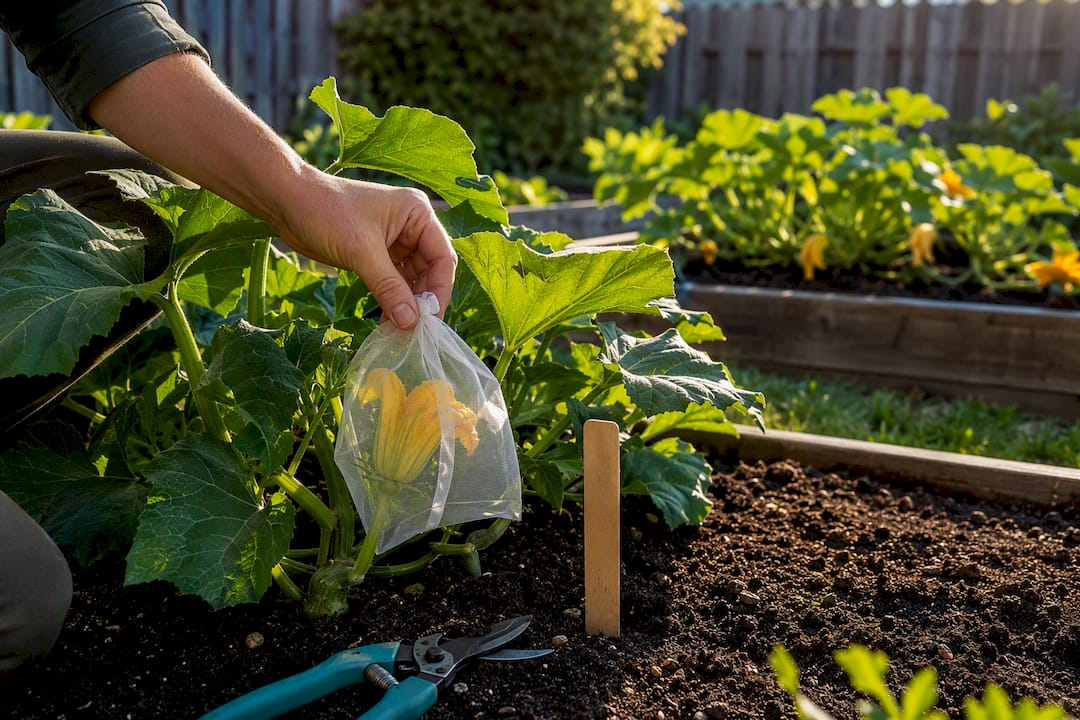
The catch is isolation. If you grow two different heirloom squash varieties close together, bees will cross them, and next year’s seed becomes an unpredictable mix. Extension guides note that heirloom, hybrid, and organic terms describe entirely separate qualities, which is exactly why gardeners confuse them so often.
People choose heirlooms for flavor, for the story behind a variety, and for keeping genetic diversity alive in their own backyard, even when a hybrid would technically out-yield them.
Hybrid Seeds: Not GMOs, Just Careful Matchmaking
An F1 hybrid comes from deliberately crossing two different parent plants, the same basic technique plant breeders have used for over a century. It’s controlled pollination, not gene splicing. Hybrid seeds are not the same as GMOs, and confusing the two is one of the most common mistakes gardeners make when shopping for seed.
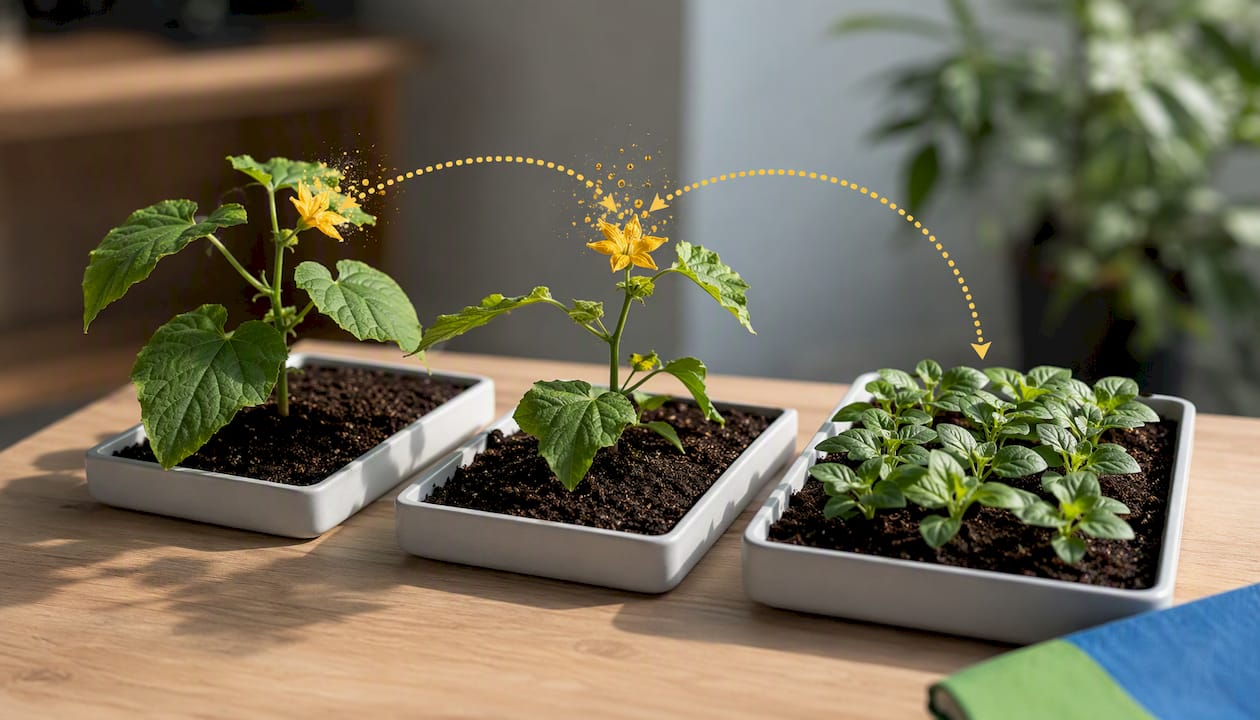
Hybrids earn their popularity honestly: uniform size, faster maturity, and often stronger disease resistance than either parent alone. The trade-off is that saved seed from a hybrid plant won’t reliably reproduce the same traits next season. Nearly every hybrid variety sold in a home garden catalog, from container-friendly tomatoes to disease-resistant cucumbers, is non-GMO. Hybrid and GMO are not synonyms, no matter how often that myth resurfaces online.
How Non-GMO Labeling and Verification Actually Work
The Non-GMO Project Verified seal means a product complies with that organization’s own standard for testing, traceability, and ingredient segregation. It’s a voluntary, third-party program, not a federal mandate. The United States also has a federal bioengineered food disclosure standard, but it operates separately from voluntary seals like this one, and it targets food products more than raw garden seed packets.
Here’s the practical reality: GMO seeds are typically sold only to farmers under commercial licensing agreements, mostly for commodity crops like corn, soybeans, and cotton. There are essentially no genetically engineered varieties of tomatoes, peppers, lettuce, or squash sitting on a garden-center shelf.
A few things worth knowing about the label itself:
- “Non-GMO” is a production claim, not a promise of zero trace contamination.
- Verification standards test for testing, traceability, and segregation practices, not a guarantee of “100% GMO-free.”
- Most seed racks at hardware stores and nurseries never carried GMO seed to begin with.
For the average backyard grower, a non-GMO seal confirms something that was already true.
Choosing Seeds for Your Garden: A Practical Checklist
Marketing labels matter less than matching seed type to your actual goals. Run through this before you buy:
- Decide if you’re saving seed. If yes, buy open-pollinated or heirloom varieties and plan for isolation distance between similar crops.
- Weigh your season length. Short growing seasons often favor hybrids bred for faster, more uniform maturity.
- Check your disease pressure. Many hybrids are bred specifically for resistance to blight, wilt, or mosaic virus common in your region.
- Consider your space. Container and small-plot gardeners often lean on hybrid vigor to get a reliable harvest from limited square footage, as explained in this practical gardening guidance for residential gardeners.
- Ask what “non-GMO” is actually telling you. For garden vegetables, treat it as reassurance rather than a differentiator, since nearly all seeds sold to home gardeners already qualify.
Pro Tip: If you’re new to starting your own plants, pair your seed choice with a reliable indoor start. A guide to starting seeds indoors will save you more headaches than any label on the packet.
Real Seed Decisions: Three Quick Scenarios
- Container gardener on a balcony: pick a compact F1 hybrid tomato bred for pots. Non-GMO is a given here; uniform size and disease resistance matter more.
- Backyard grower wanting canned tomato sauce every year: go hybrid for consistent ripening across a big batch. Check the best seeds for beginners if you’re just getting started.
- Dedicated seed saver: choose heirloom beans or peppers, isolate them from similar varieties, and save seed each fall. Skip worrying about GMO status since it was never on the table.
- Small-space herb grower: open-pollinated basil or cilantro works fine, breeds true, and reseeds itself in mild climates.
Where the Non-GMO Seed Movement Actually Came From
The non-GMO label didn’t exist because home gardeners demanded it. It emerged in the mid-2000s, largely in response to genetically engineered commodity crops like Roundup Ready soybeans and Bt corn, which had spread rapidly through American row-crop agriculture after their commercial introduction in the mid-1990s. Consumer groups and organic advocates wanted a way to verify that packaged foods, not seed packets, hadn’t been made with engineered ingredients. The Non-GMO Project launched its verification program to fill that gap, since federal organic certification alone didn’t give shoppers a dedicated symbol to look for on grocery shelves.
Seed catalogs picked up the language later, partly out of genuine transparency and partly because it sold well. Most heirloom and hybrid seed companies had never touched genetic engineering in the first place. Labeling a packet of open-pollinated zinnia seeds “non-GMO” was accurate, but it also traded on consumer anxiety that had almost nothing to do with what was actually inside that packet.
That history matters because it explains the disconnect gardeners keep running into. The non-GMO conversation was built around soy, corn, and canola grown on thousands of acres, engineered for herbicide tolerance or pest resistance. Backyard vegetable seed was never really part of that story. The label followed the market instead of following any real risk in home garden seed, and it stuck around because reassurance sells, even when there’s nothing to be reassured about.
Myths About Non-GMO Seeds That Won’t Go Away
The biggest one: “hybrid means GMO.” It doesn’t. Hybridization is controlled cross-pollination between two parent plants, a technique gardeners and farmers have used for generations. Confusing hybrid with genetically engineered is the single most common mistake home gardeners make when reading seed catalogs.
A second myth: that GMO seeds are quietly showing up in home garden centers. They aren’t. Genetically engineered seed is restricted almost entirely to licensed commercial agriculture, covering commodity crops most home gardeners never plant anyway.
Third myth: that “non-GMO” means “pesticide-free” or “organic.” It doesn’t touch growing methods at all. A non-GMO tomato seed can still be grown with synthetic fertilizer and conventional pesticides; the label says nothing about that side of production.
Fourth myth: that heirloom automatically means healthier or more nutritious. Heirloom status is about genetic stability and history, not nutrition. Some heirlooms are more disease-prone and lower yielding than modern hybrids bred from the same genetic stock.
Fifth myth, and this one trips up even experienced gardeners: that “non-GMO” guarantees zero genetic material from a GMO crop ever touched the seed. It doesn’t. The label reflects production and testing standards, not an absolute biological guarantee, since wind and pollinators don’t respect certification paperwork.
Weighing the Real Benefits and Drawbacks of Non-GMO Seed
The upside is straightforward: buying non-GMO seed supports transparency in the seed supply chain and, for crops where GMO versions genuinely exist (mostly commodity grains, not garden vegetables), it lets you avoid genetically engineered genetics entirely if that’s a personal priority. It can also align with broader values around traditional breeding and biodiversity, since companies that emphasize non-GMO sourcing often carry more heirloom and open-pollinated varieties as a result.
The drawback is that the label can create false urgency. Paying a premium for “non-GMO” green bean seed, when GMO green beans don’t commercially exist, buys you a feeling rather than a functional difference. That money might do more for your garden spent on soil amendments, season-extension equipment, or a wider variety selection.
There’s also an opportunity cost in decision-making. Gardeners who fixate on the GMO question sometimes overlook the distinction that actually affects their harvest: hybrid versus heirloom, and whether a variety suits their climate and disease pressure. The label answers a question most garden seed already answers by default, while the questions that determine whether your tomatoes actually thrive go unasked.
How Non-GMO Standards Differ Around the World
Regulatory treatment of genetically engineered seed varies sharply by country, and that shapes what “non-GMO” even means depending on where you’re standing. The United States allows GMO cultivation for approved commodity crops, with no federal ban on genetically engineered seed for agriculture. The European Union takes a far more restrictive approach, requiring case-by-case approval for cultivation and mandatory labeling for GMO food products, which has made GMO crop planting rare across most member states.
Voluntary verification programs like the Non-GMO Project operate within U.S. and Canadian markets specifically. Other countries rely on different frameworks entirely, some built around mandatory labeling laws rather than voluntary third-party seals. That inconsistency is exactly why a “non-GMO” claim on an imported seed packet doesn’t always map onto the same testing rigor you’d get from a domestic verification program.
For home gardeners in the United States, the practical upshot doesn’t change much: garden vegetable seed sits almost entirely outside the GMO conversation regardless of which country’s framework you’re comparing it against.
Biodiversity: The Argument for Non-GMO and Heirloom Seed Together
The strongest ecological case for favoring non-GMO, and particularly heirloom, seed isn’t about genetic engineering risk directly. It’s about seed diversity. Commodity agriculture’s reliance on a narrow set of genetically engineered crop varieties has concentrated the genetic base of major crops like corn and soybeans into a handful of dominant lines. Home gardeners growing and saving heirloom seed help keep hundreds of regional and heritage varieties in active circulation, which matters when a disease or pest outbreak threatens a genetically uniform crop.
Open-pollinated seed saving also keeps plants adapting to local conditions over successive generations, since seed saved from your own healthiest plants each year gradually selects for traits suited to your specific soil, climate, and pest pressure. That kind of small-scale, decentralized breeding is something a hybrid seed, bred once in a controlled cross and repurchased every season, simply can’t replicate.
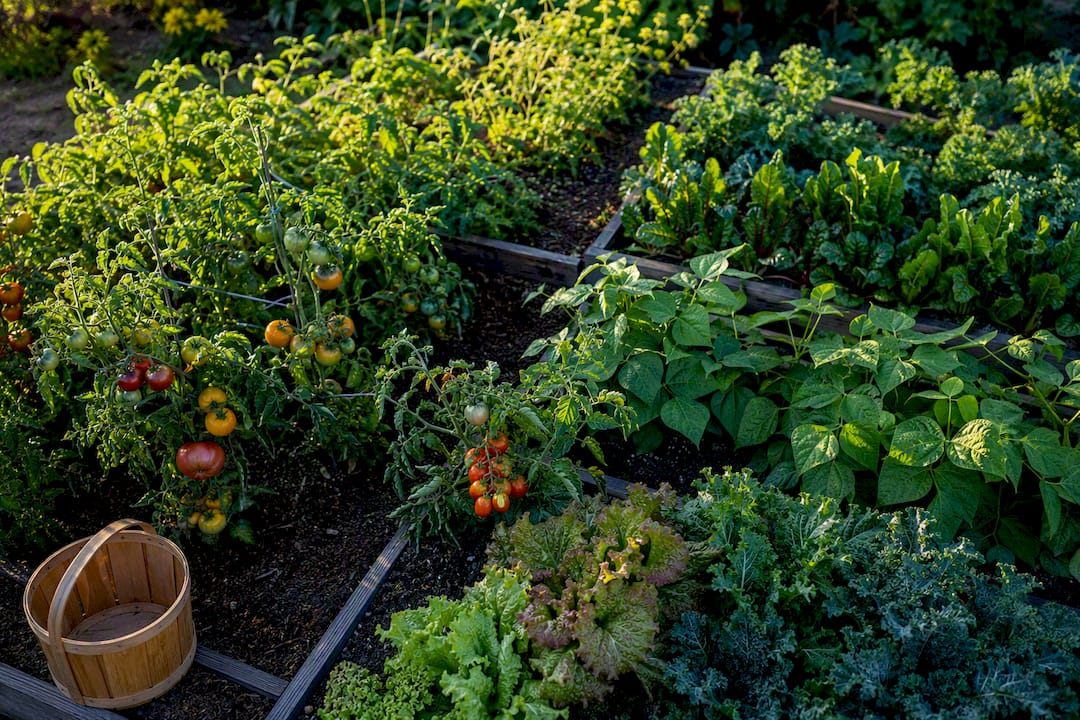
None of this means hybrids harm biodiversity by existing. It means gardeners who care about genetic diversity in the food system have a meaningful lever to pull: growing and saving heirloom and open-pollinated varieties instead of buying every seed fresh each spring.
Gridwise Perspective: Seed Choice Is Half the Equation
Picking the right seed type solves one problem. Protecting that crop long enough to matter solves the other. Some gardeners build their greenhouse and seed-starting lineup around exactly that gap: a heirloom tomato carefully isolated for seed saving still needs frost protection and a controlled start indoors to reach maturity reliably.
The gardeners who get the most out of seed selection tend to follow a simple sequence: choose the seed type that matches their goal, start it indoors under a proper microgreens or seed-starting setup, then move it into a greenhouse that extends the season and keeps cross-pollination under control. Non-GMO status was never the variable that determined their harvest. Isolation, timing, and shelter were.
— Gridwise
Sources
- Non-GMO Project: GMO FAQ
- Non-GMO Requirements under the National Organic Program (OTA fact sheet)
- Heirloom vs. Hybrid vs. GMO Vegetables: Know The Differences | Gardening Know How
- Master Gardener: FAQs about GMOs, hybrids and heirlooms | GMO Answers