

Three Copyable Models for a Year-Round Food Garden
Three garden models will get you fresh food every month of the year: a perennial-heavy food garden, a mixed succession garden with season extension, and a greenhouse-intensive system. Each works. The right one depends on how much space, patience, and upfront effort you’re willing to spend.
The perennial-heavy model asks for the least yearly labor but the most patience up front. Plants like asparagus and rhubarb need two to three years before they produce a real harvest, but then they keep producing for 15 to 30 years with almost no replanting. The mixed succession model splits the difference. You get harvests within the first season from annuals like kale and peas, while perennial beds mature in the background. The greenhouse-intensive model is the fastest route to winter tomatoes and greens, but it costs the most and demands the most attention to temperature and airflow.
Here’s how they stack up at a glance:
- Perennial-heavy garden: Low weekly maintenance, 2 to 3 years to full production, works well in USDA zones 3 through 9, moderate upfront cost for plants and bare roots.
- Mixed succession garden: Moderate maintenance, harvests within weeks of the first planting, adaptable to zones 4 through 9, low to moderate cost.
- Greenhouse-intensive system: Higher maintenance and monitoring, harvests possible within the first winter, works in nearly any zone with adequate heating, higher upfront investment.
If you’re starting today, pick one action per model. For the perennial garden, order bare-root asparagus or rhubarb crowns this winter. For the succession garden, map your first frost date and count back for your first fall planting. For the greenhouse model, measure your site and decide between a cold frame, a low tunnel, or a full structure before you buy anything.
Key Takeaways
A year-round food garden works when perennial staples, staggered annual succession beds, and at least one season-extension structure operate together rather than as separate projects.
| Point | Details |
|---|---|
| Pick one model first | Choose perennial-heavy, mixed succession, or greenhouse-intensive based on your available time and space. |
| Find your frost dates | Use the USDA Plant Hardiness Zone Map to set your count-back planting schedule accurately. |
| Plant one bed of each type | Start one perennial (asparagus or rhubarb) and one succession crop (kale or spinach) this season. |
| Add one extension structure | A row cover or cold frame costs little and adds weeks of harvest on both ends of the season. |
| Preserve what you can’t eat fresh | Freeze, dry, or store surplus harvests so nothing goes to waste between planting cycles. |
| Consider a greenhouse for winter production | Gridwiseliving’s greenhouse kits support the season-extension and greenhouse-intensive models covered above. |
Table of Contents
- Examples Of Year-Round Food Gardens You Can Copy
- How Do You Plan A Year-Round Planting Rotation?
- Which Perennials And Crops Belong In Every Plan?
- What Season-Extension Method Should You Use?
- How Much Space Do You Actually Need?
- A Worked Planting Calendar You Can Copy
- How Do You Store And Preserve A Continuous Harvest?
- How Should You Water Across The Seasons?
- How Do You Manage Pests And Disease All Year?
- Why Does Crop Rotation Matter In A Year-Round Garden?
- Extend Your Harvest With The Right Greenhouse Setup
- Sources
Examples Of Year-Round Food Gardens You Can Copy
These three blueprints aren’t theoretical. Each one reflects patterns used by home gardeners and small-scale growers who’ve built systems that produce something edible in every season, based on established perennial garden design and season-extension practice.
Example 1: The Perennial-Focused Food Garden
This layout treats your yard like a small orchard with vegetables tucked underneath. It fits a 400 to 600 square foot footprint, though it scales down for smaller yards.
Plant list:
- Asparagus (back row, permanent bed, needs its own 4-foot-wide strip)
- Rhubarb (2 to 3 crowns, spaced 3 feet apart)
- Egyptian walking onions (border planting, self-propagating)
- Sunchokes (contained bed or large buried container, they spread aggressively)
- Strawberries (ground cover under fruit trees or in a dedicated 4×8 bed)
- Raspberries (trellised along a fence line)
- Perennial herbs: chives, oregano, thyme, sorrel
- One or two dwarf fruit trees or berry shrubs (apple, fig, or currant depending on zone)
A mature version of this garden produces something across nearly every month of the calendar once perennials hit their stride, typically by year three to five.
| Month | What’s harvestable |
|---|---|
| March–April | Asparagus spears, chives, sorrel |
| May–June | Rhubarb stalks, early strawberries, walking onion greens |
| July–August | Raspberries, herbs, sunchoke greens |
| September–October | Sunchoke tubers, late raspberries, fruit tree harvest |
| November–February | Stored sunchokes, dried herbs, dormant bed maintenance |
Pro Tip: In zones 5 through 8, plant bare-root asparagus and rhubarb in early spring as soon as the soil can be worked, and mulch heavily in fall to protect crowns through hard freezes.
Example 2: The Mixed Succession Garden
This model suits gardeners who want fresh vegetables sooner rather than later. It works well in a 300 to 400 square foot space split between annual beds and a smaller perennial section.
Plant list for the annual beds (cool-season rotation):
- Kale and spinach (spring and fall, tolerates light frost)
- Carrots (spring sowing, fall storage crop)
- Peas (early spring, trellised)
- Broccoli and cabbage (spring and fall crops)
- Brussels sprouts (long-season, harvest after first frost for better flavor)
Interplant two or three perennial anchors, like a rhubarb crown at one bed corner and a strawberry patch along the border, so the space keeps producing even between annual plantings.
| Month | What’s harvestable |
|---|---|
| April–May | Spinach, peas, early kale |
| June–July | Carrots (spring sowing), broccoli |
| August–September | Second kale planting, cabbage |
| October–November | Brussels sprouts, fall carrots, late broccoli |
| December–February | Stored root crops, cold-frame greens |
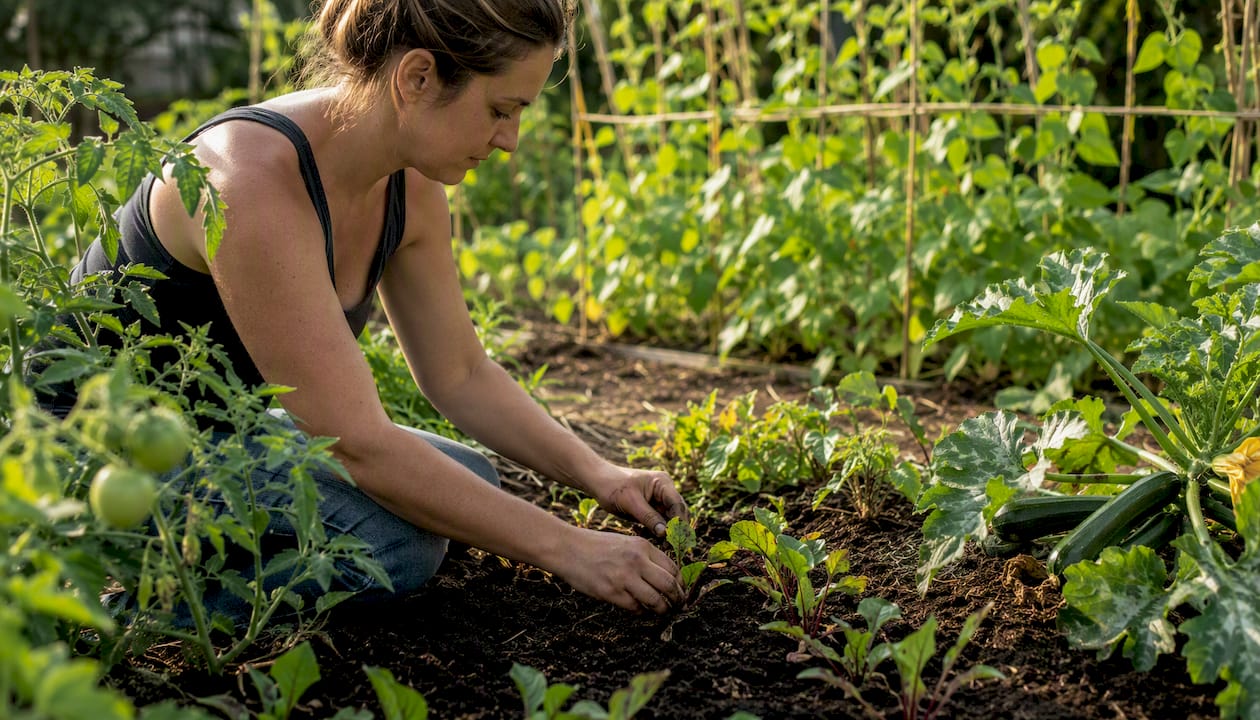
Pro Tip: In zones 5 through 8, direct-sow a second kale and spinach crop in late July for a harvest that runs from October through the first hard freeze, or later under a low tunnel.
Example 3: The Greenhouse-Intensive Compact System
This model fits tight lots or gardeners who want maximum winter production from minimal square footage, often under 150 square feet.
Crop list suited to greenhouse and vertical setups:
- Leafy greens (lettuce, spinach, arugula) on staggered succession
- Microgreens for fast, weekly harvests
- Herbs (basil, cilantro, parsley) in containers
- Compact tomato and pepper varieties for a heated structure
- Vertical hydroponic setups for greens and strawberries in very small footprints
A compact structure like a greenhouse turns a few square feet into a month-round production line when paired with supplemental lighting or a vertical growing system.
| Month | What’s harvestable |
|---|---|
| Year-round with heat | Microgreens (weekly), lettuce, herbs |
| Fall–winter | Spinach, arugula, cold-tolerant greens |
| Spring–summer | Tomatoes, peppers, basil |
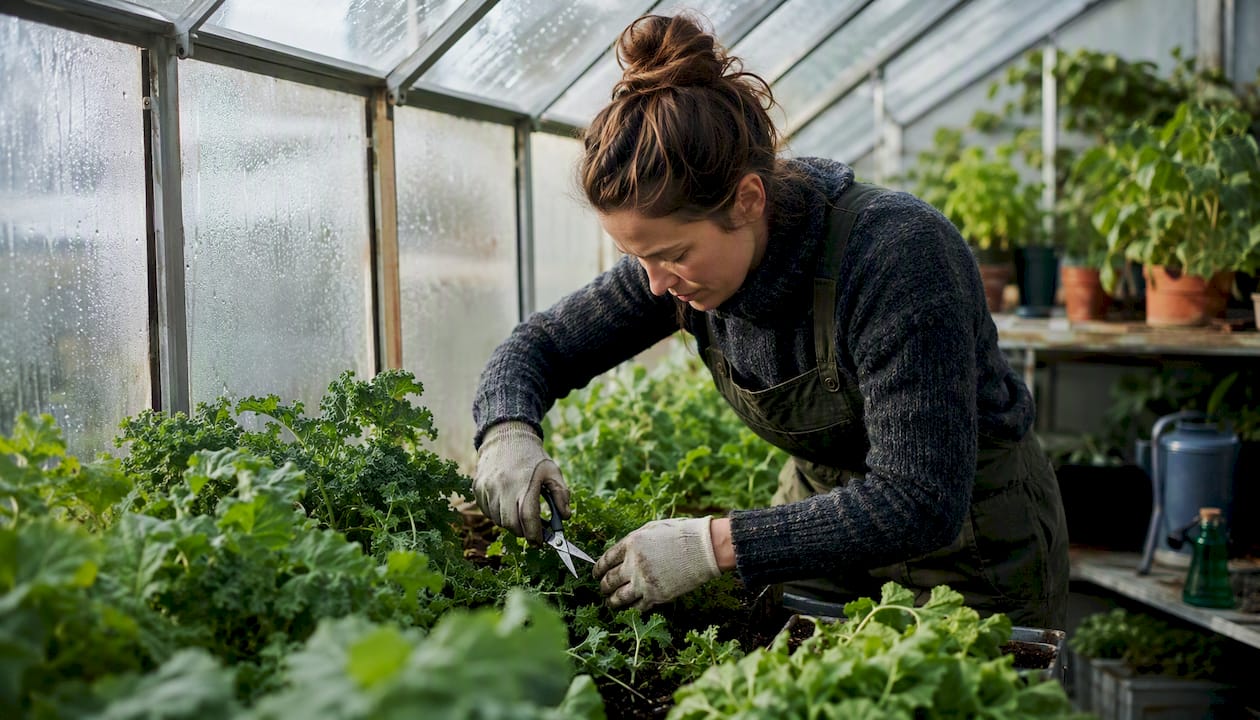
Pro Tip: In zones 5 through 8, an unheated greenhouse buys you roughly one extra growing zone’s worth of protection, enough to keep greens alive through winter without supplemental heat in most years.
How Do You Plan A Year-Round Planting Rotation?
The single most useful planning tool is the count-back formula: first frost date minus (days to maturity plus a 14-day fall buffer). This turns a vague goal like “grow food all year” into an actual date on your calendar.
Here’s how it works. Say your first fall frost typically lands around October 15, and you want to plant broccoli that takes 70 days to mature. Subtract 70 days, then subtract another 14 for the fall buffer, since plants grow more slowly as daylight shortens. That puts your planting date around July 18. Gardeners commonly start cool-season brassicas and root crops 8 to 12 weeks before frost for exactly this reason.
You’ll need your local frost dates before any of this works. The USDA Plant Hardiness Zone Map is the standard tool for figuring out your zone, and most local extension offices publish average frost dates specific to your county.
Spacing determines how many staggered plantings you can fit. A single 4×8 bed holds roughly 8 to 12 lettuce plants at 12-inch spacing, or double that with tighter succession blocks. Stagger new plantings every 10 to 14 days rather than sowing an entire bed at once, so you’re not stuck with 20 heads of lettuce maturing the same week.
A basic planting-calendar template looks like this:
- List your last spring frost date and first fall frost date.
- For each crop, note days to maturity from the seed packet.
- Apply the count-back formula for fall crops; for spring crops, add 2 to 4 weeks to the last frost date for direct-sow, or start indoors 6 to 8 weeks before that date.
- Mark indoor start dates, transplant dates, and direct-sow windows on a single calendar.
- Flag any crop that benefits from a “second spring” start, since starting seeds in August in many temperate coastal climates produces fall and winter harvests other gardeners miss entirely.
Weekly and seasonal tasks that keep this on track:
- Weekly: Check soil moisture, scout for pests, harvest anything ready.
- Every 2 weeks: Start a new succession block for fast crops like lettuce or spinach.
- Monthly: Review your calendar against actual weather and adjust upcoming start dates.
- Seasonally: Test soil, amend beds between crop cycles, and rotate planting locations.
Which Perennials And Crops Belong In Every Plan?
Six perennial staples show up in nearly every serious year-round garden design: asparagus, rhubarb, Egyptian walking onions, sunchokes, strawberries, and raspberries. Each one, once established, keeps producing with minimal replanting for years.
Reliable cool-season annuals fill the gaps between perennial harvests. Kale, spinach, mâche, and claytonia tolerate hard frosts and often taste sweeter after cold exposure. Broccoli, cabbage, carrots, peas, and Brussels sprouts round out the list, with carrots and Brussels sprouts both improving in flavor after a light frost.
Time-to-first-harvest varies enormously by plant, and this is where a lot of new gardeners get discouraged if nobody warns them upfront:
- Asparagus: 2 to 3 years before a real harvest, then productive for 15 to 20 years, sometimes up to 30.
- Rhubarb: Light harvest in year 2, full production by year 3.
- Strawberries: Small yields in year 1, full production in year 2.
- Raspberries: Modest harvest in year 2, full production by year 3.
- Egyptian walking onions and sunchokes: Usable greens or tubers within the first year.
- Kale, spinach, peas: 30 to 60 days from direct sowing to first harvest.
- Broccoli, cabbage, Brussels sprouts: 60 to 100 days depending on variety.
A few placement rules matter more than most garden plans mention. Sunchokes spread through underground tubers and will take over a bed if left unchecked, so contain them in a buried barrier or a dedicated raised bed. Sorrel and Egyptian walking onions make excellent near-house plantings since they’re often the first fresh greens available in early spring, well before annual beds wake up.
What Season-Extension Method Should You Use?
Simple infrastructure multiplies how many months your garden produces, often by two to four months on either end of the normal growing season. The main options are row covers, low tunnels, cold frames, mulch, and greenhouses, and each one fits a different budget and goal.
Row covers are the cheapest entry point. A lightweight fabric draped over hoops gives roughly 5 to 10°F of frost protection, which is often enough to save a late-planted crop from an early frost or push a spring planting a few weeks earlier. Low tunnels and cold frames go further, extending harvest windows into deep frost periods for cold-hardy greens like kale, spinach, and mâche. A greenhouse is the only option that enables genuine winter production of warm-season crops, but it’s also the biggest investment and the most maintenance.
| Method | Expected season gain | Best crop matches |
|---|---|---|
| Row covers | 5–10°F protection | Tender greens, extending shoulder seasons |
| Mulch | Moderates soil temperature, protects roots | Root crops, perennial crowns overwintering |
| Low tunnels | Extends harvest weeks into frost | Kale, spinach, carrots, mâche |
| Cold frames | Extends harvest weeks into frost | Salad greens, seedling starts |
| Greenhouse | Full winter production for select crops | Tomatoes, peppers, leafy greens, herbs |
Choose temporary covers when you’re protecting a crop that’s already cold-tolerant and just needs a buffer against an occasional hard freeze. Choose a greenhouse when your goal is actively growing warm-season crops through winter, not just keeping cold-hardy ones alive.
Pro Tip: Vent your low tunnel or greenhouse on any day above 40°F, even in winter. Trapped heat and humidity on a sunny day can cook seedlings or trigger fungal disease faster than a cold night ever would.
How Much Space Do You Actually Need?
A rough rule of thumb: budget about 100 square feet per person if you want a modest supplemental harvest, and 200 to 400 square feet per person if you’re aiming to cover a meaningful share of your household’s produce. These are starting estimates, not guarantees, since yield swings with soil quality, sunlight, and your own experience level.
To translate that into something concrete: a single 4×8 bed (32 square feet) planted with lettuce at 12-inch spacing holds about 24 to 32 plants. With succession planting every two weeks, that one bed can produce a fresh cutting every 10 to 14 days for most of the growing season, rather than one giant harvest all at once.
A simple formula for scaling any bed:
Bed area × planting density = number of plants. Then stagger new plantings every X days, where X is roughly one-quarter to one-third of that crop’s days-to-maturity number.
So for a 60-day crop, stagger new sowings every 15 to 20 days to keep a steady supply instead of one glut followed by a gap. This applies whether you’re running the mixed succession model or filling in the annual beds of a perennial-heavy design.
Yield always varies by crop, site conditions, and how much you’ve learned about your own soil and microclimate. Plan conservatively in your first year, track what actually comes out of each bed, and scale up the following season based on real numbers instead of a seed packet’s optimistic estimate.
A Worked Planting Calendar You Can Copy
The count-back formula plus three sample calendars gives you a ready-to-use plan you can adjust to your own first frost date.
Here’s the math worked out in full for a fall cabbage crop that takes 75 days to mature, with a first frost date of October 20:
- Start with your first frost date: October 20.
- Add the 14-day fall buffer to the days-to-maturity: 75 + 14 = 89 days.
- Count back 89 days from October 20, landing on approximately July 23.
- That’s your latest safe transplant date for fall cabbage in this scenario.
- If starting from seed indoors, subtract another 4 to 6 weeks for seedling growth, putting your seed-start date in mid-June.
Three sample calendars for different temperate conditions:
| Climate type | Seed-start (indoor) | Transplant/direct-sow | Season-extension notes |
|---|---|---|---|
| Cool-temperate, short season | Late May | Mid-July | Low tunnel recommended by September |
| Moderate temperate | Early June | Late July | Row cover for early frost protection |
| Mild-temperate, long season | Mid-June | Early August | Cold frame optional, often unheated harvest through winter |
A copyable template you can paste straight into a spreadsheet:
Crop | Days to Maturity | First Frost Date | Count-Back Date | Indoor Start Date | Transplant Date | Extension Method
Fill in one row per crop, and the sheet becomes your entire season’s schedule at a glance.
How Do You Store And Preserve A Continuous Harvest?
The direct answer: rotate fresh eating with basic preservation, so nothing rots in the crisper drawer while you’re still waiting on the next bed to mature. Freezing, simple canning, drying, and root storage cover almost everything a home garden produces.
Practical options that don’t require special equipment:
- Blanch and freeze greens like kale and spinach for use within 8 to 12 months.
- Freeze berries whole on a tray before bagging, so they don’t clump together.
- Cure onions and garlic in a dry, ventilated spot for two to three weeks, then store in mesh bags.
- Store potatoes and winter squash in a cool, dark space around 45 to 55°F.
- Dry herbs by hanging small bundles in a low-humidity room.
A short preservation checklist for the season:
- Harvest before quality peaks decline, not after.
- Process within 24 hours of picking for best flavor and nutrient retention.
- Label everything with the harvest date.
- Rotate stock so older preserved food gets used first.
- Check root storage monthly for rot or sprouting.
A small unheated basement corner or an insulated bin outdoors can function as a mini root cellar for potatoes, carrots, and squash, and it’s often enough for a household that isn’t storing hundreds of pounds. Full root cellars make sense once you’re growing at a scale beyond a few raised beds, but most home gardeners get by fine with cool storage and a chest freezer. Reducing food waste through this kind of rotation also stretches your grocery budget further than most people expect.
How Should You Water Across The Seasons?
Watering needs shift dramatically between a July heat wave and a January cold snap, and treating every season the same is one of the fastest ways to lose plants. Spring calls for consistent, moderate watering as seedlings establish shallow root systems that dry out fast. Summer demands deep, less frequent watering, roughly one to two inches per week, to encourage roots to grow downward instead of staying near a surface that bakes dry every afternoon.
Fall watering tapers off as growth slows, but don’t stop entirely. Newly planted fall crops still need consistent moisture to germinate and establish before cold weather locks things down. Winter watering, for anything under a cold frame or low tunnel, becomes occasional and light, mostly to prevent the soil from drying out completely during long dry spells, since frozen or near-frozen soil doesn’t need much.
Drip irrigation or soaker hoses work better than overhead sprinklers in almost every season, since they keep foliage dry and reduce fungal disease pressure while wasting less water to evaporation. If you’re running a greenhouse, check soil moisture more often than you’d expect. Enclosed structures dry out unevenly depending on sun exposure, and a corner bed can go bone dry while the center stays soggy.
How Do You Manage Pests And Disease All Year?
Pest pressure doesn’t take a season off, it just changes shape. Spring brings aphids and slugs drawn to tender new growth. Summer adds squash bugs, cabbage worms, and fungal issues that thrive in heat and humidity. Fall and winter shift the problem toward rodents and overwintering insect eggs looking for cover in mulch and plant debris.
Row covers do double duty here, since the same fabric that adds a few degrees of frost protection also physically blocks cabbage moths and flea beetles from reaching your brassicas. Handpicking slugs and cabbage worms in the early morning, when they’re most active, remains one of the most effective non-chemical controls for a small garden.
Crop diversity matters more than any single product. A bed mixing perennials, annuals, and herbs disrupts the kind of pest buildup that happens when the same crop occupies the same soil year after year. Clean up spent plant material promptly at the end of each season rather than letting it sit through winter, since diseased leaves and stems are exactly where fungal spores and insect eggs overwinter.
Greenhouse growers face a narrower but more concentrated set of problems. Enclosed, humid air is an ideal environment for spider mites, whiteflies, and powdery mildew. Ventilation, the same practice that prevents heat damage, also keeps humidity from climbing to the point where fungal disease takes hold.
Why Does Crop Rotation Matter In A Year-Round Garden?
Rotating crops between beds prevents the same pests and diseases from building up in one spot, and it keeps individual nutrients from getting stripped out of the soil year after year. Heavy feeders like broccoli and cabbage pull a lot of nitrogen from soil, while legumes like peas actually add nitrogen back through root nodules. Planting peas where last year’s brassicas grew, then following with a nitrogen-hungry crop the next season, keeps soil fertility more balanced without constant fertilizer input.
Perennial beds complicate rotation because, by definition, they don’t move. Asparagus, rhubarb, and raspberries stay put for over a decade, so plan those beds separately from your rotating annual sections and treat soil health there through annual mulching and compost top-dressing instead of rotation.
For annual beds, a simple four-group rotation works for most home gardens: leafy greens, root crops, legumes, and fruiting crops like tomatoes or squash, cycling through each bed in that order year over year. Perennial beds paired with an annual maintenance routine that includes deep watering in summer and mulch refreshing in autumn keep soil structure and fertility stable without needing to till or rotate those permanent plantings.
Compost and cover crops fill the gaps between rotations. A quick cover crop of clover or buckwheat between a spring harvest and a fall planting adds organic matter and suppresses weeds during what would otherwise be dead time in the bed.
A Practical Note On What Actually Changed Outcomes
We’ve watched enough backyard growing attempts fail in month two, not because the gardener lacked knowledge, but because nothing protected the plants when the first real cold snap or heat wave hit. A raised bed full of kale doesn’t need much babying, but it does need something between it and a hard frost in October. That’s the gap a simple structure fills, whether it’s a $30 length of row cover fabric or a proper greenhouse.
Gridwiseliving built its greenhouse and starter kit lineup around that exact gap. Families who added even a small cold frame or compact greenhouse to a mixed succession garden reported harvesting fresh greens weeks past when their neighbors’ unprotected beds had already frozen out. If you’re weighing whether a season-extension structure is worth the investment, our greenhouse planning guide walks through sizing and setup for exactly this scenario.
Extend Your Harvest With The Right Greenhouse Setup
A greenhouse or compact greenhouse kit does more than any other single upgrade to stretch a garden’s productive months, especially if you’re running the greenhouse-intensive or mixed succession model described above.
The value shows up in a few concrete ways. A greenhouse gives you a controlled microclimate, so a cold snap that would wipe out an unprotected bed barely registers inside. It also makes succession planting far easier, since you can start the next round of seedlings indoors while last month’s crop is still finishing up outside. And compact kits mean you don’t need a quarter acre to get real winter production. Our collection of home greenhouses includes options sized for everything from a small backyard corner to a full production setup.
Sizing matters more than most first-time buyers expect. A structure too small for your crop list gets cramped and humid fast, while one too large wastes heating budget. Our guide on choosing the right greenhouse site walks through sun exposure, drainage, and access before you commit to a size.
Pro Tip: Match greenhouse footprint to your actual crop list, not your ambitions. A 6×8 structure comfortably handles a rotation of greens, herbs, and a few compact tomato plants; anything larger starts requiring supplemental heating to stay efficient through winter.
Browse the current lineup and find a size that fits your space before the next frost date arrives.
Sources
For planting dates specific to your location, check the USDA Plant Hardiness Zone Map. For perennial vegetable selection and cautions about aggressive spreaders, the Food Forest Nursery perennial vegetable guide covers zone-by-zone options. For season-extension methods and how they combine with a planting schedule, the N.C. Cooperative Extension season extension primer is a solid starting point.
- Asparagus | University of Illinois Extension
- Time to plant a fall vegetable garden | N.C. Cooperative Extension (Wayne County)
- Season extension intro | Growing Small Farms (N.C. Cooperative Extension)
- Homestead perennial food garden | Plan Your Homestead
- USDA Plant Hardiness Zone Map