

Home Gardeners: Drought Tolerant Vegetable Seeds That Cut Water Use
Deep-rooted legumes like cowpeas and chickpeas, root vegetables such as beets and carrots, Mediterranean herbs like rosemary and thyme, and select heat-bred solanums and cucurbits handle low water the best. The trick is buying varieties actually labeled for drought or arid-climate performance, then watering deeply and rarely while roots establish. There are suppliers offering seed options and growing guides built around exactly this kind of low-water strategy.
TL;DR:
- Choosing drought-tolerant varieties with deep taproots, waxy leaves, or early maturity can significantly reduce water needs during establishment and beyond.
- Proper seed storage in cool, dark, airtight containers extends viability, especially for legumes and microgreens, which last longer when stored correctly.
- Deep, infrequent watering combined with organic mulch and improved soil structure are crucial for building garden resilience against dry spells.
- Tomatoes and cucumbers require regular soil moisture even if bred for heat, unlike true drought crops like chickpeas and beets that thrive on less water.
- Using season-extending structures like greenhouses and raised beds helps optimize water retention and offers greater control over drought-proof gardening.
Table of Contents
- Top Drought-Tolerant Vegetables to Start From Seed
- How to Choose Seeds That Actually Reduce Your Water Bill
- Watering Techniques That Build Real Drought Resilience
- Building Soil That Holds Water for You
- Storing Seeds So They Stay Viable in Dry Climates
- Pests and Diseases That Target Water-Stressed Plants
- Matching Seed Choices to Your Climate and Soil
- Companion Planting to Stretch Every Drop of Water
- Perspective: Why Seed Selection Is Only Half the Equation
- Building a Low-Water Garden System, Not Just a Seed Packet
- Sources
- FAQ
Top Drought-Tolerant Vegetables to Start From Seed
Not every “heat tolerant” seed packet belongs in a water-wise garden. Some crops merely shrug off high temperatures while still demanding steady moisture. Others actually cut their water use through biology, whether that’s a taproot that mines deep soil or leaves coated in a waxy layer that slows transpiration. Here’s a shortlist organized by category, with the trait that makes each one worth planting.
- Cowpeas (black-eyed peas): A genuinely drought-adapted legume with a deep taproot system that keeps producing through dry stretches.
- Chickpeas: Bred for dryland farming for centuries; low water needs once established, minimal leaf surface to lose moisture through.
- Beets: Store water in a swollen root and tolerate irregular watering better than most leafy crops.
- Carrots: A long taproot pulls moisture from deeper soil layers than shallow-rooted vegetables can reach.
- Rosemary and thyme: Mediterranean natives with small, waxy leaves that reduce water loss by design.
- Sage: Similar dry-climate origin, thrives on infrequent watering once roots take hold.
- Okra: Handles heat and dry spells with a deep root and tough, fibrous stem.
- Amaranth: An ancient grain crop with genuine drought tolerance, not just heat tolerance.
- Kohlrabi: A cool-season crop that still performs respectably in dry beds when started early. Kohlrabi Purple Microgreens Seeds are a fast, low-water way to get a harvest without a full growing season of irrigation.
- Genovese basil: Better classified as heat-tolerant than drought-tolerant, but it grows fast and rewards mulched beds. Basil Genovese Microgreens Seeds work well for gardeners who want quick turnaround without babying a full-size plant through summer.
- Tomatoes and cucumbers: Mostly heat-tolerant rather than drought-tolerant. Varieties like Heatmaster tomato are bred to set fruit under heat stress, and greenhouse cucumber types like Katrina are selected to perform under protected culture and heat, but both still want consistent soil moisture to fruit well.
That last group matters. Tomatoes and cucumbers get marketed heavily as summer-proof, but they’re playing a different game than a cowpea or a chickpea. Know which category you’re buying before you plan your watering schedule around it.
How to Choose Seeds That Actually Reduce Your Water Bill
Seed packets throw around terms that sound similar but mean very different things in the ground. “Heat tolerant” means the plant can photosynthesize and set fruit at high temperatures. “Drought tolerant” means the plant maintains yield with less water, period. Research on crop physiology confirms these are distinct biological responses: a tomato bred for heat can still wilt fast in dry soil, while a chickpea keeps producing on a fraction of the water a tomato needs. “Dryland” usually signals a variety bred or selected specifically for low-rainfall farming, a stronger claim than either “heat tolerant” or “drought tolerant” alone. “F1 hybrid” just refers to breeding method, not water needs, so don’t let that label distract you from the traits that matter.
Here’s a practical checklist to run through before you buy:
- Check the root type. Taproots (carrots, chickpeas, okra) generally outperform shallow, fibrous roots in dry soil.
- Look at days to maturity. Faster crops need less total water over their life cycle.
- Note leaf characteristics. Smaller, waxy, or silvery leaves usually signal lower water loss.
- Read disease resistance notes. Drought-stressed plants are more vulnerable to certain pathogens, so resistance matters more, not less.
- Search for regional or dryland adaptation language directly in the variety description, not just the category name.
Pro Tip: Skip anything that only says “heat tolerant” on the front of the packet. Flip it over and look for words like “drought,” “dryland,” or “low water” in the growing notes. If those words are missing, treat it as a heat-tolerant variety that still needs regular irrigation.
Watering Techniques That Build Real Drought Resilience
Establishment watering is the single biggest lever you control. Municipal horticulture guidance recommends watering deeply and infrequently rather than giving plants a light sprinkle every day. Shallow, frequent watering trains roots to stay near the surface, exactly where they’ll suffer first when a dry spell hits. Deep watering forces roots downward in search of moisture, and that root architecture is what carries a plant through August without daily attention.
A workable cadence for hand watering: soak a one to two square foot area around the base until moisture reaches several inches down, then hold off until the foliage shows the first mild signs of stress before watering again. That waiting period is uncomfortable if you’re used to daily watering, but it’s doing the actual work of pushing roots deeper.
A few more moves that pay off during the establishment window:
- Sow into warm, workable soil and consider primed seed for crops like lettuce, which germinates more reliably in warm soil when pre-treated.
- Shade new seedlings for their first week if you’re planting during a heat spike.
- Hold mulch back until germination is complete, then apply it immediately after to lock in moisture.
- Use drip irrigation or soaker hoses over sprinklers. They deliver water at the root zone instead of losing it to evaporation and wind.
- Watch for wilting that recovers by evening (normal heat response) versus wilting that persists overnight (an actual water deficit).
A partner resource worth bookmarking if you want to automate this cadence rather than track it manually is this rundown of smart irrigation controllers, which breaks down which features actually save water versus which are marketing add-ons.
Pro Tip: If you’re prone to overwatering out of habit, stick a finger two inches into the soil before you reach for the hose. Dry at two inches means it’s time. Damp means walk away.
Building Soil That Holds Water for You
Soil structure does more to reduce your watering load than almost any single technique on this list. Compacted, low-organic soil sheds water fast and forces you to irrigate constantly just to keep pace. Mixing in organic matter changes that equation. Extension research on garden soil recommends blending 20 to 30 percent well-rotted compost into raised bed topsoil, which markedly increases water-holding capacity while still draining well enough to avoid root rot.
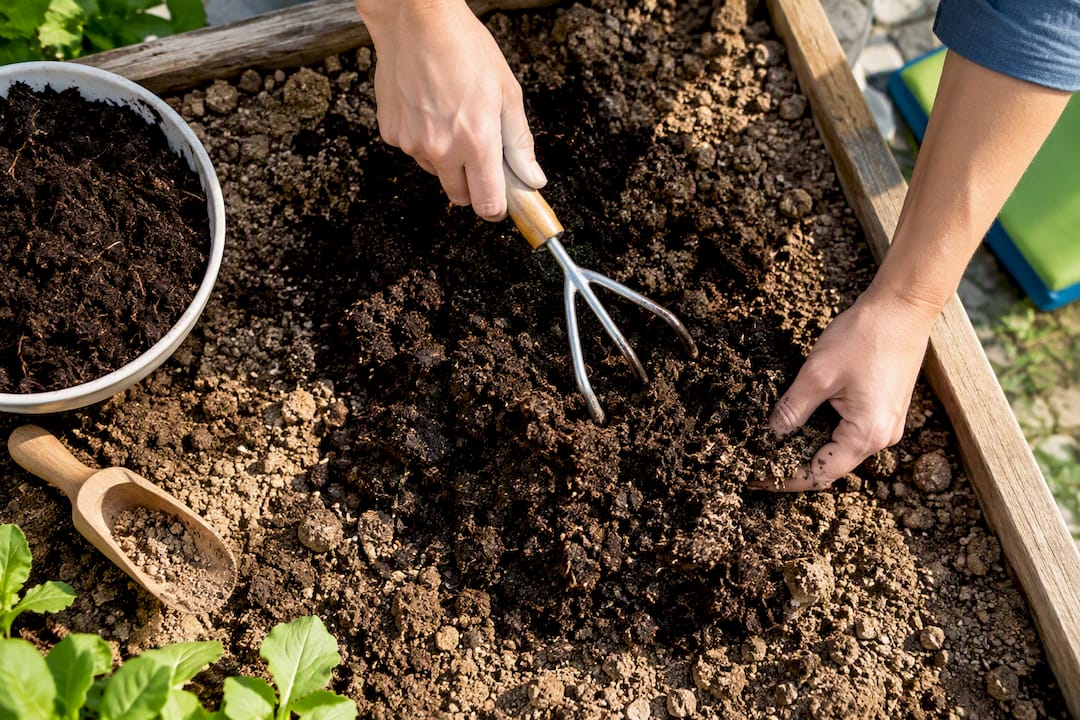
Mulch is the other half of the equation. A 2 to 4 inch layer of organic mulch, straw, wood chips, or a compost topdressing, cuts surface evaporation and moderates soil temperature. That temperature moderation matters beyond water savings too: heat spikes at the root zone are a common trigger for premature bolting in crops like lettuce and cilantro.
A few practical notes for beds and containers:
- Raised beds dry out faster than in-ground rows because they drain on all sides, so mulch depth matters even more there.
- Containers need daily monitoring during establishment regardless of variety, since soil volume is limited.
- A greenhouse or covered structure buffers wind and temperature swings, which reduces the evaporative stress that drives up watering frequency.
- If your region sees long dry stretches, a small water-storage setup as backup for irrigation during peak demand is worth planning for before the dry season starts, not during it.
Storing Seeds So They Stay Viable in Dry Climates
Ironically, the dry conditions that make your garden tough can wreck your seed supply if you store it wrong. Seeds need cool, stable temperatures and controlled humidity to stay viable, and a hot garage or a sunny windowsill degrades them fast even in an arid region. Heat is actually the bigger enemy of seed viability, more than dryness itself, since extreme temperature swings damage the embryo inside the seed coat.
Store seeds in airtight containers, glass jars or sealed mylar bags work well, in a cool, dark spot with stable temperature, ideally under 50 degrees Fahrenheit. A refrigerator works if you keep the seeds in a sealed container to prevent moisture from the fridge’s humidity cycles from reaching them. Label everything with the variety name and the year you bought or saved it. Most vegetable seeds stay viable for two to five years under good storage conditions, though legumes like beans and peas often last longer than that when kept cool and dry.
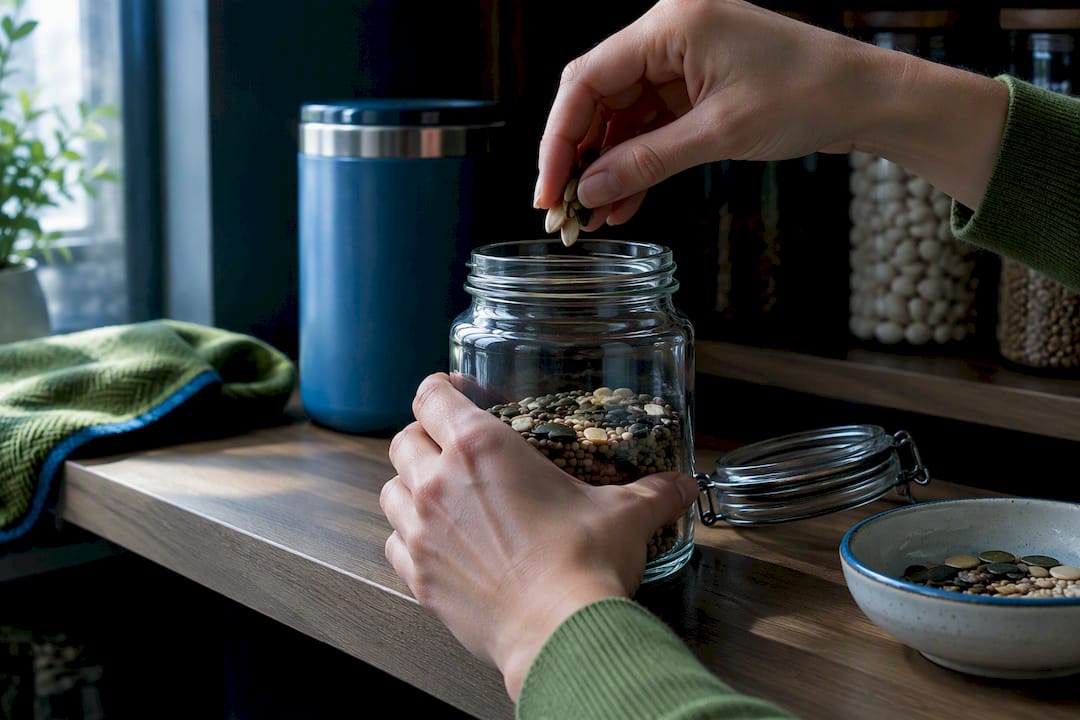
If you’re planning multiple growing seasons around drought-tolerant varieties, buy seed in bulk when you find a variety that performs well for your conditions, then store the surplus properly rather than repurchasing every year. A simple viability check before planting season, like a germination test on a damp paper towel, tells you whether last year’s seed is still worth sowing or whether it’s time to order fresh. For a deeper walkthrough of viability testing methods, see this guide on seed storage methods.
Pests and Diseases That Target Water-Stressed Plants
Drought-stressed plants are more vulnerable to certain pests and diseases, not less, which surprises a lot of new gardeners who assume tough varieties are immune to trouble. Spider mites thrive in hot, dry conditions and multiply fast on stressed foliage, especially on beans, tomatoes, and cucumbers during heat waves. Aphids also favor drought-stressed plants because stress changes the sugar concentration in plant sap, making it more attractive to them.
Root knot nematodes become a bigger problem in dry, sandy soils common to arid gardens, particularly for carrots and other root crops. Powdery mildew, somewhat counterintuitively, often shows up on drought-stressed squash and cucumber plants because weakened foliage is more susceptible even in low-humidity air.
A few management basics that matter more in dry-climate gardens than wet ones:
- Keep plants adequately watered during establishment specifically to reduce stress-related pest susceptibility.
- Inspect the undersides of leaves weekly during hot spells, since mites and aphids cluster there.
- Rotate root crops yearly to disrupt nematode buildup in the same bed.
- Remove and destroy powdery mildew-affected leaves promptly rather than composting them on-site.
Healthy, well-mulched soil does double duty here too. It buffers root stress, which is often the underlying trigger that invites pest pressure in the first place.
Matching Seed Choices to Your Climate and Soil
Drought-tolerant doesn’t mean identical everywhere. A cowpea bred for Southeastern heat and humidity behaves differently than one bred for high desert conditions with cold nights and sandy soil. Regional adaptation matters as much as the general “drought tolerant” label on the packet.
In hot, humid regions, prioritize disease resistance alongside drought tolerance, since moisture in the air (even without much rain) fuels fungal pressure that dry-climate varieties weren’t necessarily bred to resist. In high desert or arid inland climates, look for varieties with documented cold-night tolerance too, since many drought-adapted crops originated in regions with hot days and cool nights, a pattern that doesn’t match every arid zone.
Soil type shifts your approach as well. Sandy soils drain fast and need more frequent deep watering during establishment, plus heavier mulch to slow evaporation. Clay-heavy soils hold water longer but risk suffocating roots if you overwater, so drought-tolerant varieties with strong disease resistance to root rot are worth prioritizing there. If you’re working with poor native soil regardless of climate, a raised bed lets you build the exact soil composition your seed choices actually need, sidestepping years of amending a stubborn native bed.
Local extension offices and regional seed suppliers usually know which specific varieties have a track record in your exact conditions, which generic seed packet descriptions can’t tell you.
Companion Planting to Stretch Every Drop of Water
Pairing the right plants together reduces competition for water and improves how efficiently your garden uses what it gets. The classic Three Sisters combination, corn, beans, and squash, works partly for water reasons: squash leaves shade the soil and reduce evaporation, beans fix nitrogen that reduces the fertilizer-driven growth spurts that spike water demand, and corn provides structure without heavy root competition at the same soil depth.
Deep-rooted and shallow-rooted plants paired together avoid competing for the same moisture zone. Planting carrots (deep taproot) near lettuce (shallow, fibrous roots) means each draws from a different part of the soil profile instead of fighting over the same inches. Herbs like rosemary and thyme, already low-water by nature, make efficient border plants around thirstier crops since they won’t demand extra irrigation that could oversaturate their neighbors.
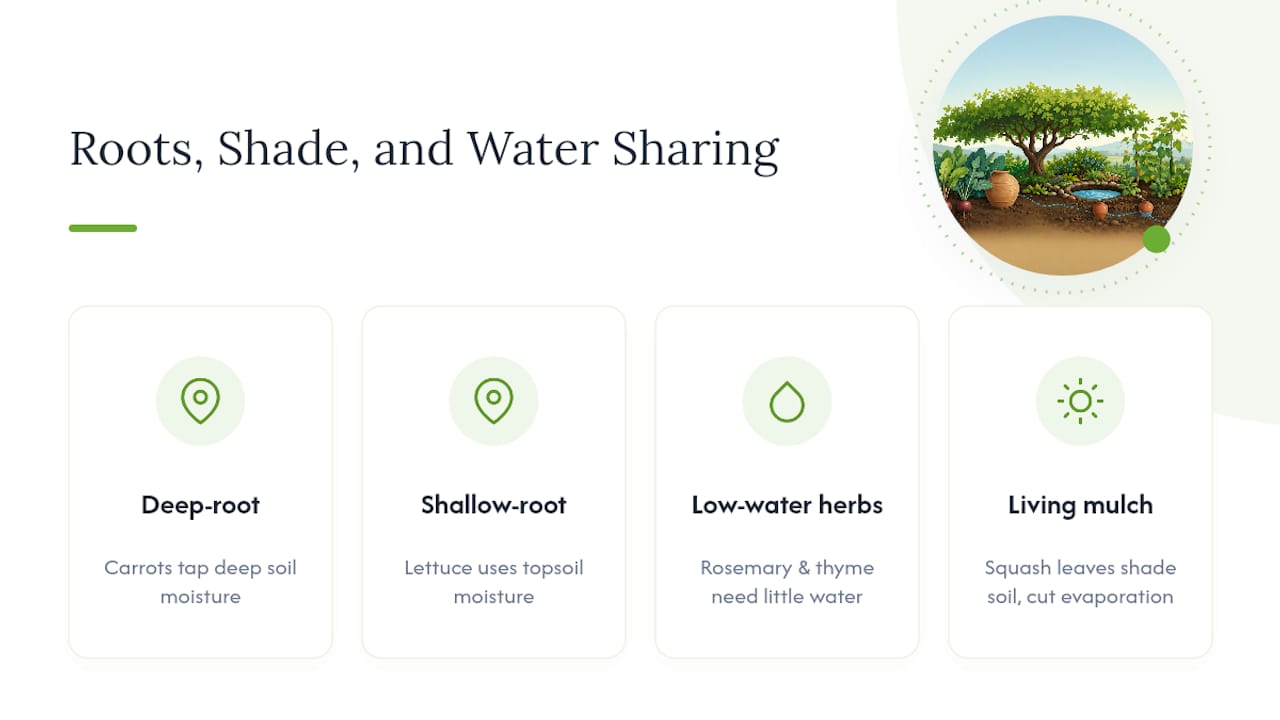
Ground-covering companions matter too. Low, spreading plants like squash or certain herbs act as living mulch, shading soil and slowing evaporation the same way a straw layer would, just with a harvest attached. Avoid pairing multiple shallow-rooted, high-water crops in the same bed section since they’ll compete hard for the same limited moisture during dry stretches.
Skip companions with wildly mismatched water needs in the same bed zone. A thirsty melon planted right next to drought-adapted sage means one of the two is going to suffer, since you can’t water a shared bed section to satisfy both.
Perspective: Why Seed Selection Is Only Half the Equation
Picking the right seed is where water-wise gardening starts, but it’s not where it ends. We’ve watched homeowners buy perfectly good drought-tolerant seed, then plant it into compacted, unmulched soil with no shade or structure, and wonder why the harvest underperformed. The seed can only do what the growing system around it allows.
That’s the piece we focus on: pairing seed selection guidance with the garden beds and greenhouse structures that let those varieties actually perform. A drought-tolerant chickpea in a raised bed with amended soil and consistent mulch will outproduce the same seed in poor native dirt every time.
— Gridwise
Building a Low-Water Garden System, Not Just a Seed Packet
A drought-tolerant seed still needs the right structure around it to earn its reputation. Some companies cover the whole system: seed, raised beds, and season-extending structures, built for gardeners who want reliability without babysitting a hose every afternoon.

A greenhouse buffers wind and temperature swings that otherwise drive up watering frequency, especially useful for starting heat-sensitive seedlings before transplanting them out into drought-hardy beds. Garden beds give you control over soil composition from day one, which matters more for water retention than almost anything else discussed above. And if dry spells regularly strain your irrigation, a water storage setup keeps backup supply on hand instead of leaving your beds to gamble on rainfall.
| Need | Gridwise Category | Why It Helps |
|---|---|---|
| Better soil, easier mulching | Garden Beds | Full control over compost mix and drainage |
| Season extension, seedling protection | Greenhouses | Buffers heat and wind stress during establishment |
| Backup irrigation during dry spells | Water Storage | On-hand supply when rainfall and taps fall short |
Start with the garden bed collection to build the soil foundation your drought-tolerant seed choices actually deserve.
Sources
- Wellington, CO municipal blog — deep watering best practices
- Bexar County (TAMU Extension) — conserving water through mulch
- Research article on plant responses to heat and drought (PMC)
- Bayer — Heatmaster tomato product details
- Johnny’s Selected Seeds — Katrina cucumber (greenhouse performer, heat-tolerant notes)
FAQ
What Are the Best Drought-Tolerant Vegetable Seeds for Beginners?
Cowpeas, chickpeas, beets, and carrots are among the most forgiving for new gardeners because they tolerate irregular watering without major yield loss. Fast, low-water crops like Gridwise’s Kohlrabi Purple Microgreens Seeds also work well if you want a harvest without managing a full season of irrigation. Start with a couple of these before experimenting with trickier heat-tolerant tomatoes or cucumbers.
Is Heat Tolerance the Same as Drought Tolerance?
No. Heat tolerance means a plant can function at high temperatures, while drought tolerance means it maintains yield with less water, and research on crop physiology confirms these are separate traits. A heat-tolerant tomato can still wilt fast without regular watering, while a true drought-tolerant crop like chickpea keeps producing on far less.
How Often Should I Water Drought-Tolerant Vegetables While They’re Getting Established?
Water deeply and infrequently rather than lightly every day, since shallow, frequent watering keeps roots near the surface instead of encouraging them downward. A good cue is soaking the root zone thoroughly, then waiting until foliage shows the first mild signs of stress before watering again.
Does Mulch Actually Reduce How Much I Need to Water?
Yes. A 2 to 4 inch layer of organic mulch cuts surface evaporation and moderates soil temperature, which reduces both watering frequency and the odds of heat-triggered bolting. Apply it after germination, not before, so seedlings still get soil warmth and light while sprouting.
Where Can I Buy Reliable Drought-Tolerant Seeds and Garden Structures Together?
Gridwiseliving carries drought and heat-tolerant seed options alongside raised garden beds and greenhouse structures designed to support them. Current seed and structure pricing is listed directly on the Gridwiseliving site, since options and availability shift by season.