

Homeowners Should Demand 120 Joule Hail Tests Before Buying Solar
Most residential solar panels survive typical hail without a scratch, but hail larger than about 1.75 inches (44 mm) can cause both visible glass breakage and invisible cell microcracks, according to the Department of Energy. Hidden cracks can quietly cut output and raise safety risks long after a storm passes. The first move after any severe hailstorm: confirm hail is a covered peril on your homeowner’s policy, then schedule a professional inspection before you assume everything is fine.
TL;DR:
- Hail larger than 1.75 inches can cause unseen microcracks in solar cells, which may impair performance and pose safety risks over time.
- Impact energy measured in Joules provides a more accurate durability assessment than hailstone size alone, with resilient panels surviving impacts over 120 Joules.
- Thicker front glass, smaller modules with reinforced frames, and specific mounting angles significantly reduce hail damage risk before installation.
- Confirm that homeowner’s insurance explicitly covers hail damage and document system condition with photos and baseline scans before storms occur.
- Post-storm, prioritize professional imaging and thorough documentation to identify microcracks that are invisible visually but could affect long-term performance.
Table of Contents
- How Hail Damage to Solar Panels Actually Happens
- What Hail Testing Standards Actually Tell You
- Design Choices That Cut Hail Risk Before Installation
- What To Do Before, During, and After a Hailstorm
- Gridwise Perspective: Building for Durability, Not Just Output
- Our Take: Resilience Beats Panic
- How Gridwise Living Supports Hail-Resilient Solar Ownership
- Sources
- FAQ
How Hail Damage to Solar Panels Actually Happens
Hail attacks a solar panel in two very different ways, and only one of them is obvious.
Visible damage looks the way you’d expect: shattered or spider-cracked tempered glass, dented frames, or a module that’s visibly caved in. Anyone walking the roofline can spot it.
Invisible damage is the more dangerous one. It shows up as microcracks running through the silicon cells themselves, or as separation at the busbars that carry current across the cell. None of it is visible to the naked eye, and a panel with a hairline microcrack can keep producing power for months before the crack widens or the affected area starts overheating.
A peer-reviewed electroluminescence (EL) imaging study of panels after a Texas hailstorm found something worth remembering: invisible microcracks turned up far more often than visible glass breakage across the same storm cluster. In other words, if you count broken glass and call it a day, you’re likely undercounting the real damage by a wide margin.
Why does this matter beyond a slow output decline?
- Microcracks create localized resistance, and localized resistance creates heat, which is how hotspots form.
- Hotspots accelerate degradation of the surrounding cell material and can, in rare cases, become a fire risk.
- A crack that seems stable can propagate later, triggered by thermal cycling or a second storm, so damage assessed right after impact isn’t necessarily the final word.
That last point is the reason EL and infrared imaging exist as a category of diagnostic tool in the first place. A visual walk-around tells you about glass. It tells you nothing about what’s happening inside the cell.
What Hail Testing Standards Actually Tell You
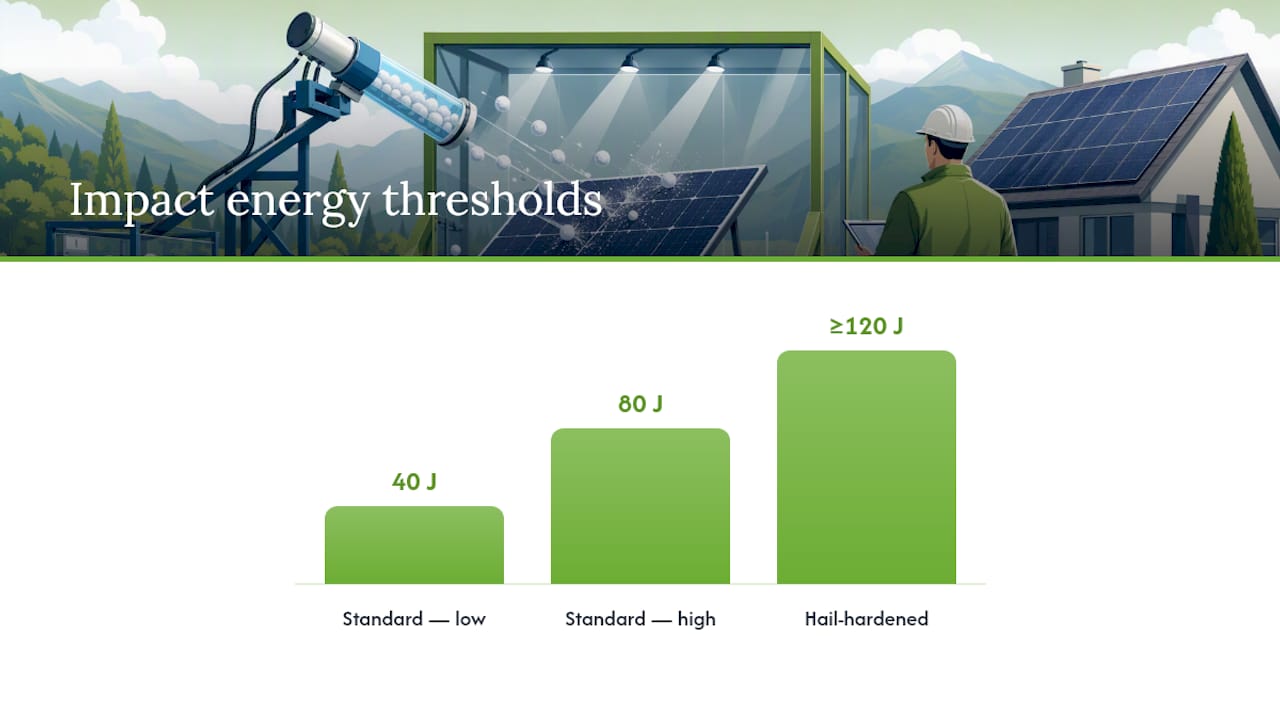
Panel datasheets reference hail resistance, but the number on the spec sheet is more limited than it sounds. Standard IEC and UL certification tests fire a steel ball of a fixed diameter at a fixed speed and check whether the panel survives. It’s a pass/fail threshold, not a real-world resilience score, and it doesn’t account for the fact that hail velocity varies enormously even within a single storm.
That gap is exactly why the industry is shifting toward energy-based testing. A new approach reported by pv magazine, built around VDE’s Hail Resiliency Curve, measures impact in Joules rather than just hailstone diameter, since Joules capture both mass and velocity together.
Standard panels typically fail somewhere between 40 and 80 Joules of impact energy, while hail-hardened panels can withstand 120 Joules or more — roughly a 50 to 200 percent gap in real-world durability that a diameter-only rating would never reveal.
Before buying or evaluating an existing system, ask your installer or manufacturer for:
- The panel’s front glass thickness in millimeters, not just “tempered glass” as a generic label.
- Any published impact-energy (Joules) results, not only the baseline IEC/UL pass/fail rating.
- Third-party hail testing data from labs like PVEL, RETC, or FM Global, where available.
- Whether the manufacturer markets a specific hail-resistant or hail-hardened product line.
A datasheet that only cites the minimum certification standard isn’t lying to you. It’s just not telling you the whole story.
Design Choices That Cut Hail Risk Before Installation
Hail resilience gets decided long before a storm ever forms, mostly in three decisions: glass, geometry, and mounting.
- Choose thicker front glass where hail risk is real. Testing reported by Ceramic Tech Today shows 4 mm tempered glass loses less power and survives larger impacts than the 2.8 to 3.2 mm glass common on standard panels. In hail-prone regions, that extra millimeter or two of glass is cheap insurance against a very expensive failure.
- Favor smaller-format modules with reinforced frames. Larger panels flex more under impact, and flex is what turns a surface dent into a propagating crack. A mid-span support bar on the frame reduces that flex meaningfully.
- Think about tilt and mounting geometry together, not separately. A slightly steeper tilt can help hail glance off rather than strike a panel dead on, but steeper tilt also raises wind load, so the two variables need to be balanced, not optimized in isolation.
- For ground-mounted arrays, consider trackers with hail-stow capability. These systems automatically rotate panels to a near-vertical, edge-on position when a storm approaches, shrinking the exposed surface area dramatically. Manufacturers have leaned into this response as documented losses on utility-scale projects pushed thicker glass and hail-resistant lines into the mainstream market.
Pro Tip: *If you’re sizing a system for a hail-prone region, don’t chase the cheapest panel per watt. Compare cost-per-watt against the glass thickness and any published impact-energy rating first.
Roof-mounted homeowners weighing tilt against seasonal energy yield can work through the tradeoffs using a straightforward wattage and sizing calculation before locking in a mounting angle.
What To Do Before, During, and After a Hailstorm
Treat hail preparedness as three separate windows, not one panicked reaction after the fact.
Before the storm:
- Confirm your homeowner’s insurance policy explicitly lists hail as a covered peril, not just “wind and storm damage” in general terms.
- Take dated photos of your system now, and if your installer offers infrared or EL scanning, get a baseline reading while everything is working normally.
- Agree on an action plan with your installer in advance, including who to call and how fast they can respond after a severe storm.
During the storm: Safety comes first, always. Never climb onto a roof or approach an array during active hail, lightning, or high wind. Solar systems carry live current even in bad weather, and only a qualified technician should power down a system if a shutdown becomes necessary.
After the storm:
- Photograph and video every visible sign of damage, with timestamps, before touching anything.
- If you see cracked or shattered glass anywhere on the array, shut the system down and call your installer rather than continuing to run it.
- Schedule infrared, EL, or UV imaging within about a month of the event. The DOE recommends this window specifically because microcracks that seem stable at first can still be growing.
- Keep every photo, report, and invoice in one file. Insurers and manufacturer warranty claims both move faster with a complete paper trail. A post-storm inspection checklist built for roofing claims applies almost line for line to rooftop solar arrays.
Gridwise Perspective: Building for Durability, Not Just Output
Gridwiseliving evaluates solar hardware the same way it evaluates every product line: durability first, ease of ownership second. That bias matters more in hail country than almost anywhere else, because the cheapest watt-per-dollar panel on paper is rarely the cheapest panel over a ten-year ownership window once you factor in one hailstorm’s worth of repairs.
Whether insurance or hardware upgrades make more sense depends on your local hail frequency. Check your region’s risk profile against the FEMA National Risk Index before deciding how much to invest in thicker glass versus relying on coverage.
For ongoing ownership, a simple routine goes a long way:
- Walk the array visually after any storm rated severe by local weather alerts.
- Watch remote monitoring dashboards for sudden output drops on individual strings, a common early sign of hidden cell damage.
- Order professional imaging any time output drops without an obvious cause like shading or dirt buildup.
Our Take: Resilience Beats Panic
Most of the hail anxiety we hear from homeowners is disproportionate to the actual risk. Modern tempered glass and certified modules handle the overwhelming majority of hail events fine, and the DOE’s own data backs that up. The mistake isn’t buying solar. It’s assuming a clean-looking panel is automatically a healthy one.
That’s where conventional advice falls short. Most guidance stops at “check for cracked glass,” when the research on microcracks makes clear that glass condition and electrical health are two separate questions entirely. A panel can look perfect and still be losing output from a busbar crack no one can see without EL imaging.
Our priority order for readers: verify insurance coverage first, since it’s free and takes ten minutes. Then, if you live somewhere hail actually happens with regularity, spend the money on glass thickness and a mounting design that reduces flex. Diagnostics come third, but only because they matter after an event, not before one.
— Gridwise
How Gridwise Living Supports Hail-Resilient Solar Ownership
Our solar catalog focuses on products designed for durability and reliability. That shows up in the durable framing of systems like the 800-watt off-grid solar kit, a practical option for homeowners who want backup capacity that doesn’t depend on a single rooftop array surviving every storm.
If a hailstorm ever does take part of your system offline, having a bridge power source matters more than most people plan for. A whole-home solar generator or a portable backup power station keeps critical circuits running while repairs get scheduled and insurance paperwork gets processed. Browse the full solar energy systems collection to compare panel and kit options built for durability, and reach out for a durability consultation if you’re weighing glass thickness, mounting geometry, or backup capacity for a hail-prone property.
Sources
- Hail Damage Mitigation for PV Systems | Department of Energy
- New hail test aims to more accurately measure solar panel resilience - pv magazine Global
- Electroluminescence analysis and grading of hail damaged solar panels
FAQ
How big does hail need to be to damage solar panels?
Hail larger than about 1.75 inches (44 mm) in diameter is where the DOE sees significant damage risk rise, though impact energy (mass and speed combined) matters as much as size alone.
Does homeowners insurance cover solar panel hail damage?
Many homeowner policies cover hail damage to rooftop solar as part of standard wind and storm coverage, but you need to confirm hail is explicitly listed as a covered peril rather than assuming it’s included.
Can hail damage solar panels even if the glass doesn’t crack?
Yes. Research on EL imaging after hailstorms found invisible microcracks were much more common than visible glass breakage, which is why professional imaging matters after severe storms even when panels look fine.
Why is it difficult to sell a house with solar panels that have hail damage?
Undisclosed or undiagnosed hail damage creates uncertainty for buyers and appraisers, since hidden microcracks can affect long-term output and safety in ways a visual inspection won’t catch, making documented diagnostic history valuable at resale.
Should I cover my panels before a hailstorm?
Temporary hard-shell or padded covers can prevent impact damage, but they stop power generation entirely, so they only make sense as a short-term measure when someone can remove them right after the storm, according to SolarReviews.