

Homeowners: Size Home Solar Backup Right, Example 54 kWh
Whole-home solar backup is practical for most houses today, not just an off-grid dream. The technology that makes it work is a modular lithium battery paired with a hybrid inverter sized to your panel’s amperage and installed by a licensed electrician. The real question isn’t “can this work” but “how much capacity do I actually need.” Start there with a load assessment, either through a local installer or by reviewing Gridwiseliving’s solar systems to see what a properly sized build looks like.
TL;DR:
- Most households need at least 54 kWh of battery capacity paired with a 15kW inverter to run essential loads like air conditioning and well pumps continuously for several hours.
- Lithium iron phosphate batteries are the preferred chemistry due to their longer cycle life and better thermal stability, which enhances safety and longevity.
- Proper system sizing requires a load assessment, focusing on essential loads and desired backup hours, with inverter power rated first to prevent starting issues.
- Installation typically takes 8 to 16 weeks, and costs range from $12,000 to over $55,000 depending on capacity, hardware choices, and site complexity.
- Modular, scalable systems allow future expansion, but inverter capacity must be planned upfront to support added batteries without constraints.
Table of Contents
- How Does Home Solar Backup Actually Work?
- How Much Battery Capacity and Power Do You Need?
- Which Battery Chemistry and Hardware Should You Prioritize?
- What Does Whole-Home Solar Backup Cost?
- What Is the Installation Timeline for a Solar Battery System?
- Should You Back Up the Whole House or Just Critical Circuits?
- When Is a Solar Battery Backup Actually Worth the Investment?
- Which Gridwiseliving Products Fit Which Backup Scenario?
- How Does Weather Affect Solar Backup Performance?
- How Long Do Solar Batteries Last and What Maintenance Do They Need?
- Can You Expand Your Battery System Later?
- What Safety Steps Matter Most With a Home Battery System?
- Why Durable, Serviceable Hardware Matters More Than Specs on a Sheet
- Ready to Build Your Home Solar Backup System?
- Sources
How Does Home Solar Backup Actually Work?
A home solar backup system runs on one of three basic architectures, and the one you pick determines your cost, complexity, and how much of the house stays powered during an outage.
Grid-tied hybrid systems are the most common setup for American homes. Solar panels feed a hybrid inverter, which charges a battery and also syncs with utility power. When the grid drops, a backup gateway automatically islands your home from the grid in a fraction of a second, so the battery and panels keep running your circuits without you touching a switch. Off-grid systems skip the utility connection entirely, relying on panels, batteries, and sometimes a generator for cloudy stretches. Portable battery-generator combos sit in between, giving you flexible, plug-in backup without any permanent electrical work.
Batteries in any of these setups can charge three ways: from solar panels during the day, from the grid overnight on off-peak rates, or from a backup generator when neither is available. The Department of Energy’s overview of solar and storage integration breaks down how these charging paths work together to keep a home resilient.
Every functional system needs the same core pieces:
- Solar panels or an existing array to generate power
- An inverter/charger that converts DC battery power to usable AC electricity
- A battery bank that stores the energy
- A transfer switch or smart panel that isolates backup circuits from the grid
- A monitoring app or display so you can see charge level and consumption in real time
Skip any one of these and the system either doesn’t work automatically or doesn’t work at all during an outage.
How Much Battery Capacity and Power Do You Need?
Two numbers matter, and confusing them is the single most common mistake homeowners make. kWh (kilowatt-hours) measures how much energy your battery stores, essentially your fuel tank. kW (kilowatts) measures how much power it can deliver at once, your engine size. A battery with plenty of storage capacity but an inverter with insufficient power rating may not be able to start devices with high startup loads like air conditioners. The DOE’s guidance on balancing power and energy in storage design flags undersized inverter power as a common design flaw, even when total stored energy looks sufficient on paper.
Sizing your system comes down to three steps:
- List your essential loads. Refrigerator, well pump, a few circuits of lights, internet router, medical devices, and maybe one HVAC zone.
- Add up hourly consumption. Most of these loads together run 1 to 3 kW continuously, with brief spikes when a compressor or pump kicks on.
- Multiply by desired backup hours. Want 24 hours of coverage at 2 kW average draw? You need a substantial amount of kWh storage to cover that, though real-world efficiency losses push the required capacity higher.
Pro Tip: Oversize your inverter’s kW rating before you oversize your battery’s kWh. A battery that’s slightly too small just means shorter runtime, but an inverter that’s too weak means your air conditioner or well pump simply won’t start.
Real-world examples help here. A battery with typical capacity on the lower end can run basic loads such as refrigerator, lighting, and internet for an extended period, but cannot power major appliances like central air conditioning. With larger battery capacity, intermittent devices such as heat pump cycling and sump pumps can also be supported. At 54 kWh, paired with a 15kW inverter like Gridwiseliving’s Sol-Ark hybrid unit, a typical 2,000 square foot home can run air conditioning, a well pump, and full kitchen loads simultaneously.
Which Battery Chemistry and Hardware Should You Prioritize?
Lithium iron phosphate (LFP) is the chemistry to prioritize for home backup, and it’s not close. LFP batteries offer significantly higher cycle life and better thermal stability compared to older lithium-ion chemistries and lead-acid batteries, which is advantageous for long-term home backup applications. Enphase’s guidance on home solar batteries notes that LFP has become the standard choice specifically for safety and longevity reasons.
Beyond chemistry, you’re choosing between two hardware approaches:
- All-in-one units integrate the battery and inverter in a single enclosure, simpler to install and typically more compact.
- Separate hybrid inverter plus stackable battery setups, like pairing a Sol-Ark inverter with modular battery banks, cost more upfront but scale more easily as your needs grow.
Whichever you choose, don’t skip the transfer switch or smart panel, and don’t skip a certified installer. A poorly wired transfer setup can backfeed power onto grid lines, which is a genuine safety hazard for utility workers, not just a warranty issue.
Pro Tip: Ask any installer for their electrician license number and their experience count with battery interconnection specifically, not just solar panel mounting. These are different skill sets, and plenty of installers are strong on one but weak on the other.
What Does Whole-Home Solar Backup Cost?
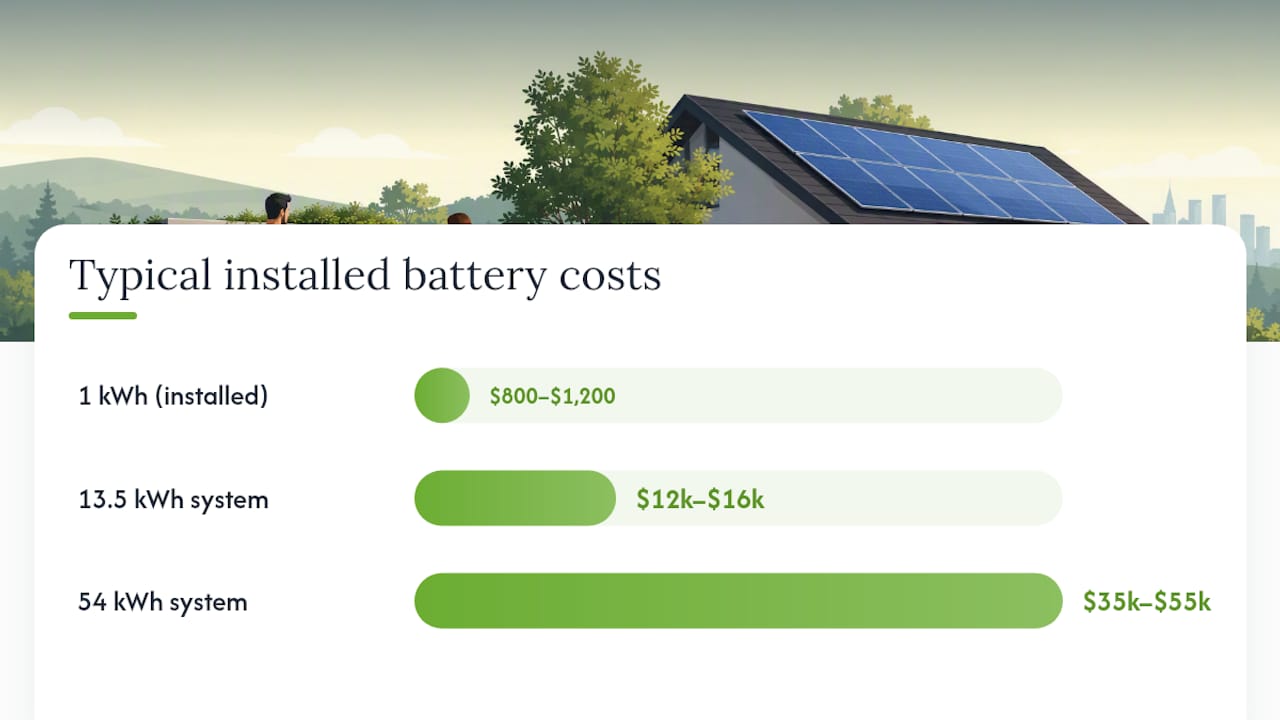
Installed battery storage typically runs $800 to $1,200 per kWh once you include the inverter, transfer equipment, and labor. That puts a modest 13.5 kWh entry system around $12,000 to $16,000, while a whole-home 54 kWh build with a 15kW inverter can land anywhere from $35,000 to $55,000 depending on panel upgrades and site complexity. SolarReviews’ 2025 comparison of home battery systems breaks down cost-per-kWh and warranty terms across the market, and the ranges vary more by capacity and brand than most sales pitches suggest.
Several factors push your price up or down:
- Battery capacity and inverter power rating, the two biggest cost drivers by far
- Electrical panel upgrades, needed on older homes with outdated service panels
- Permitting fees, which vary by county and utility
- Installer labor, which climbs with site complexity like roof pitch or trenching for ground-mount panels
The federal solar Investment Tax Credit currently allows homeowners to claim a percentage of total system cost, including battery storage when paired with solar, against federal taxes owed. Financing options include solar loans, home equity lines, and lease-to-own arrangements through installers, each of which changes your effective payback timeline. Warranties on quality LFP systems typically run 10 years or 6,000 cycles, whichever comes first, according to industry comparison data from SolarReviews.
What Is the Installation Timeline for a Solar Battery System?
Installing a home solar backup system moves through a predictable sequence, and knowing the order helps you avoid the delays that catch most homeowners off guard.
- Site survey and load assessment (1 to 2 weeks to schedule): an installer evaluates your roof, panel, and electrical service to confirm what capacity fits.
- Equipment ordering and lead time (2 to 8 weeks): battery and inverter availability varies by manufacturer and current demand.
- Permitting and utility interconnection paperwork (2 to 6 weeks): your installer typically files this, but the utility and local building department both have to sign off.
- Physical installation (1 to 3 days): mounting the battery, wiring the transfer panel, and connecting the inverter.
- Inspection and utility approval to operate (1 to 3 weeks): a local inspector checks the wiring before the utility grants final permission to activate.
Total time from signed contract to system activation usually runs 8 to 16 weeks. The biggest delays come from panel upgrade requirements discovered mid-project and utility interconnection backlogs, both of which are easier to plan around if your installer flags them during the initial site survey rather than after equipment is already on order.
Should You Back Up the Whole House or Just Critical Circuits?
This decision shapes your budget more than almost any other choice you’ll make. Whole-home backup covers every circuit, including air conditioning, electric ranges, and EV chargers, but it demands the largest battery and inverter capacity you can afford. A critical-load panel approach backs up only a chosen subset of circuits, cutting your upfront cost significantly while still covering what actually matters during an outage.
Ask yourself these questions before deciding:
- How often does your area lose power, and for how long on average?
- Does anyone in the household depend on medical equipment that needs continuous power?
- Do you have a well pump, sump pump, or septic system that fails without electricity?
- Are you planning to add an EV or already charging one at home?
- Is central air conditioning a comfort issue or a genuine health necessity in your climate?
A typical prioritized-circuit list includes the refrigerator, well or sump pump, a few lighting circuits, internet and phone charging, and one bedroom or living room outlet circuit. That combination usually draws under 2 kW and can run comfortably for 24 to 48 hours on a mid-size battery, well before you need a whole-home-scale investment.
When Is a Solar Battery Backup Actually Worth the Investment?
Battery backup delivers clear value in a few specific situations: homes in areas with frequent or multi-day outages, households running medical equipment that can’t tolerate a power gap, and anyone building toward genuine off-grid independence. Storage adoption reflects this shift. Battery attachment on residential solar installs tripled since 2018 and reached 13% of new installs by 2023, with growth expected to double again by 2028.
Financially, batteries rarely pay for themselves through utility bill savings alone unless you’re on aggressive time-of-use rates. The value proposition is resilience first, savings second. Watch for these red flags before signing a contract:
- An installer who won’t commit to a specific kW inverter rating in writing
- No documented warranty terms for cycle count or calendar years
- Battery and inverter from different ecosystems with no confirmed compatibility
- A quote with no mention of a transfer switch or interconnection plan
Which Gridwiseliving Products Fit Which Backup Scenario?
Matching hardware to your actual situation matters more than chasing the biggest battery on the market. Gridwiseliving’s lineup covers three distinct use cases, and picking the wrong tier either wastes money or leaves you underpowered.
- Portable emergency power: the Mega 3 Home Backup & Portable Power Station delivers 3,600 watts continuous with 3,072Wh capacity, enough for a fridge, some lighting, and device charging without any electrical work, paired well with a 120-watt portable panel kit for recharging in the field.
- Entry-level home backup: the Powerhouse Gen 2 Whole Home Solar Generator bridges the gap between portable units and a permanent installed system, suited to households that want more coverage than a power station but aren’t ready for a full electrical retrofit.
- Scalable whole-home system: the Sol-Ark 15kW hybrid inverter supports the largest loads, HVAC, well pumps, and EV charging together, with battery banks that stack as your needs grow.
Pro Tip: If you’re not sure which tier fits, start with the portable option and treat it as a trial run. It teaches you your actual load patterns before you commit tens of thousands of dollars to a permanent system.
How Does Weather Affect Solar Backup Performance?
Solar production swings hard with the seasons, and a system sized only for summer sun will disappoint you in December. Snow accumulation blocks output entirely until it slides or melts off, though steep panel mounting angles help shed it faster than flatter roof installs.

Battery performance itself also shifts with temperature. LFP batteries handle cold better than most lithium chemistries, but extreme heat above 104°F can accelerate degradation if the battery isn’t in a temperature-regulated space like a garage or basement. This is one more argument for LFP over lead-acid, which loses usable capacity fast in cold weather.
The practical fix is sizing for your worst realistic month, not your best one. Installers in cloudy climates like the Pacific Northwest routinely oversize battery banks for exactly this reason, and it’s cheaper to build that margin in upfront than to discover the gap during a January ice storm.
How Long Do Solar Batteries Last and What Maintenance Do They Need?
Quality LFP batteries last 10 to 15 years or 4,000 to 6,000 charge cycles, whichever comes first, and most manufacturers back that with a matching warranty. Maintenance is minimal by design. Modern lithium systems don’t need the water top-offs or equalization charging that lead-acid batteries once required.
What actually extends battery life is avoiding extremes. Keeping the battery’s state of charge between roughly 20% and 90% for daily cycling, rather than routinely draining to zero or holding at 100%, meaningfully slows degradation. Most quality battery management systems handle this automatically, but it’s worth checking your monitoring app occasionally to confirm the system isn’t fighting its own settings.
Temperature control matters just as much as charge habits. A battery installed in a garage that swings from freezing to over 100°F will degrade faster than one in a climate-controlled utility closet. If your installer offers a choice of mounting location, prioritize temperature stability over convenience.
Monitoring software flags problems early, catching a failing cell or a communication error between battery modules before it becomes a full outage-day failure. Check your app monthly, and don’t ignore firmware update notifications. Manufacturers push updates that improve charge algorithms and fix bugs that shorten cycle life.
Can You Expand Your Battery System Later?
Yes, and this is exactly why modular systems have become the industry standard. Rather than buying your maximum anticipated capacity on day one, most hybrid inverter setups let you add battery modules incrementally as your budget or needs grow. Industry surveys show installers increasingly steering homeowners toward expandable systems for this reason, since energy needs tend to grow with EV adoption, home additions, or new appliances.
The catch is planning ahead on inverter capacity. Your battery bank can grow, but only up to the ceiling your inverter and electrical panel support. A 15kW inverter like the Sol-Ark leaves plenty of headroom for adding battery modules over several years, while an undersized inverter locks you into your starting capacity no matter how many extra batteries you buy. This is worth discussing explicitly with your installer before your first purchase, not after you’ve maxed out.
If you’re starting with a portable unit and thinking about a permanent installed system down the road, treat the portable purchase as a stepping stone rather than a dead end. It teaches you your real consumption patterns, which makes sizing the permanent system far more accurate when you’re ready to upgrade.
What Safety Steps Matter Most With a Home Battery System?
Battery systems are safe when installed and used correctly, but a few precautions deserve real attention rather than a passing mention. Never attempt to wire a transfer switch yourself. Backfeeding power onto grid lines during an outage can injure utility workers who assume the line is dead, and it’s illegal in every jurisdiction for good reason.
Keep your battery installed in a ventilated, temperature-stable space, away from direct sunlight and away from flammable storage like paint cans or gasoline containers. LFP chemistry is far more thermally stable than older lithium formats, but every battery deserves clearance and airflow.
During an actual outage, check your monitoring app first to confirm which circuits are live and how much runtime remains before you start running non-essential appliances. If you smell anything unusual, notice swelling, or see warning lights on the battery enclosure, shut the system down at the disconnect and call your installer immediately rather than troubleshooting yourself.
Keep your installer’s contact information and your system’s model numbers somewhere accessible that doesn’t depend on power or internet, a paper folder works better here than a phone app you can’t charge.
Why Durable, Serviceable Hardware Matters More Than Specs on a Sheet
The mistake we see homeowners make most often isn’t picking the wrong battery chemistry, it’s picking a system nobody nearby knows how to service five years from now. A battery with a great cycle count on paper is worthless if the manufacturer has vanished or the local installer network dried up. That’s the thinking behind how Gridwiseliving selects hardware: durability and straightforward serviceability first, spec-sheet bragging rights second.
Energy independence isn’t really about buying the biggest battery you can afford. It’s about matching real capacity to real household needs, backed by equipment you can actually get repaired or expanded later. That’s a less exciting pitch than “54 kWh of pure freedom,” but it’s the one that holds up when your system is eight years old and you need a replacement part. If you’re weighing your options, requesting a sizing assessment costs nothing and tells you more than any spec comparison will.
— Gridwise
Ready to Build Your Home Solar Backup System?
Gridwiseliving builds toward energy independence in stages, not as an all-or-nothing purchase, which means you can start where your budget actually is instead of where a sales pitch wants you to be.
If you’re testing the waters, the Mega 3 Home Backup & Portable Power Station covers portable emergency power with 3,600 watts continuous output, no electrician required. Homeowners ready for a bigger step can look at the Powerhouse Gen 2 Whole Home Solar Generator for entry-level home backup that bridges into permanent coverage. For a scalable whole-home build that grows with your electrical needs, the Sol-Ark 15kW Hybrid Inverter gives you the power headroom to add battery capacity over time.
Browse the full Solar Energy Systems collection to compare capacity and pricing side by side, or request a sizing assessment directly to get a recommendation matched to your home’s actual load, not a generic package. The next outage isn’t asking your permission to happen. Get your system sized before it does.
Sources
Technical basics from the Department of Energy, market and cost data from SolarReviews, battery chemistry guidance from Enphase, consumption context from the EIA, and homeowner cheat sheets from SEIA.
- Energy
- Best Solar Battery Backup Systems for Homes in 2025 (SolarReviews)
- The Essential Guide to Home Solar Batteries (Enphase)