

U.S. Homeowners: Calculate Solar Panel Wattage With Watts×Sun×0.8
A solar panel’s wattage is its power output under lab test conditions, not a promise of what it delivers on your roof. Most residential panels sold today are commonly rated in a range that includes 400 to 460 watts, higher than the range typical a decade ago. To turn that rating into real energy, multiply the panel’s watts by your local peak sun hours and a derate factor of about 0.8. A 400W panel at 5 peak sun hours with a typical derate produces roughly 1,600 watt-hours a day.
TL;DR:
- Most residential solar panels range between 400 and 460 watts, with higher wattage often resulting from larger size rather than better efficiency.
- Real-world energy production depends on peak sun hours and a derate factor of about 0.8, meaning a 400W panel at five peak sun hours yields roughly 1,600 watt-hours daily.
- To accurately estimate annual energy output, multiply your system wattage, local peak sun hours, and the derate factor, then scale by the number of panels.
- Panel efficiency, temperature coefficient, and degradation rate are critical when choosing panels, especially for limited roof space or hot climates.
- Use address-specific tools like PVWatts and compare installer assessments to refine system size and avoid over or underestimating actual energy production.
Table of Contents
- How Solar Panels Get Their Wattage Rating
- What’s a Typical Solar Panel Wattage Range Today?
- How Do You Calculate Solar Panel Output?
- Efficiency vs. Wattage: What Matters More for a Small Roof
- What Actually Cuts Into Your Solar Panel Output
- How Do You Find the Wattage of Panels You Already Have?
- Sizing a System: A Worked Example and Why Modeling Beats Guessing
- Gridwise Perspective: Sizing Solar for Tiny Homes and Off-Grid Kits
- Finding the Right Solar Kit for Your Wattage Needs
- Tools to Run Your Own Solar Estimate
- Sources
How Solar Panels Get Their Wattage Rating
Every panel’s wattage comes from a lab test, not a rooftop measurement. Manufacturers rate panels under Standard Test Conditions (STC): 1,000 watts per square meter of sunlight, a cell temperature of 25°C, and zero wind. That controlled setup produces the number printed on the box, known as Wp, or watts peak. It’s a benchmark for comparing panels side by side, not a forecast of what your roof will produce on a July afternoon when the cells themselves are baking at 45°C or more.
The spec sheet behind that headline number carries a handful of fields worth understanding before you buy:
- Pmax (Wp): maximum power output at STC, the number on the label.
- Vmp: voltage at maximum power, used with Imp to calculate Pmax.
- Imp: current at maximum power.
- Voc: open circuit voltage, relevant mainly for string design.
- Isc: short circuit current, another electrical design figure.
Multiply Vmp by Imp and you get Pmax. That’s the whole trick behind the wattage rating: volts times amps, measured under ideal lab light.
Here’s where a lot of homeowners get tripped up. Watts measure power, the rate of energy flow at any given instant. Your electric bill, though, is denominated in kilowatt-hours (kWh), which is energy accumulated over time. A 400 watt panel doesn’t produce 400 watts continuously all day. It produces 400 watts near solar noon on a clear day and far less at dawn, dusk, or under clouds. The EIA’s explanation of watts versus kilowatt-hours is the clearest primer if the distinction still feels slippery. Once you separate the instantaneous rating from the accumulated energy, the rest of solar math gets a lot easier.
What’s a Typical Solar Panel Wattage Range Today?
Panels sold for home installations mostly cluster in one narrow band. An EnergySage analysis of marketplace quotes found that about 97% of home solar panels quoted in late 2025 fell between 400 and 460 watts, with most homeowners landing in the 420 to 440 watt sweet spot. That’s a tight range compared to a decade ago, when 250 to 380 watt panels were standard and roofs needed more of them to hit the same system size.
Higher average wattage today comes from two changes: bigger physical panels and better cell technology (monocrystalline PERC and newer designs squeeze more output per cell than the polycrystalline panels common in the 2010s). A panel rated at 460 watts isn’t necessarily a better panel than a 400 watt one; it might just be physically larger.
If you’re comparing quotes, don’t assume the highest wattage number wins. Ask what physical footprint comes with it.
How Do You Calculate Solar Panel Output?
The formula homeowners actually need is short enough to keep in your head: Daily watt-hours = panel watts × peak sun hours × derate factor.
Peak sun hours aren’t the same as daylight hours. They represent the equivalent hours of full-intensity sunlight your location gets, and they vary by geography and season. The NREL solar resource maps show that a home in Arizona might average 6 to 7 peak sun hours a day, while a home in Ohio might see closer to 4.
The derate factor accounts for everything that keeps a panel from performing at its lab rating in the real world: heat, dirt, wiring resistance, inverter conversion loss. A reasonable planning estimate is 0.80.
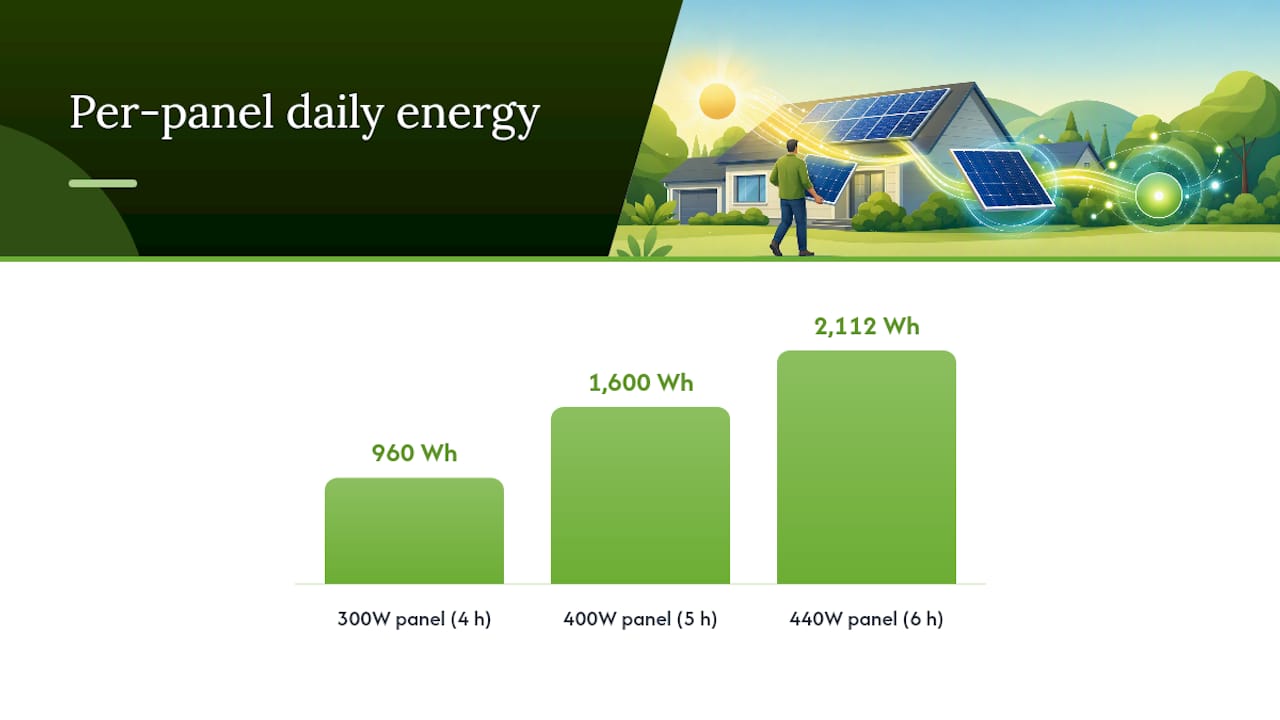
Here’s how that plays out for three common panel sizes:
- 300W panel, 4 peak sun hours: 300 × 4 × 0.8 = 960 Wh per day.
- 400W panel, 5 peak sun hours: 400 × 5 × 0.8 = 1,600 Wh per day.
- 440W panel, 6 peak sun hours: 440 × 6 × 0.8 = 2,112 Wh per day.
Pro Tip: Multiply your single-panel daily output by the number of panels in your array, then by 365, to get a rough annual kWh figure. A 20-panel, 440W system at 6 peak sun hours would produce roughly 2,112 Wh × 20 × 365, or about 15,400 kWh a year, before accounting for shading or seasonal swings.
That per-panel math scales linearly, which makes it easy to sanity-check any installer’s quote before you sign anything.
Efficiency vs. Wattage: What Matters More for a Small Roof
Wattage tells you the total output; efficiency tells you how much output you get per square foot. If your roof has limited usable area, efficiency should outrank the headline wattage number every time.
Module efficiency measures how much of the sunlight hitting a panel gets converted into electricity, typically 18 to 22% for residential panels today. Two panels can both be rated at 440 watts, but one might achieve that with premium high-efficiency cells in a compact frame, while the other reaches it simply by being physically bigger. EnergySage’s analysis makes this point directly: wattage alone can mislead buyers, because power density, not the raw number, is what determines how many panels fit on a constrained roof.
Two other specs matter more than most buyers realize:
- Temperature coefficient: how much output drops per degree above 25°C; a lower (less negative) number performs better in hot climates.
- Annual degradation rate: most panels lose a small, predictable percentage of output each year, so a 25 year warranty reflects expected decline, not a defect.
Pro Tip: If your roof can only fit 15 panels, choose the highest-efficiency option that fits your budget before chasing the biggest wattage number. Squeezing an extra 20 watts per panel across 15 panels adds up faster than most homeowners expect.
What Actually Cuts Into Your Solar Panel Output
The gap between a panel’s nameplate rating and what it delivers on your roof comes down to a handful of measurable losses.
Heat is the biggest one. Panels lose roughly 0.3 to 0.4% of output for every degree Celsius above 25°C, and rooftop cell temperatures on a sunny afternoon can easily hit 45 to 55°C.
Beyond heat, four other factors chip away at production:
- Partial shading: a chimney or tree shadow on one panel can drag down an entire string’s output unless the system uses power optimizers or microinverters to isolate the loss.
- Inverter efficiency: converting DC to AC power typically loses 2 to 4% of total energy.
- Wiring resistance: longer cable runs and connection points add small but real losses.
- Soiling and seasonal buildup: dust, pollen, and snow cover reduce output until cleared, and this varies heavily by region and season.
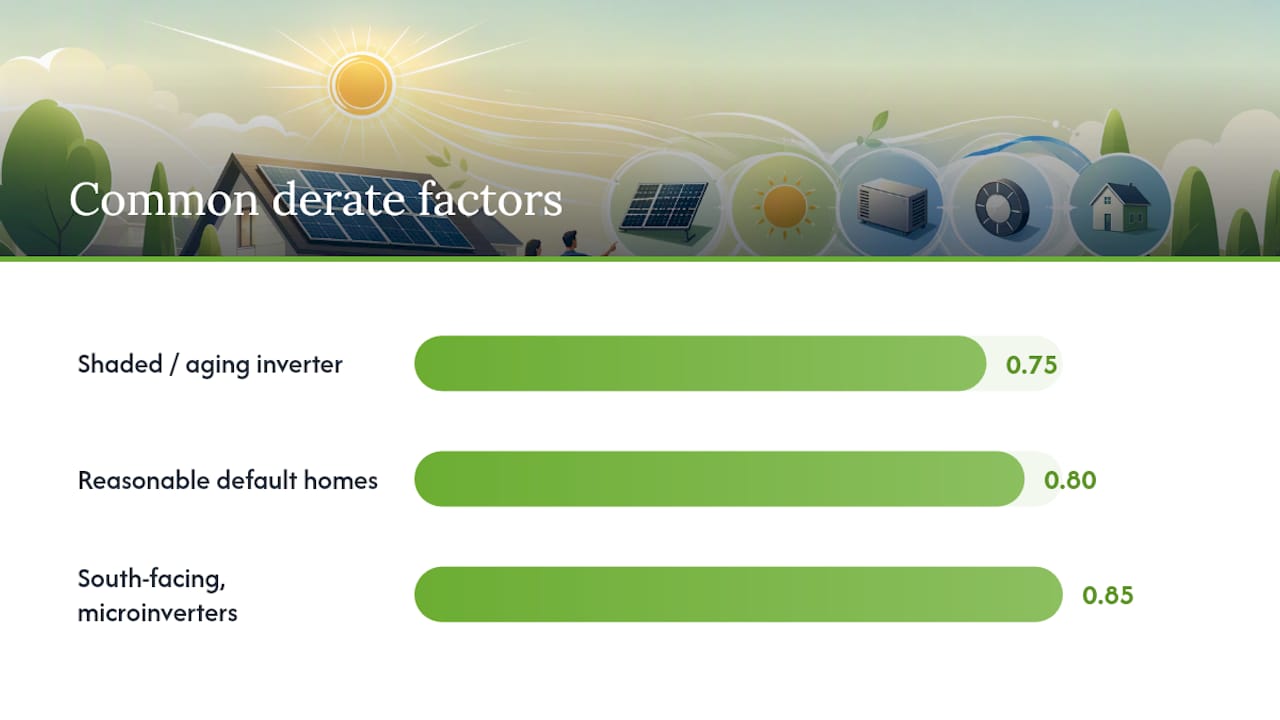
Choosing the right derate factor for your own planning depends on how many of these apply to your situation. A 0.75 derate fits a shaded roof with an aging inverter. 0.80 is the reasonable default for most homes. 0.85 applies to a south-facing roof with modern microinverters, minimal shading, and regular cleaning.
How Do You Find the Wattage of Panels You Already Have?
Check the nameplate sticker on the back of the panel, or on the frame edge, and look for Pmax (W), Vmp, and Imp. That label is legally required and gives you the exact STC rating without any guesswork.
If the sticker has faded or you can’t safely access the roof, follow these steps:
- Look up the model number printed on the label using the manufacturer’s spec sheet, usually found in a quick web search.
- Check your installer’s documentation, including the permit filing or the interconnection paperwork your utility required, which typically lists panel make, model, and wattage.
- Do the math backward if neither is available: divide your total system size in kilowatts by the panel count. A 6.6 kW system with 15 panels works out to roughly 440 watts per panel.
That last method won’t be exact, but it gets you close enough for planning purposes.
Sizing a System: A Worked Example and Why Modeling Beats Guessing
Say your household uses about 30 kWh a day and you want solar to cover most of it. Work backward from the same formula used earlier: required system watts = daily kWh target ÷ (peak sun hours × derate factor).
At 5 peak sun hours and a 0.80 derate, that’s 30,000 Wh ÷ (5 × 0.8) = 7,500 watts, or a 7.5 kW system. With 440 watt panels, that’s about 17 panels. Change your location to a cloudier region with 4 peak sun hours, and the same 30 kWh target now needs a 9.4 kW system, roughly 21 panels. Geography changes the math more than most people expect.
That’s exactly why generic charts and rules of thumb only get you so far. PVWatts models your actual address using decades of localized weather data, factoring in your roof’s tilt, orientation, and shading rather than a single national average. The Department of Energy’s homeowner guide recommends exactly this step before finalizing a system size, and a professional site visit adds shading and structural checks that no online tool can fully replicate. If you’re weighing how solar affects a future home sale, a buyer’s and seller’s guide to solar installations is worth a look before you commit to a system size.
- Run your address through PVWatts before finalizing panel count.
- Cross-check the estimate against a licensed installer’s site assessment.
- Re-run the numbers if you add battery backup, since backup capacity changes the ideal array size.
Gridwise Perspective: Sizing Solar for Tiny Homes and Off-Grid Kits
Roof space on a tiny home is the real constraint, not budget. When usable area is under 150 square feet, we generally favor fewer high-efficiency panels over a larger count of cheaper, lower-wattage ones. The math above still applies, but the derate factor deserves extra caution on a mobile structure, since mounting angle and shading change every time the home moves.
Before choosing a kit, walk your roof and measure actual usable, unshaded area. Confirm your mounting hardware fits that footprint, and be honest about battery expectations. A modest daily energy budget goes a long way if you calculate it correctly first. Our sizing guide for tiny house solar walks through the same watts times peak sun hours math applied specifically to compact roofs and off-grid battery banks.
— Gridwise
Finding the Right Solar Kit for Your Wattage Needs
Once you’ve run the numbers, matching them to an actual product is the easy part. There are portable kits for smaller loads, complete off-grid systems for cabins and tiny homes, and whole-home backup units for households that want to cover a full daily energy budget rather than just a portion of it.

If your calculation came out closer to a few hundred watts, a 100 watt portable briefcase kit covers small backup needs without a rooftop installation. For a bigger daily target, like the 7.5 kW example above, an 800 watt off-grid crystalline panel kit scales toward whole-property coverage. Browse the full Solar Energy Systems collection and compare specs directly against the wattage figure you calculated earlier in this guide. If backup power capacity is part of your plan, our home backup sizing example walks through a real 54 kWh household case worth comparing against your own numbers before you order.
Tools to Run Your Own Solar Estimate
For a real, address-specific projection, run the PVWatts calculator, which uses decades of weather data for your exact location. Check NREL’s solar resource maps for regional peak sun hour context, and read EnergySage’s output explainer for consumer-friendly benchmarks on typical panel performance.