

Owner vs Third Party: Who Keeps the 2026 Solar Credit in the U.S.
If you own your home and install solar after December 31, 2025, you do not get a federal tax credit. That homeowner benefit, known as Section 25D, expired at the end of last year. The Section 48E credit still exists, but only businesses, landlords, and third-party system owners can claim it directly. If you’re weighing solar in 2026, everything now hinges on two dates: when your system was placed in service and who legally owns it.
TL;DR:
- Homeowners who placed systems in service after December 31, 2025, no longer qualify for the federal Section 25D credit, regardless of system ownership.
- The July 4, 2026, start-of-construction deadline is critical for projects claiming the Section 48E credit, which remains available for commercial and third-party owners.
- State incentives vary widely, with some offering up to 35% rebates, making local programs more influential on return on investment after federal credits end.
- If systems were installed before the end of 2025, homeowners can still claim the credit by filing IRS Form 5695; late installations may lose eligibility.
- Lease or PPA agreements need detailed, written pass-through calculations, and eligibility depends on system ownership and the actual date it is placed in service.
Table of Contents
- What Changed Under the 2026 Solar Tax Credit Rules
- Who Qualifies For Solar Tax Credits In 2026?
- Which Deadlines Actually Matter For 2026 Solar Projects?
- State And Utility Incentives That Now Decide Your Payback
- How Do You Actually Claim Your Solar Tax Credit?
- Considering A Solar Lease Or PPA? Ask These Questions First
- What Do The New Numbers Mean For Your Payback Period?
- Gridwise Living’s Guidance For Homeowners Deciding Now
- Where To Verify Your Eligibility
- Gridwise Living’s Take On The 2026 Solar Reset
- Sources
What Changed Under the 2026 Solar Tax Credit Rules
The One Big Beautiful Bill Act, signed into law as Public Law 119-21, rewrote the federal solar incentive map. It ended Section 25D, the Residential Clean Energy Credit that let homeowners deduct 30% of their system cost, for anything placed in service after December 31, 2025. Section 48E, the Clean Electricity Investment Credit built for commercial and third-party-owned projects, stayed on the books.
The controlling test is “placed in service,” not the date you signed a contract or made a deposit. A system installed but not yet inspected, connected to the grid, and given permission to operate by your utility technically has not been placed in service. That distinction changes everything for anyone who bought during the 2025 rush and is still waiting on final utility sign-off.
Practical effects homeowners are running into in 2026:
- Quotes no longer include a federal credit discount baked into the math.
- Installers are pushing lease and power purchase agreement (PPA) options harder, since those structures can still route Section 48E value through the business that owns the equipment.
- Homeowners who closed contracts in late 2025 but haven’t been inspected yet risk missing the deadline entirely.
Who Qualifies For Solar Tax Credits In 2026?
Eligibility now splits cleanly along ownership lines, and it’s worth understanding exactly where you fall.
- Homeowners who own their system outright and placed it in service after December 31, 2025 get no federal credit under Section 25D. It’s gone for this ownership category, period.
- Homeowners with a lease or PPA don’t own the equipment. The financing company or installer owns it, and that entity can claim Section 48E. Some of that value may get passed to you through lower monthly payments, but the credit itself belongs to the owner, not the person on the electric bill.
- Businesses, landlords, and rental property owners installing solar on commercial or rental buildings can claim Section 48E directly, typically at a 30% base rate with potential adders.
- Tax-exempt organizations and tribal entities can use direct pay elections under Section 48E, receiving the credit’s value as a payment rather than a tax offset, according to the Department of Energy’s homeowner guidance.
Pro Tip: Before signing anything, ask the installer point blank: “Who legally owns this system once it’s installed?” If the answer is “you,” Section 48E does not apply to you. If the answer is a financing company, ask them to show their math on what they’re passing through.
Which Deadlines Actually Matter For 2026 Solar Projects?
Two dates decide almost everything, and they apply to different situations.
- December 31, 2025 was the last day a homeowner-owned system could be placed in service and still qualify for Section 25D. That window has closed. If your system crossed that line, you’re covered by the old rules. If it didn’t, you’re not.
- July 4, 2026 is the begin-construction deadline tied to Section 48E’s more flexible safe-harbor timing rules, established under Public Law 119-21. Projects that start construction by that date can lock in eligibility even if they’re placed in service later.
- Confirm your actual placed-in-service date with your installer and your utility’s interconnection paperwork, not your purchase contract. Permission to operate (PTO) is the document that proves it.
State And Utility Incentives That Now Decide Your Payback
With the homeowner federal credit gone, state programs and utility rebates carry far more weight in your ROI calculation than they used to. A few examples show how much variation exists state to state:
- New York offers a state solar tax credit worth 25% of system cost, capped at $5,000.
- New Mexico offers 10%, capped at $6,000.
- Hawaii offers 35%, capped at $5,000.
Homeowners’ guide to federal tax credits from the Department of Energy points to state incentives, utility rebates, and net metering as the primary remaining levers now that the residential federal credit has expired.
Net metering, where your utility credits you at retail rate for excess power sent to the grid, still exists in most states, though many utilities have shifted to net billing, which pays a lower wholesale rate. Where net billing has replaced full-retail net metering, battery storage becomes more valuable, since storing your own excess power for evening use beats selling it cheap and buying it back expensive. State rebate budgets are finite and can close mid-year, so verify availability the same week you get quotes, not months in advance.
How Do You Actually Claim Your Solar Tax Credit?
If your system was placed in service by December 31, 2025, you’re still eligible for Section 25D on your 2025 return.
- Use IRS Form 5695 to calculate and claim the residential credit, then carry the result to your Form 1040.
- If your tax liability is smaller than the credit, the unused portion carries forward to next year’s return. It doesn’t expire in one shot.
- Businesses claiming Section 48E typically file Form 3468 alongside their regular business return; tax-exempt entities can use direct pay elections instead.
- Missed claiming a 2025 credit you were entitled to? You generally have three years from the filing date to amend your return and claim it.
Considering A Solar Lease Or PPA? Ask These Questions First
Since leases and PPAs are one of the few paths left for homeowners to benefit from federal solar value indirectly, the contract details matter more than ever.
- Ask for the exact dollar or percentage pass-through in writing, along with the assumptions behind that number, not just a verbal promise that “you’ll save money.”
- Check whether the agreement transfers to a new buyer if you sell your home, and what the buyout terms look like if it doesn’t.
- Confirm the contract term length and whether payments escalate annually, and by how much.
Pro Tip: Walk away from any lease or PPA that offers a vague pass-through promise with no written math, or that locks you into a 20-year term with no buyout option. Those are the two biggest red flags in this market right now.
What Do The New Numbers Mean For Your Payback Period?
Gridwise Living’s cost analysis for 2026 puts typical home systems in the $15,000 to $35,000 range before incentives, and removing that 30% credit adds real years to a homeowner’s payback timeline compared to 2025 buyers.
A few things to weigh before you commit:
- Battery storage tends to earn its cost back faster in states that shifted from full net metering to net billing, since self-consumption beats selling power at wholesale rates.
- Smaller or portable setups, like the kind detailed in Gridwise Living’s tiny home solar guide, can sidestep some of this math entirely by keeping upfront costs low.
- Before signing anything, verify your placed-in-service date, confirm which state and utility rebates you actually qualify for, get written pass-through math on any lease, and talk to a tax professional about your specific filing situation.
Routine upkeep also factors into long-term ROI. Partner services like solar panel cleaning help maintain output over a system’s lifespan, which matters more when the payback window is longer than it used to be.
Gridwise Living’s Guidance For Homeowners Deciding Now
Confirm your placed-in-service date before you assume you missed the 2025 window. Some late-2025 installs are still eligible if permission to operate came through before the cutoff. If you qualify, file Form 5695 and claim it.
If a state credit or utility rebate is available where you live, verify it’s still funded before you count on it in your budget. If a lease or PPA is on the table, demand written pass-through math and compare total lifetime cost against buying outright. Gridwise Living’s home solar cost guide can help you model your own numbers before you sign anything.
If greenhouse growing or a tiny home is part of your broader self-reliance plan, explore Gridwise Living’s greenhouse collection or tiny homes to see how solar sizing fits the bigger picture.
Where To Verify Your Eligibility
Check the IRS Residential Clean Energy Credit page and Form 5695 instructions, the Section 48E statute, and your state’s incentive database. Consult a tax professional for guidance on your specific return.

Gridwise Living’s Take On The 2026 Solar Reset
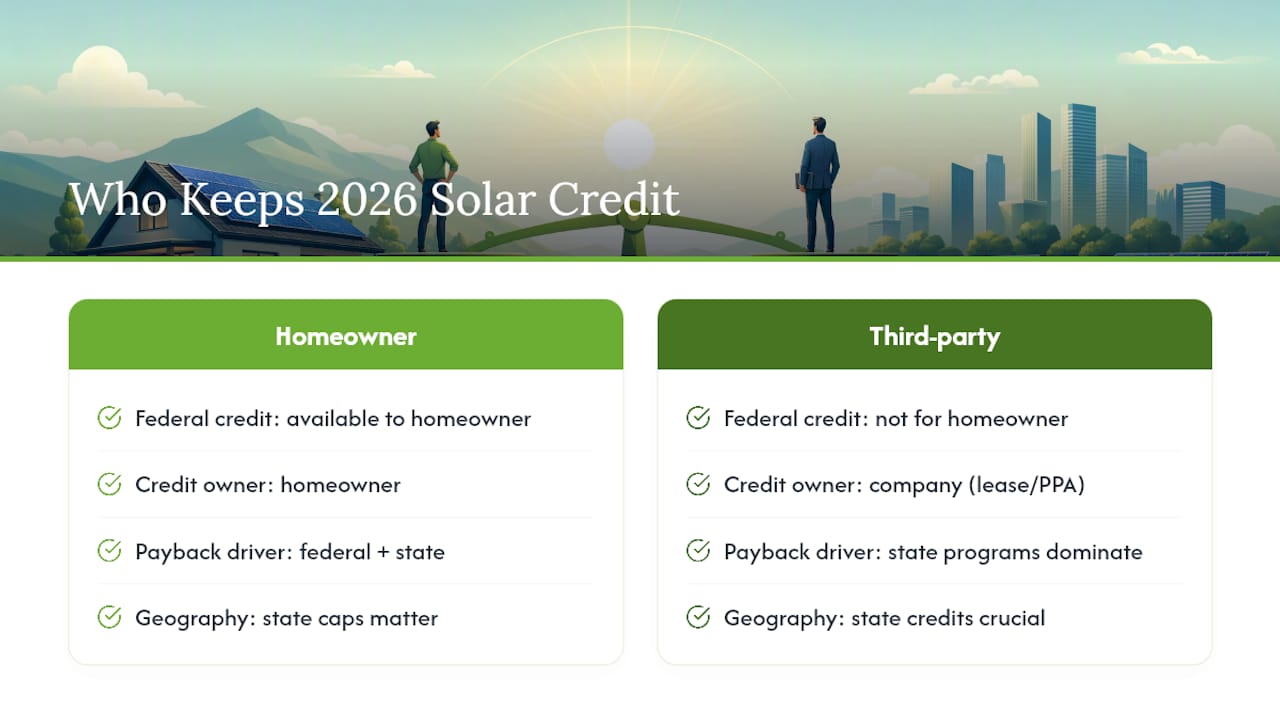
The homeowner solar credit didn’t just shrink this year. It disappeared entirely for one ownership category and stayed fully intact for another, and most of the marketing noise around solar right now glosses over that split on purpose. Lease and PPA offers built around “federal savings” deserve more scrutiny than ever, because the credit those pitches reference belongs to the company, not the family signing the contract.
What gets overlooked is that state programs, not the federal government, are now doing the heavy lifting on payback timelines. A homeowner in Hawaii or New York checking their state’s credit cap will find a meaningfully different financial picture than someone in a state with no residential solar credit at all. Geography now matters as much as system size.
— Gridwise
This article is general information, not a substitute for advice from a qualified financial advisor. Consult a qualified financial professional about your own circumstances before acting on anything here.
Sources
- 26 U.S.C. § 48E (prelim) — Clean Electricity Investment Credit
- H.R.1 — Public Law 119-21 (One Big Beautiful Bill Act)