

How Gutter Systems Shape Greenhouse Production
Greenhouse gutter systems are multifunctional infrastructure: they carry structural loads, serve as the primary platform for hanging and training crops, route water away from the growing zone, and provide the backbone for conveyor and automation integration. Every serious production decision you make about crop density, ventilation, water reuse, and workflow efficiency traces back to how your gutters are designed and maintained.
The core roles gutters play in a well-run greenhouse:
- Structural member: Per NGMA structural guidance, gutters act as horizontal bracing, purlins, and beams that transfer both vertical and lateral loads across the frame.
- Crop-support platform: Gutters anchor hanging baskets, trellis wires, motorized conveyor rails, and substrate troughs directly above the growing zone.
- Drainage and rainwater collection: They channel roof runoff to downspouts and storage, making rainwater harvesting viable when paired with proper filtration.
- Horizontal bracing: In multi-span houses, gutters tie adjacent bays together and distribute wind and snow loads across the whole structure.
- Automation conduit: Trolley rails, electrical conduit, and irrigation supply lines often mount directly to gutter members, keeping the floor clear for workers and equipment.
Key Takeaways
Greenhouse gutter systems are structural, horticultural, and water-management infrastructure simultaneously, and getting the design right from the start determines production capacity, sanitation outcomes, and long-term operating costs.
| Point | Details |
|---|---|
| Design for structural loads | Gutters act as bracing and purlins; specify gauge and profile for wind, snow, and crop loads before ordering. |
| Set drainage slope and cleanouts | Maintain a minimum slope of 1/16 inch per foot and place cleanout access every 100 feet to prevent overflow and clogs. |
| Match gutter type to sanitation policy | Closed gutters suit high-value, sanitation-sensitive crops; open gutters offer easier cleaning and full flow visibility. |
| Plan gutter height for ventilation and crop size | 12 feet is a practical minimum; 16 feet is standard for most production crops and improves air volume and HAF fan effectiveness. |
| Treat recirculated water before reuse | Apply first-flush diversion, staged filtration, and UV or chlorination; expect about 65% usable yield from harvested rainwater. |
| Gridwiseliving greenhouse models | Heavy-duty aluminum frames with compatible mounting points support gutter accessories, hanging hardware, and drainage fittings for backyard and small commercial growers. |
Table of Contents
- What types of greenhouse gutter systems are there?
- Key benefits of well-designed gutter systems for production
- What design fundamentals should you get right from the start?
- How do gutters actually support crops in practice?
- How should you design drainage, recirculation, and rainwater harvesting?
- Cleaning, inspection, and end-of-cycle sanitation
- How to plan a new gutter system or retrofit an existing greenhouse
- When should you choose open versus closed gutters?
- U.S. best practices for structural loads, ventilation, and water reuse
- What growers consistently underestimate about gutter systems
- Gridwise Living greenhouse models built for gutter integration
- Sources
What types of greenhouse gutter systems are there?
The four main configurations each suit different crops, operation sizes, and sanitation priorities.
Open gutters are U- or V-shaped channels with no lid. Water flow is visible at all times, and end-of-cycle cleaning is straightforward. The trade-off is higher algae and debris risk because sunlight reaches the water surface. Suitable crops include tomatoes, cucumbers, and any crop where growers want to monitor drainage visually.
Closed (enclosed) gutters have a capped or covered profile. Limiting sunlight inside the channel suppresses algae growth and reduces contamination risk during production, which is why they are the default choice for high-value, sanitation-sensitive crops. The downside is that cleaning requires flushing or disassembly rather than a simple wipe-down. Closed gutters reduce algae and contamination risk but complicate cleaning, while open gutters provide visibility and easier access.
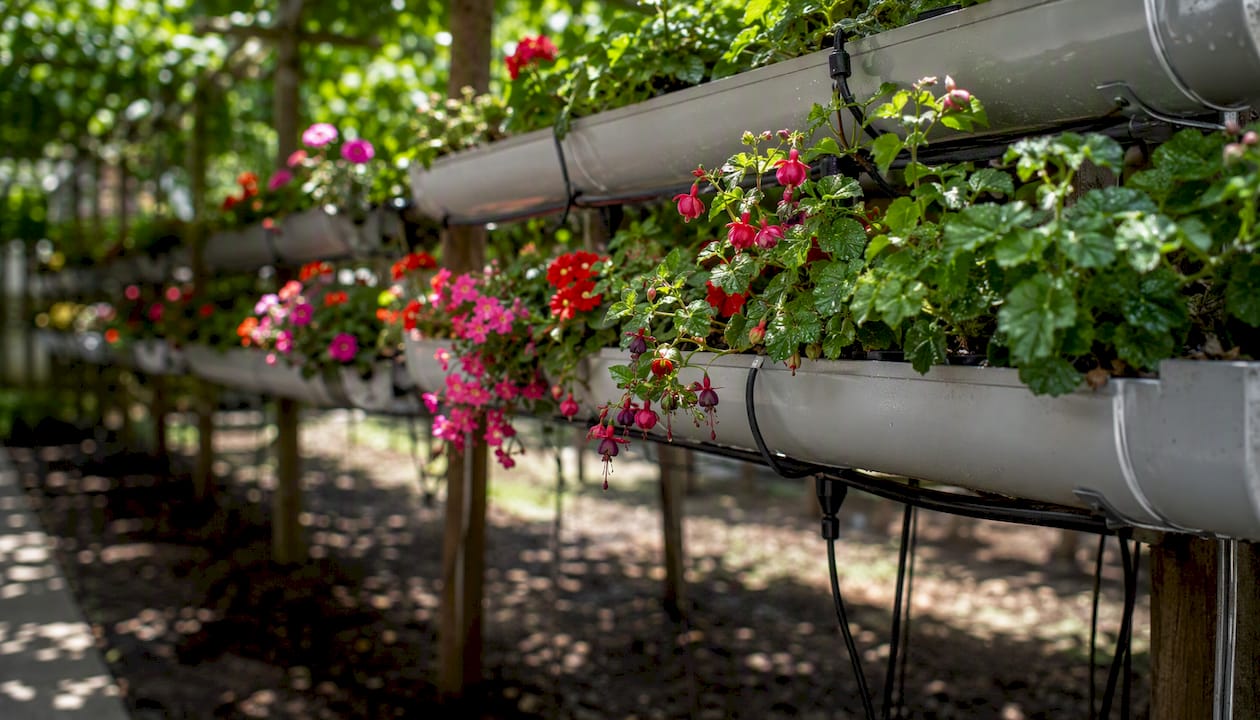
Hanging gutters are suspended from the roof structure rather than resting on posts or columns. They are common in ornamental and cut-flower production where floor space is at a premium. Multi-tier arrangements stack two or three levels of hanging baskets, dramatically increasing production per square foot. Petunias, impatiens, and mixed ornamental baskets are the classic fit.
Gutter-connected (multi-span) greenhouses use the gutter line as the structural junction between adjacent bays. Gutter-connected designs maximize planted area efficiency, simplify expansion, and support unified environmental control, but they demand stronger gutter members and integrated drainage planning. Long-season tomatoes, peppers, and large-scale leafy-green operations are the primary users.
| Feature | Open gutter | Closed gutter | Hanging gutter | Gutter-connected |
|---|---|---|---|---|
| Algae risk | High | Low | Medium | Medium |
| Cleaning access | Easy | Complex | Moderate | Moderate |
| Structural strength | Moderate | Higher | Lower | Highest |
| Visibility of flow | Full | None | Partial | Partial |
| Sanitation suitability | Moderate | High | Moderate | High |
Suitable crops at a glance:
- Open: tomatoes, cucumbers, peppers, herbs
- Closed: strawberries, cannabis, high-value ornamentals
- Hanging: petunias, impatiens, ferns, mixed baskets
- Gutter-connected: large-scale tomatoes, peppers, leafy greens, cut flowers
Key benefits of well-designed gutter systems for production
Good gutter design pays off across nearly every dimension of greenhouse operations. Here is what growers actually gain:
- Increased vertical production density. Hanging gutters and multi-tier basket systems let you stack crops above the floor zone, often doubling usable production space without expanding the footprint.
- Reduced labor per unit. Conveyor rails and trolley systems mounted to gutters move plants through the production cycle without manual carrying, cutting labor hours on large operations.
- Better water reuse. Closed drainage loops that collect and recirculate runoff reduce freshwater consumption and fertilizer waste. Properly designed systems recover a meaningful share of applied irrigation water.
- Improved air circulation. Raising crops on gutter-mounted substrate troughs lifts the canopy off the floor, improving airflow beneath the plants and reducing foliar disease pressure.
- Sanitation control. Gutters keep root zones elevated and separated from floor-level contamination. Closed systems further limit pathogen exposure during production.
- Ergonomic workflows. Gutter height determines working height. A system set at 12 feet minimum lets workers operate at a comfortable standing position, while 16 feet is standard for most production crops and improves air volume and ventilation; plan gutter height according to your crop and ventilation needs.
- Modular expansion. Gutter-connected greenhouse systems allow you to add bays without rebuilding the entire structure, making phased growth financially manageable.
- Automation compatibility. Gutters provide a ready-made mounting surface for irrigation manifolds, grow lights, and environmental sensors, keeping infrastructure organized and accessible.
What design fundamentals should you get right from the start?
Gutter height
Modern greenhouse gutter heights commonly start at about foot-level minimums, with taller heights standard for many production crops. Heights above 20 feet are used for long-season or tall-crop production. Taller houses increase air volume and ventilation effectiveness and create room for insect screens and multi-tier systems, but they add construction cost, heating load, and fan-capacity requirements. For a backyard or small commercial house, 12 feet is a practical minimum; 16 feet is standard for most production crops and improves air volume, ventilation, and room for screens. Reserve heights above 20 feet for long-season or tall-crop production.
Drainage slope
Gutters need a continuous fall toward downspouts to prevent standing water. Industry guidance calls for a minimum slope of approximately 1/16 inch per foot for large-scale drainage piping. Steeper slopes drain faster but require more precise leveling during installation. Downspout placement follows from slope direction: one downspout per bay end is common, with additional drops on long runs.
Materials and corrosion resistance
Galvanized steel is the most common gutter material in commercial greenhouses. Zinc-coated profiles resist corrosion in humid environments, but the coating degrades over time, especially where fertilizer salts accumulate. Aluminum profiles are lighter and inherently corrosion-resistant, making them a strong choice for coastal or high-humidity climates. Thickness matters: heavier gauge profiles carry higher crop loads and resist deflection under snow.
Structural loads
Gutters must be designed for dead and live loads and often function as bracing or purlins. In many U.S. regions, wind design speeds of 80 mph or higher are standard, and snow loads vary significantly by location. The NGMA structural chapter treats gutters as structural members whose section properties and connections must appear in design documents. Never treat a gutter as a passive drainage channel when it is also carrying roof loads and bracing the frame.
Design checklist for growers
- Confirm gutter height against your tallest crop and ventilation targets
- Calculate drainage slope and downspout locations before ordering materials
- Specify material and gauge based on regional climate and crop load
- Request structural calculations for wind and snow loads from your fabricator
- Identify automation attachment points (rails, conduit, irrigation) in the design phase
- Plan cleanout access locations at intervals no greater than 100 feet
Pro Tip: Ask your fabricator for the gutter’s section modulus and moment of inertia before signing off on a design. These numbers tell you whether the profile can carry the combined weight of crops, substrate, and any attached hardware without deflecting.
How do gutters actually support crops in practice?
Gutters do more than hold water. In most commercial production systems, they are the primary structural attachment point for everything above the floor.
Hanging baskets and multi-tier systems. Baskets hook directly onto the gutter flange or onto wire hangers clipped to the gutter. Multi-tier arrangements use a lower gutter for the primary crop and a higher gutter or overhead wire for a second tier of ornamentals or propagation trays. The weight of a fully watered basket can reach several pounds, so gutter gauge and spacing matter.
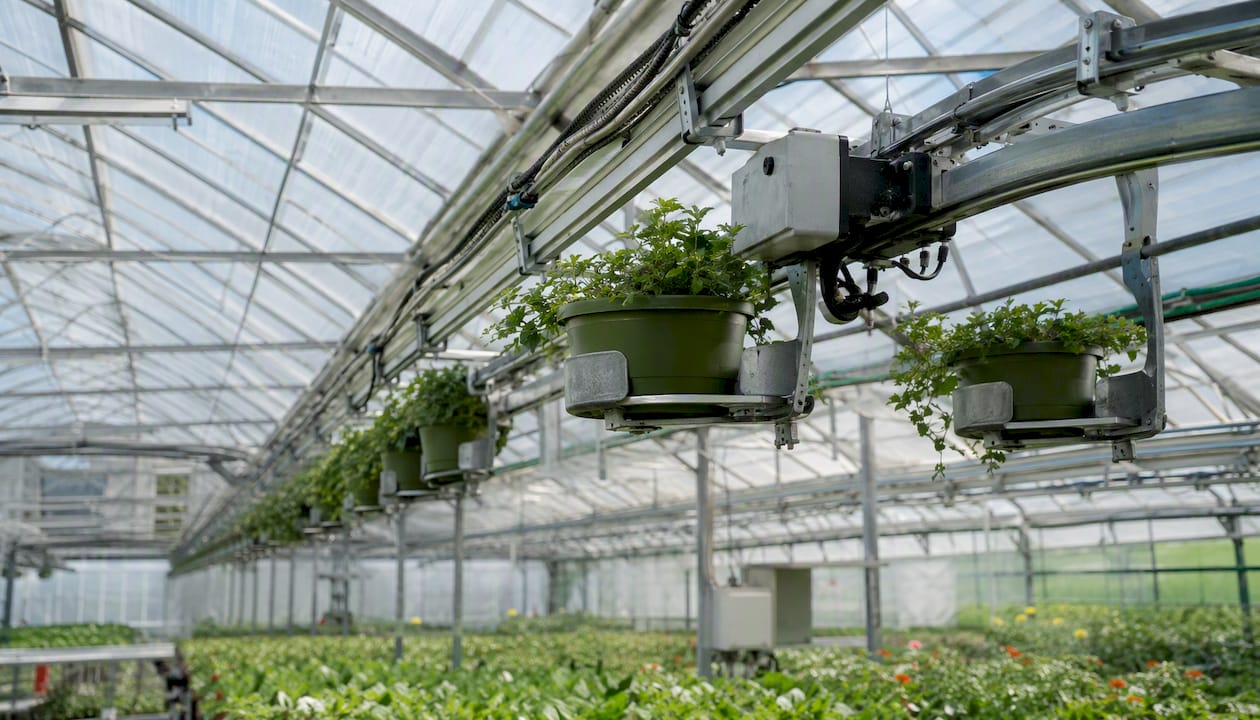
Motorized conveyors and trolley rails. In larger operations, a rail system mounts to the gutter or to a dedicated beam running parallel to it. Plants in pots or slabs ride the rail from propagation through finishing, reducing the number of times a worker physically moves a plant. This is standard in Dutch-style tomato and pepper production and is increasingly common in U.S. cut-flower operations.
Trellis and vertical-training anchors. Overhead trellis wires for indeterminate crops attach to the gutter or to a wire strung between gutter posts. The gutter provides the lateral anchor point that keeps wire tension from racking the structure. For crops like tomatoes and cucumbers, the gutter height directly sets the maximum wire length and therefore the number of leaf nodes a plant can develop before lowering.
Substrates and containers. Rockwool slabs, coir bags, and perlite-filled grow bags sit in or on gutter-mounted channels or troughs. The gutter keeps the substrate level, drains excess irrigation water, and positions the root zone at a consistent working height. Weight per linear foot adds up quickly: a saturated rockwool slab can weigh 8–12 pounds per linear foot, and that load transfers directly to the gutter.
Irrigation and electrical integration. Drip lines, supply manifolds, and grow-light fixtures often clip or strap to the gutter profile. Running services along the gutter keeps them out of the aisle and simplifies maintenance access. Plan conduit routing in the design phase so you are not retrofitting brackets onto a loaded gutter later.
How should you design drainage, recirculation, and rainwater harvesting?
Internal vs. external drainage
Internal drainage routes water through pipes inside the greenhouse structure. It protects piping from freezing in cold climates but complicates access for cleaning and repair. External drainage runs pipes along the outside of the foundation or below grade. It is easier to inspect and service but vulnerable to freezing in USDA hardiness zones 6 and below without insulation.
Downspout sizing and cleanout spacing
Properly sized gutters, downspouts, and strategically placed cleanouts prevent overflow and keep maintenance intervals manageable. For drainage piping, maintain a minimum slope of 1/16 inch per foot and place cleanout access points approximately every 100 feet. Undersized downspouts are the most common cause of gutter overflow during heavy rain events; size them for your region’s peak rainfall intensity, not just average annual precipitation.
Rainwater yield planning
A practical starting point: multiply your greenhouse footprint in square feet by 0.4 to estimate total theoretical gallons of harvestable rainwater. Then expect only about two-thirds usable yield after accounting for wind-driven losses, evaporation, and first-flush diversion. A 5,000-square-foot greenhouse theoretically collects 2,000 gallons per inch of rain, but realistically delivers closer to 1,300 gallons to storage.
Rainwater yield estimate: footprint (sq ft) × 0.4 = theoretical gallons per inch of rain. Apply a 65% usable-yield factor for realistic storage sizing.
Biosecurity and treatment
Rainwater harvesting requires careful system design, including filtration and proper storage, to prevent contaminants, algae, and plant pathogens from compromising crop quality. UMass Extension recommends first-flush diversion to discard the initial runoff that carries the highest contaminant load, followed by staged filtration (sediment filter, then UV or chlorination), and covered storage to prevent re-contamination. For susceptible crops like lettuce or strawberries, add periodic biological testing of stored water. Place monitoring points at the storage tank inlet, after treatment, and at the irrigation manifold.
Cleaning, inspection, and end-of-cycle sanitation
Algae, mineral scale, and organic debris accumulate in gutters regardless of system type. A consistent maintenance cadence prevents the kind of buildup that clogs downspouts and harbors pathogens.
Sample maintenance schedule:
- Weekly during production: Visually inspect open gutters for debris, check downspout flow, and confirm drainage slope has not shifted.
- End of crop cycle: Full cleanout of open gutters with a pressure washer or brush; flush closed gutters with a cleaning solution and follow with a clean-water rinse. Remove and inspect any substrate trays or hanging hardware.
- Annual structural inspection: Check gutter connections, fasteners, and welds for corrosion or fatigue. Verify that gutter slope has not changed due to settlement or load deflection.
Open vs. closed cleaning comparison:
- Open gutters are faster to clean because the channel is fully accessible. A brush, pressure washer, and a sanitizing rinse handle most end-of-cycle work. The downside is that algae can re-establish quickly if sunlight is not blocked between cycles.
- Closed gutters require flushing with a cleaning solution through the enclosed channel, then rinsing. Some designs allow end caps to be removed for physical access. Open gutters provide full visibility and are easier to clean; closed gutters limit sunlight and improve structural strength but make cleaning more complex.
Pro Tip: For algae control in open gutters, apply a physical shade strip along the gutter lip between crop cycles. Combined with an upstream sediment filter on your recirculation line, this cuts algae re-establishment time significantly without relying solely on chemical treatments.
Safety note: gutter cleaning often requires working at height. Use a rated platform or ladder system, never lean a ladder against an unsupported gutter, and follow applicable fall-protection requirements for work above 4 feet on any fixed structure.
How to plan a new gutter system or retrofit an existing greenhouse
Whether you are building new or upgrading an existing structure, the planning sequence matters more than the hardware choices.
- Site assessment. Measure the greenhouse footprint, confirm soil bearing capacity, and map existing drainage routes. Note the direction of prevailing wind and the local snow load zone.
- Load analysis. Calculate dead load (gutter weight, crop weight, substrate, hardware) and live load (snow, maintenance workers). Confirm wind design speed for your county. For gutter-connected or large single-span houses, engage a licensed structural engineer at this step.
- Drainage plan. Determine internal vs. external routing, downspout locations, pipe slope, and cleanout spacing. Size storage if rainwater harvesting is planned.
- Material selection. Choose gutter profile, gauge, and coating based on crop load, climate, and budget. Get section properties from the fabricator and confirm they meet load requirements.
- Contractor specifications. Write a spec sheet that includes gutter height, slope, material, load requirements, and automation attachment points. Get at least two bids from qualified greenhouse fabricators or, for gutter work on adjacent structures, a professional gutter installation contractor.
- Commissioning tests. After installation, run water through the full system to confirm slope, check for leaks at joints, verify downspout flow rates, and test any automation rails under load.
Major cost drivers: gutter material and gauge, height increases (taller posts and more glazing), drainage piping complexity, automation rail attachments, and labor for retrofits. Retrofitting an existing house costs more per linear foot than new construction because existing crops, glazing, and structural members constrain access.
Retrofit tips:
- Stage the installation bay by bay to keep part of the house in production.
- Use modular gutter sections that bolt together rather than welded runs, which simplify replacement and adjustment.
- Install temporary supports under existing glazing before removing old gutter members.
- Minimize crop interruption by scheduling heavy work between crop cycles.
Permits and code interactions: In the U.S., gutter-connected greenhouses that exceed certain square footage thresholds typically require a building permit and may trigger commercial construction code review. Check with your local building department before breaking ground. Structural changes to an existing permitted greenhouse usually require an engineer’s stamp on revised drawings.
When should you choose open versus closed gutters?
The right choice depends on your crop, your sanitation policy, and how much cleaning labor you can realistically commit to.
Quick-match decision guide:
- If your crop is high-value and sanitation-sensitive (strawberries, cannabis, leafy greens) and you can handle complex end-of-cycle cleaning, choose closed gutters.
- If you prioritize visual monitoring of flow and want fast, simple cleaning between cycles, open gutters are the better fit.
- If you are running ornamentals or mixed baskets with moderate sanitation requirements and want to minimize capital cost, open gutters work well.
- If you are building a multi-span gutter-connected house and need maximum structural strength at the junction, closed or reinforced profiles are standard.
| Operation type | Crop examples | Recommended gutter style |
|---|---|---|
| High-value, sanitation-critical | Strawberries, cannabis, lettuce | Closed |
| Commercial vegetable production | Tomatoes, cucumbers, peppers | Open or closed |
| Ornamental / cut flower | Petunias, roses, mixed baskets | Open or hanging |
| Multi-span / gutter-connected | Large-scale vegetables, greens | Closed or reinforced |
| Small commercial / hobby | Herbs, mixed vegetables | Open |
The trade-off between open and closed systems ultimately comes down to whether you are managing algae risk during production or managing cleaning complexity at the end of a cycle. Neither system eliminates both problems simultaneously.
U.S. best practices for structural loads, ventilation, and water reuse
Structural design expectations
Gutters must be designed for dead and live loads and often function as horizontal bracing members. In U.S. practice, this means accounting for wind speeds that commonly reach 80 mph in many regions, plus site-specific snow loads that can range from negligible in coastal southern regions to over 40 pounds per square foot in northern states. The NGMA structural chapter requires that gutter section properties and connections appear explicitly in structural plans. For any gutter-connected or large single-span house, a licensed structural engineer should review the design. A qualified greenhouse fabricator can handle smaller single-span structures, but the moment a gutter is carrying roof loads across multiple bays, engineering review is not optional.
Ventilation and gutter height
Taller gutter heights increase air volume and ventilation effectiveness but raise construction and heating costs. For horizontal airflow (HAF) fan systems, a taller house requires more fan capacity to achieve the same air-change rate. A practical planning number: HAF fans are typically sized to move air at roughly 1 foot per second through the cross-section of the house, according to industry ventilation guidelines. A house with 16-foot gutters has significantly more cross-sectional area than one at 12 feet, so fan count and wattage go up accordingly. Plan ventilation and gutter height together, not sequentially.
Water reuse safety
UMass Extension recommends first-flush diversion, covered storage, staged filtration (sediment removal followed by UV treatment or chlorination), and a regular testing schedule for biological contaminants. For susceptible crops, test stored water at least monthly during active production. Place filters at the storage tank inlet and at the point of use, not just one or the other.
When to call a structural engineer
Engage a licensed structural engineer when: the greenhouse exceeds 5,000 square feet, the design is gutter-connected (multi-span), the site is in a high-wind or heavy-snow zone, or you are modifying an existing permitted structure. A qualified greenhouse fabricator can design and build smaller single-span houses in moderate climates, but structural liability for larger or more complex builds belongs with a licensed professional.
What growers consistently underestimate about gutter systems
Most growers who have been through a greenhouse build or major retrofit say the same thing afterward: they wish they had specified taller gutters and a more complete drainage plan from the start. Adding 4 feet of gutter height after the fact means new posts, new glazing, new fan capacity, and a construction project that shuts down production. Doing it right the first time costs less than fixing it later.
The second thing growers underestimate is the sanitation commitment that comes with a closed gutter system. Closed gutters are genuinely better for high-value crops during production. But if your operation does not have a clear end-of-cycle cleaning protocol and the labor to execute it, a closed system will accumulate contamination faster than an open one, because problems are invisible until they cause crop losses.
The third underestimated factor is water treatment. Rainwater harvesting looks like a straightforward cost-saving measure, and it is, but only if the treatment chain is complete. A first-flush diverter and a sediment filter are not enough for susceptible crops. UV treatment or chlorination, covered storage, and periodic biological testing are the difference between a safe recirculation system and a pathogen reservoir.
Structural load planning is where the most expensive mistakes happen. A gutter that deflects under crop load shifts drainage slope, creates standing water, and can eventually compromise the roof structure. Specifying the right gauge and profile up front, with engineering review for larger houses, is the single highest-return investment in the design phase.
Gridwise Living greenhouse models built for gutter integration
Gridwise Living greenhouses are built with the structural integrity and modular design that gutter-based production systems demand. The 10x32ft Heavy-Duty Aluminum Polycarbonate Greenhouse features a heavy-duty aluminum frame with compatible mounting points for gutter accessories, hanging hardware, and drainage fittings, making it a practical starting point for growers who want to add crop-support gutters or a recirculation system without a full custom build.

The full Gridwise Living greenhouse collection includes models sized from compact backyard units to extra-large walk-in structures, all selected for durability and ease of accessory integration. If you are planning a gutter retrofit or a new build with drainage and crop-support infrastructure in mind, browse the collection to find a model that fits your footprint and production goals. For growers who want to grow food year round, pairing a well-specified greenhouse with a properly designed gutter system is the most direct path to consistent, high-density production.
Sources
- Rainwater harvesting (UMass Center for Agriculture, Food & the Environment)
- Greenhouse structural design and loads (University of Arkansas hosted greenhouse unit)
- Choosing the right gutter system for a greenhouse (HortiDaily)
- Choose the right greenhouse gutter height (Greenhouse Magazine)
- Chapter 3 - Structural design (NGMA PDF)
- What is a gutter-connected greenhouse? (INSONGREEN)
- Open vs Closed Greenhouse Gutter Systems Compared | SEF®
- What Role Do Gutter Systems Play In Greenhouse Design, And How Can They Be Optimized? – Greenhouse Design Ideas