

Minimalist Hot Tub: Clean Design for Small Yards
A minimalist hot tub is a compact, visually restrained spa built around clean lines, natural materials, and hidden mechanical systems. For most homeowners, the fastest path to one is either a prefab thermowood-clad or low-profile shell tub with integrated, concealed systems, or a planned-use stock-tank setup with a wood-fired or propane heater if off-grid simplicity is the priority.
Quick-start options at a glance:
- Prefab compact tub (thermowood or neutral shell): plug-in or hardwired, always-ready, higher upfront cost, lowest daily effort
- Wood-fired or stainless steel tub: off-grid friendly, 60–120 minute warm-up, planned-use only
- Stock-tank DIY: lowest cost, very simple form, needs insulation and a propane or tankless heater
- Low-profile inflatable or compact plunge tub: cheapest entry, least durable, visually minimal only at close range
Table of Contents
- What types of minimalist hot tubs are available?
- How do you achieve a true minimalist look?
- What heating options work best for a minimalist setup?
- What does installation actually involve?
- How do you keep maintenance simple?
- Who actually benefits from a minimalist hot tub?
- How do you choose the right minimalist option?
- Key Takeaways
- The case for keeping it simple
- How Gridwiseliving products support your minimalist tub setup
What types of minimalist hot tubs are available?
Prefab compact tubs with thermowood cladding or clean acrylic shells are the closest thing to push-button simplicity. Integrated pumps, insulation, and optional heat pump support mean you can use them year-round with minimal fuss. The trade-off is cost: quality prefab units start well above $5,000, and designer options run significantly higher.
Wood-fired and stainless steel tubs are the off-grid favorite. They heat in roughly 60–120 minutes using dry firewood and need no electrical hookup. Best for couples or small families who plan their soaks in advance and want the lowest possible tech footprint.
Stock-tank DIY setups use a galvanized or poly stock tank paired with an external propane or tankless heater. Each of these budget-friendly DIY hot tubs can be built for under $3,000, a fraction of what a comparable prefab costs. The catch: insulation is non-negotiable for efficiency, and these are strictly planned-use systems.
Low-profile inflatables and compact plunge tubs cost the least and set up in minutes. They work for occasional cold plunges or warm soaks, but the plastic aesthetic undercuts the minimalist goal at any distance. Best treated as a temporary or trial option.
How do you achieve a true minimalist look?
Modern minimalist spa design comes down to three rules: restrained palette, clean geometric lines, and no visible equipment. Every decision should push toward calm and uncluttered.
Material choices that hold up:
- Thermowood or stained cedar for exterior cladding (weathers gracefully, resists rot)
- Stainless steel interiors for longevity and easy cleaning
- Large-format concrete pavers or simple gravel surrounds to anchor the tub visually
Design checklist:
- Single neutral color for the tub shell and surround (charcoal, natural wood, or white)
- No ornamental plastic trim or visible jet hardware from the exterior
- Recessed LED lighting at ground level rather than above-water spotlights
- Hidden towel storage built into the surround or deck, not a freestanding rack
- Landscape integration using low plantings or gravel borders to frame the tub without competing with it
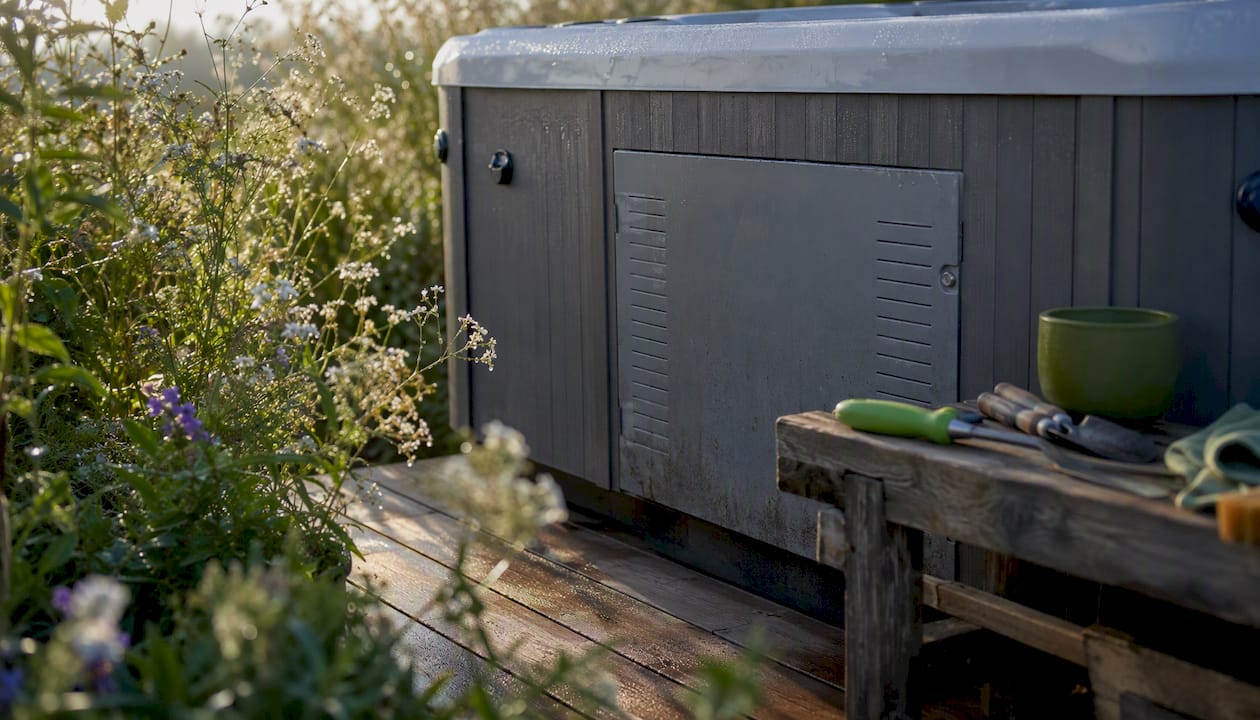
Concealing the mechanical systems is where most DIY builds fall short. Hiding pumps, filters, and heaters in integrated cabinetry or recessed under-deck compartments is what separates a truly minimal spa from a tub with a wood skirt slapped on it.
Pro Tip: Route all plumbing and electrical through a single access panel on the least-visible side of the tub. One clean door beats four exposed pipe runs every time.
What heating options work best for a minimalist setup?
Insulation and water volume are the single biggest efficiency levers, regardless of heat source. A smaller, well-insulated tub heats faster and costs less to run than a large tub with a powerful heater.
| Heat Source | Typical Heat-Up Time | Best For | Key Trade-Off |
|---|---|---|---|
| Electric heat pump | 4–8 hours (initial fill) | Always-ready use | Higher install complexity, needs 240V |
| Propane/tankless | 1–3 hours | Planned-use, portable setups | Fuel cost, tank management |
| Wood-fired | 60–120 minutes | Off-grid, low-tech | Requires dry firewood, active tending |
| Solar-assisted | Varies (supplement only) | Sustainability-first setups | Needs thermal store or battery backup |
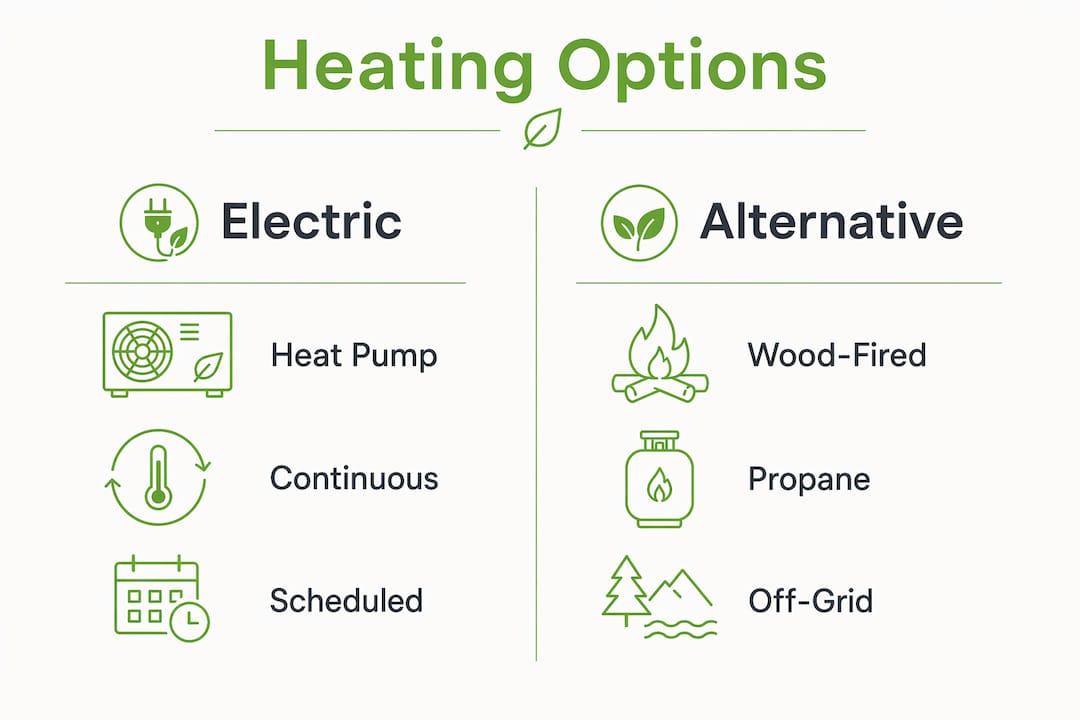
Electric heat pumps keep water at temperature continuously, which suits families who want to soak without scheduling. Propane and wood-fired options suit the planned-use mindset: you decide to soak, you start the heat, you go in an hour or two later. Solar works best as a supplement, pre-warming water or charging a battery system that powers a small pump or controller.
Pro Tip: Pair a thick insulated thermal cover with a low water volume and nighttime off-peak charging if you’re running an electric system. That combination cuts operating costs more than upgrading the heater itself.
What does installation actually involve?
Most minimalist tubs need a level, load-bearing pad and either a 120V or 240V circuit, or safe clearance for propane or wood-fired equipment. Sort this out before you buy, not after.
Installation checklist:
- Measure the footprint and confirm the pad or deck can handle the combined weight of the tub, water, and occupants (water alone adds roughly 8.3 lbs per gallon).
- Check local electrical capacity: most electric tubs need a dedicated 240V/50A GFCI-protected circuit installed by a licensed electrician.
- For wood-fired setups, confirm clearances for the stove and flue per local fire codes.
- Verify local permitting requirements for fixed plumbing or electrical connections before breaking ground.
- Plan the service access panel location before finalizing the enclosure design.
Typical timeline:
- Site prep and pad pour: 1–3 days
- Electrical or gas hookup (contractor): 1 day
- Enclosure, decking, and concealment work: 1–7 days depending on scope
For hardscaping the surround, large-format pavers set in a simple grid keep the visual weight low and drain well. Avoid raised timber decking unless the structural load has been professionally assessed.
How do you keep maintenance simple?
Match your filtration approach to how often you actually use the tub. A planned-use system drained and refilled periodically needs a different routine than an always-ready tub running continuously.
Core maintenance schedule:
- Weekly: Test sanitizer levels with test strips (chlorine target: 3–5 ppm; bromine: 4–6 ppm) and adjust as needed
- Weekly: Rinse the cartridge filter with a garden hose
- After each use: Replace the insulated thermal cover to cut evaporation and debris
- Monthly: Shock the water to break down organic buildup
- Every 3–4 months: Deep-clean or replace the filter cartridge
For a lower-chemical approach, a small UV or ozone add-on reduces the sanitizer load noticeably. Neither replaces shocking entirely, but both extend the time between chemical adjustments. For freezing climates, winterizing means either draining completely and blowing out the lines, or keeping the heater running continuously with a reliable cover. A half-measure in a Minnesota winter will crack your plumbing.
Who actually benefits from a minimalist hot tub?
Minimalist tubs favor visual calm and a lower physical footprint, but they often trade convenience for simplicity. That’s the honest trade-off.
Pros:
- Integrates cleanly into small yards, patios, and tiny-home properties
- Simpler mechanical systems mean fewer parts to fail and easier DIY repairs
- Lower embodied material use compared with large multi-person spas
- Compatible with off-grid and solar-assisted energy setups
Cons:
- Planned-use systems require 1–2 hours of lead time
- Limited capacity for large gatherings (most seat 2–4 people)
- DIY water care takes more active management than a fully automated system
| Household Type | Best Option | Why |
|---|---|---|
| Couples | Wood-fired or compact prefab | Right-sized, easy to heat, low visual impact |
| Small families (3–4) | Compact prefab with heat pump | Always-ready, seats everyone, manageable cost |
| Off-grid households | Stock-tank DIY or wood-fired | No grid dependency, low-cost build |
| Tiny-home owners | Low-profile prefab or plunge tub | Minimal footprint, pairs with solar or generator |
How do you choose the right minimalist option?
Answer-first checklist: prioritize (1) insulation and water volume, (2) heat source compatibility with your site, (3) genuinely concealed systems, (4) warranty and confirmed service access.
Before you buy, tick these off:
- Confirm your electrical panel can support a dedicated 240V circuit, or that you have a safe propane or wood-fire setup.
- Verify the pad or deck structural rating for the filled weight.
- Ask the seller for the insulation specification (R-value or equivalent) for the shell and cover.
- Confirm parts and service availability in your region, not just at point of sale.
- Check that equipment access panels are included in the design, not an afterthought.
Red flags to watch for:
- No equipment concealment in the design
- Vague or missing insulation specs
- Sellers who can’t name a local service provider
- “Always-ready” claims for a low-volume DIY system with no insulation plan
Questions to ask any seller or installer:
- What is the rated heat-up time from cold fill at 40°F ambient?
- Where is the service access, and how long does a filter change take?
- What is the warranty on the shell, the heater, and the pump separately?
Key Takeaways
A minimalist hot tub rewards planning: insulation and water volume determine running cost more than any other single factor.
| Point | Details |
|---|---|
| Insulation first | Shell insulation and a thermal cover cut operating costs more than upgrading the heater. |
| Planned-use reality | Wood-fired and stock-tank setups need 60–120 minutes of lead time; they are not always-ready systems. |
| Conceal the equipment | Hidden pumps, filters, and heaters are what make a tub genuinely minimalist, not just a wood skirt. |
| Choose by use pattern | Always-ready families need a prefab with a heat pump; off-grid households are better served by wood-fired or propane. |
| Gridwiseliving’s approach | Gridwiseliving’s solar kits and tiny-home systems pair directly with minimalist tub setups for lower operating costs. |
The case for keeping it simple
The conventional wisdom says buy the biggest, most feature-rich spa you can afford. Gridwise Living’s view is the opposite: the best minimalist hot tub is the one you actually use, and complexity is the enemy of that.
Most homeowners who go the high-tech route end up with a tub that sits covered for weeks because the chemistry is off, a jet needs servicing, or the control panel threw an error. A wood-fired tub or a well-insulated stock-tank setup with a propane heater has almost nothing to break. You light a fire or open a valve, you wait, you soak. That simplicity is the point.
The same logic that makes smaller homes cost less to heat applies directly to hot tubs: lower volume, better insulation, and a heat source matched to your actual use pattern will outperform a larger, more complex system every time. Pair that with a solar kit or a backup generator and you have a spa setup that works whether the grid does or not.
How Gridwiseliving products support your minimalist tub setup
Running a minimalist hot tub off-grid or at lower cost is straightforward when you have the right power and energy infrastructure behind it. Gridwiseliving’s solar energy systems can pre-warm water, power a small circulation pump, or charge a battery bank for planned-use heating windows, cutting your reliance on grid power without adding visual clutter to the setup. For homeowners pairing a tub with a tiny-home property, Gridwiseliving’s tiny-home solutions include siting and utility integration guidance that translates directly to compact spa placement.
A portable power station handles pump and controller loads during a heating cycle. A whole-home solar generator covers backup heat and pumps if your primary source fails. Neither requires a permanent electrical upgrade to get started. Browse Gridwiseliving’s off-grid power and tiny-home pages to find the configuration that fits your site and budget.
Sources
- Outdoor Hot Tub Ideas for Every Backyard | Jacuzzi®
- Nordic Quattro | TheNordicSauna
- How to Turn a Stock Tank Into a Hot Tub — MAKER GRAY
- Cube 1–2 Person Stainless Steel Hot Tub | CoreRecovery
- 3 Budget Friendly DIY Hot Tub Ideas | Build a Hot Tub
- How to Build a Wood-Fired Hot Tub | Family Handyman