

Companion Planting Vegetables: What Actually Works
Companion planting vegetables works best when you focus on biodiversity and a handful of research-backed pairings, like tomato with basil or the classic corn, beans, and squash trio. It’s not a substitute for good spacing, watering, and crop rotation, but layered on top of those basics, it measurably improves pollination and pest resilience. Use the chart below and pick two to four pairings to test in your own beds this season.
TL;DR:
- Research-backed pairings like tomato with basil and the Three Sisters system significantly enhance pollination and pest resistance with minimal effort.
- Spacing and timing are critical; root depth, nutrient needs, and harvest schedules must be carefully managed to prevent competition and maximize benefits.
- Successful companion planting depends on biodiversity, trap cropping, and insectary habitat, supported by trial data for certain pairings.
- Regional climate and pest pressure influence which combinations work best, requiring local experimentation and rotation to sustain soil health.
- Overcrowding and ignoring known antagonists are common mistakes that undermine the benefits of companion planting strategies.
Table of Contents
- Companion Planting Chart: Vegetable-By-Vegetable Pairings
- Why Does Companion Planting Work?
- Which Companion Pairings Are Backed By Research?
- How Do You Space and Time Companion Plants Correctly?
- Two Layouts and a 4-Step Plan to Try This Season
- How Does Companion Planting Affect Harvest Timing and Crop Rotation?
- What Are the Most Common Companion Planting Mistakes?
- Do Companion Planting Strategies Change By Season and Climate?
- Can Companion Planting Actually Reduce Pests and Disease?
- How Does Companion Planting Improve Soil Beyond Nitrogen?
- Gridwise Perspective: Where Companion Planting Fits Into a Resilient Food System
- Tools That Make Companion Planting Easier to Implement
- Sources
Companion Planting Chart: Vegetable-By-Vegetable Pairings
You don’t need to memorize a hundred folk pairings. You need to know which ones hold up and which ones are worth trying anyway. Here’s a working companion planting chart for the crops most home gardeners actually grow.
- Tomato: Pair with basil (research-backed, primes plant defenses), borage (attracts pollinators), and carrots (shares root depth well). Avoid corn and potatoes, which share pests and diseases.
- Pepper: Pair with basil and onions (pest confusion) and spinach (living mulch). Avoid fennel, which can suppress nearby growth.
- Cucumber: Pair with nasturtium (research-backed trap crop) and dill (attracts predatory wasps). Avoid potatoes, which compete for the same soil resources.
- Carrot: Pair with onion (research-backed, reduces carrot fly damage) and leeks. Avoid dill, which can cross-attract pests and inhibit growth.
- Lettuce: Pair with radish (quick shade companion) and chives (pest-deterrent traditional pairing). Avoid heavy feeders that will outcompete it for water.
- Brassicas (broccoli, cabbage): Pair with dill and nasturtium (trap crop for aphids) and onions. Avoid strawberries and tomatoes, which share soil pathogens.
- Potato: Pair with beans (nitrogen fixer) and corn. Avoid tomatoes and cucumbers, which share blight risk.
- Corn: Pair with beans (nitrogen fixer, research-backed via Three Sisters) and squash (living mulch). Avoid tomatoes, which compete for the same nutrients.
- Beans: Pair with corn and cucumbers. Avoid onions and garlic, which can stunt legume nodulation.
- Squash: Pair with corn, beans, and nasturtium (trap crop). Avoid potatoes, which compete heavily for space and nutrients.
A Penn State Extension review points out that biodiversity, not any single “magic pair,” is the most reliable driver of a healthier garden. The pairings above with “research-backed” tags have trial data behind them; the rest are traditional practice worth testing on a small scale before you commit a whole bed to them.
Why Does Companion Planting Work?
Five distinct mechanisms explain most of what gardeners see when good companion planting vegetables strategies pay off. Knowing which one you’re leaning on helps you pick partners for a reason, not a rumor.
- Nitrogen fixation: Legumes like beans and peas host Rhizobium bacteria that pull nitrogen from the air and deposit it in the soil, feeding nearby heavy feeders like corn.
- Volatile priming: Basil releases compounds, including linalool and chavicol, that prime a tomato’s own defense signaling, making it more resistant to caterpillar damage.
- Trap cropping: Nasturtium draws squash bugs and cucumber beetles away from your cucurbits, sacrificing itself so your main crop stays cleaner.
- Insectary habitat: Flowering herbs and umbellifers like dill give predatory wasps and hoverflies somewhere to live between pest outbreaks.
- Physical microclimate: Squash leaves shade soil and suppress weeds; tall corn gives beans a living trellis.
Diverse plantings support predator and parasitoid insect populations far better than a single trap crop planted in isolation, according to UMN Extension. That’s the mechanism behind the old advice to “plant a mess of flowers” among your vegetables. It isn’t decoration. It’s pest management infrastructure.
The Three Sisters system stacks three of these mechanisms at once: beans fix nitrogen for corn, corn provides a trellis for beans, and squash shades the ground as a living mulch, a combination Penn State Extension still recommends as one of the most functional traditional pairings available.
Which Companion Pairings Are Backed By Research?
Not every pairing you’ll read about has data behind it, and pretending otherwise sets gardeners up for disappointment. Some hold up well under scrutiny. Others are worth a try, but you should know you’re experimenting.
- Strong evidence: Tomato + basil (defense priming), carrot + onion (reduced carrot fly damage), and the Three Sisters trio.
- Moderate evidence: Nasturtium as a trap crop for cucurbit pests, and multi-species plantings that support beneficial insect populations.
- Mixed or traditional: Marigold against Colorado potato beetle. UC ANR’s Master Gardener Program notes marigolds can help against nematodes and some cabbage pests in trials, but results against potato beetles are inconsistent.
When a claim falls in that third bucket, test it small. A peer-reviewed review of intercropping recommends running a split-plot trial, half your bed with the pairing, half without, and tracking pest counts and yield across multiple harvests before you decide it’s worth repeating.
How Do You Space and Time Companion Plants Correctly?
Getting the mechanism right doesn’t help if the plants themselves are crowded or competing for the same root zone. Spacing and timing are where most companion planting plans quietly fail.
- Pair by root depth first. Combine shallow-rooted lettuce or radish with deep-rooted tomatoes or carrots so they aren’t drawing from the same soil layer.
- Give heavy feeders room. Space corn, squash, and brassicas a sufficient distance from other heavy feeders to avoid nutrient competition.
- Harvest fast crops early. Pull radishes or lettuce before slower companions like tomatoes need the space and light they were using.
- Place trap crops at the bed perimeter. Nasturtium works best planted a few feet outside your cucurbit rows, not tucked in the middle.
- Keep antagonists apart. UC ANR recommends separating alliums and legumes by a sufficient separation, and keeping fennel a safe distance from most vegetables since it can suppress neighboring growth.
Pro Tip: Rotate nightshades (tomato, pepper, potato) to a different bed section each year. Planting them in the same spot repeatedly builds up soil-borne blight pathogens that no companion plant can offset.
Two Layouts and a 4-Step Plan to Try This Season
You don’t need a farm to run a real companion planting trial. A single raised bed or a stack of containers is enough to test what actually works in your climate and soil.
Raised bed layout (4x8 feet): Corn along the north edge for height, beans climbing the corn, squash filling the ground beneath, and a nasturtium border along the south edge to intercept cucumber beetles before they reach anything else.
Container layout: One large container for a tomato staked with basil planted at its base, and a second, smaller container of lettuce and radish nearby to catch overflow shade in the heat of summer. This setup works well for anyone testing pairings on a porch or patio before committing bed space, an approach covered in more depth in Gridwiseliving’s guide to container gardening for small spaces.
- Choose a small selection of main crops for the season.
- Pick one companion per main crop from the research-backed tier above.
- Plant by root depth and height, tall crops on the north side so they don’t shade shorter ones.
- Monitor pest counts and yield weekly, and keep notes so you know which pairing to repeat next year.
How Does Companion Planting Affect Harvest Timing and Crop Rotation?
Companion planting changes not just what grows next to what, but when you pull it and where you plant it next. A well-timed harvest keeps companion pairings from tipping into competition, and a thoughtful rotation plan keeps those same pairings from wearing out your soil.
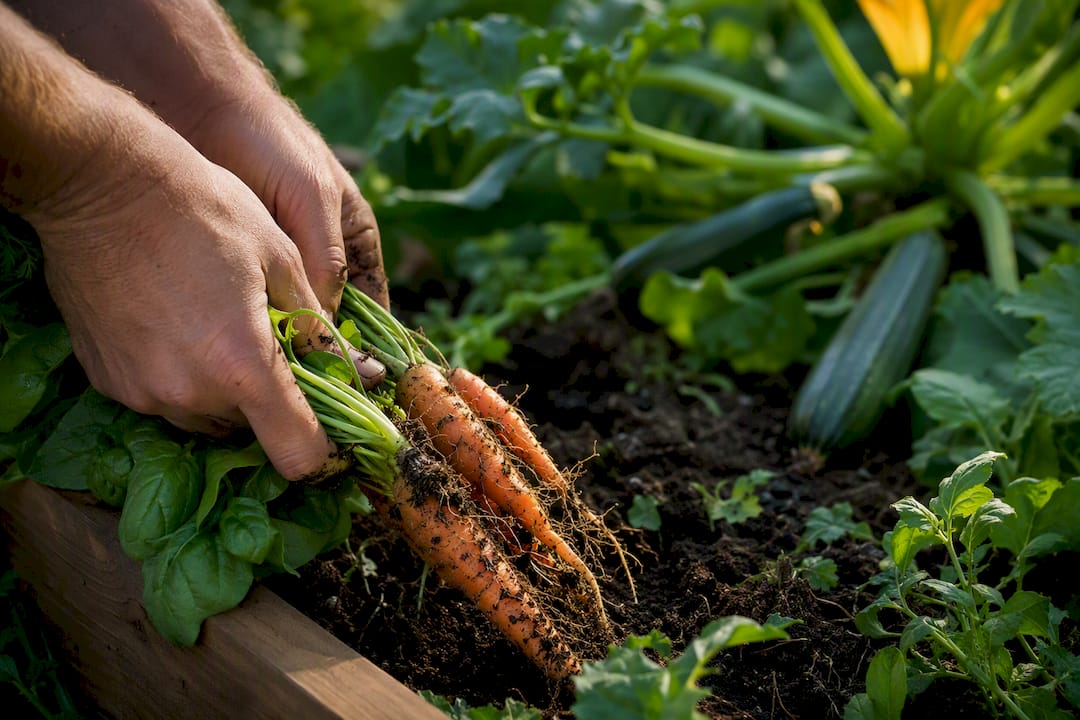
Fast crops like radish and lettuce are meant to come out early, freeing space and light for slower companions like tomatoes or peppers. UMN Extension flags this kind of active management, harvesting nurse crops before they compete, as one of the more overlooked parts of making companion pairings actually pay off.
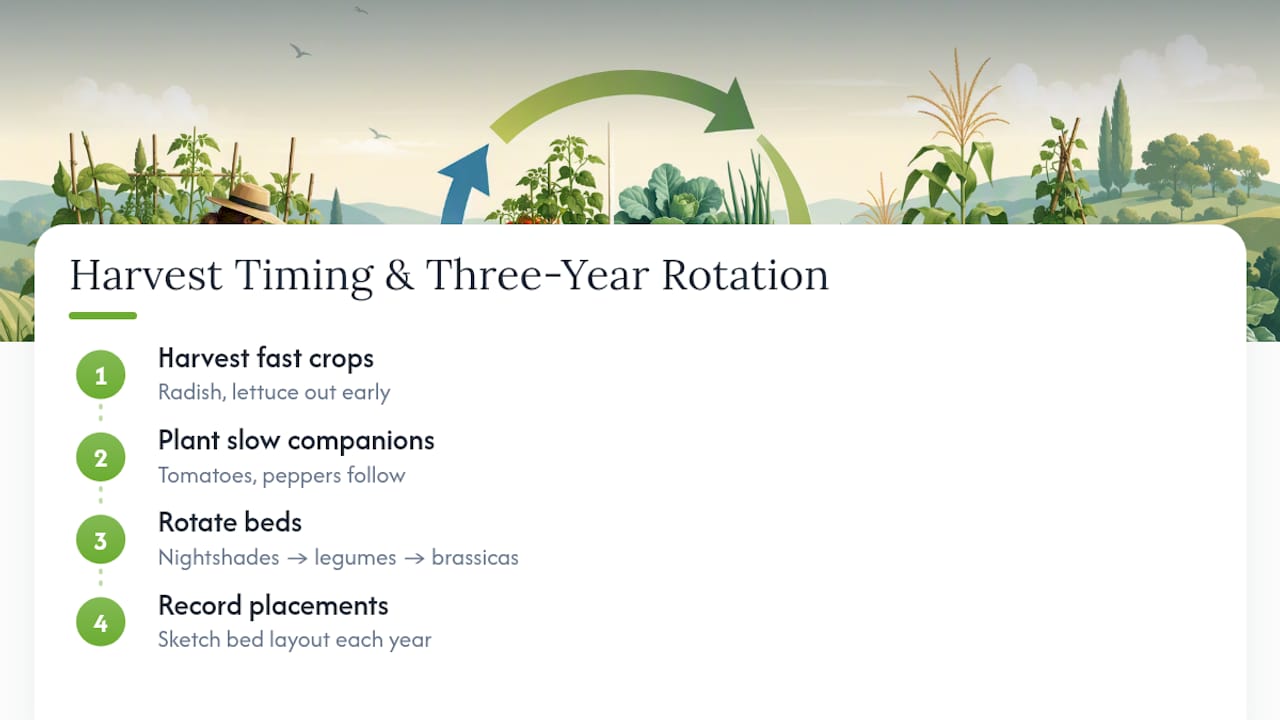
Rotation matters just as much as pairing. If you grew beans near corn this year to fix nitrogen, move both to a different bed section next season rather than repeating the exact layout. Legumes deplete less nitrogen than heavy feeders, but repeating the same nightshade or brassica family in the same spot year after year builds up soil-borne disease pressure no companion plant can counteract. A simple three-year rotation, nightshades, then legumes, then brassicas, then back to nightshades, keeps pest and pathogen cycles from establishing permanent residence in your soil.
The takeaway: treat your companion planting plan and your rotation plan as one system, not two separate decisions. Write down what grew where each year, even a rough sketch works, so you’re not relying on memory when spring planting starts again.
What Are the Most Common Companion Planting Mistakes?
The biggest mistake gardeners make with companion planting vegetables isn’t picking the wrong pairing. It’s treating companion planting as a replacement for garden fundamentals instead of an addition to them.
Overcrowding is the most frequent failure. Gardeners read that basil and tomatoes are good companions and cram them close enough that both compete for water and airflow, which actually increases disease risk. Give companions the same spacing rules you’d use for any two vegetables, and let the pairing work through root chemistry and pest deterrence, not proximity alone.
Ignoring known antagonists is the second common error. Planting alliums right next to beans, or fennel anywhere near your main vegetable bed, can quietly suppress growth through allelopathic effects. UC ANR’s chart notes that negative interactions like these are often easier to prove in trials than positive ones, so treat the antagonist list as more reliable than most of the folklore pairings.
The third mistake is expecting a pairing to solve a pest problem it was never suited for. Marigolds get planted everywhere as a blanket pest deterrent, but the evidence only supports specific uses against specific pests. If your trap crop or companion isn’t reducing damage after a season, drop it and try a different mechanism, insectary flowers instead of a trap crop, for instance, rather than assuming you did something wrong.
Do Companion Planting Strategies Change By Season and Climate?
Companion planting isn’t a fixed formula. What works in a short, cool growing season looks different from what works in a long, hot one, and your regional pest pressure shapes which pairings are worth prioritizing.
In cooler, shorter seasons, fast-maturing companions like radish and lettuce matter more because they need to complete their cycle and clear space before your main crops need the room. In longer, hotter climates, shade-providing pairings like corn and squash become more valuable since they protect soil moisture and reduce heat stress on shallow-rooted companions.
Regional pest pressure also shifts what’s worth planting. Gardeners dealing with heavy cucumber beetle pressure get more value from nasturtium as a trap crop than someone in a region where that pest is rare. If you’re extending your season with a greenhouse or high tunnel, pest dynamics change again, some open-garden pests disappear indoors, while others, like aphids, can build up faster in an enclosed space without the outdoor predator population to check them, a challenge covered in Gridwiseliving’s guide to greenhouse pest control.
The practical move is to treat your first year of companion planting as a local experiment. Note which pairings reduced pest damage or boosted yield in your specific soil, climate, and pest pressure, then repeat what worked and drop what didn’t, rather than importing someone else’s regional success wholesale.
Can Companion Planting Actually Reduce Pests and Disease?
Companion planting reduces pest and disease pressure through two distinct strategies: pulling pests away from your main crop, and building a habitat that keeps predator insects around before an outbreak starts.
Trap cropping is the most direct approach. Nasturtium planted near cucurbits draws squash bugs and cucumber beetles onto itself, sacrificing some of its own growth so your cucumbers and squash stay cleaner. This only works if you’re willing to let the trap crop take damage, pulling it out at the first sign of pest activity defeats the purpose.
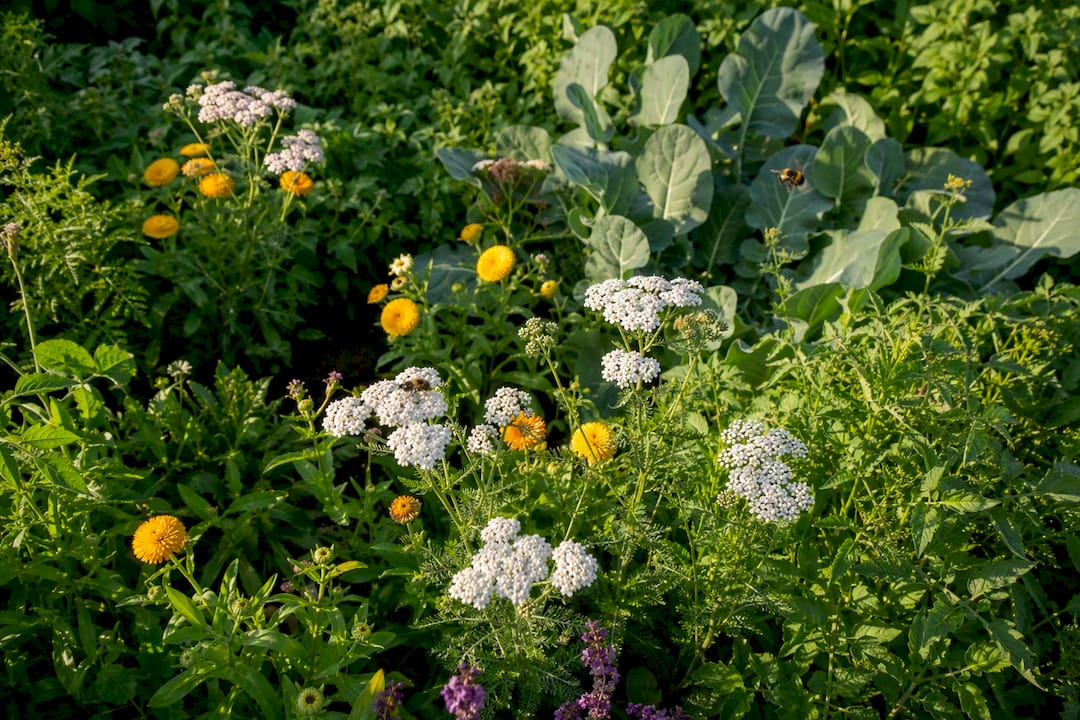
Insectary planting is the slower, more durable strategy. Dill, alyssum, and other flowering plants give predatory wasps and hoverflies a place to live between pest waves, so when aphids or caterpillars show up, natural predators are already established rather than arriving too late. Disease management works on a similar logic: pairing crops from different plant families disrupts the ability of soil-borne pathogens to spread easily from one susceptible plant to the next, which is part of why rotating nightshades and keeping brassicas separated from repeat plantings of themselves matters as much as any single companion pairing.
How Does Companion Planting Improve Soil Beyond Nitrogen?
Nitrogen fixation gets most of the attention, but companion planting affects soil health in ways that go well beyond what legumes contribute. Root diversity itself does a lot of the quiet work.
Different vegetables root at different depths and pull different nutrients, so mixing shallow and deep-rooted companions keeps any single nutrient from being depleted in one soil layer while another sits untouched. Living mulches, like squash spreading beneath corn, protect topsoil from erosion and moisture loss while feeding organic matter back into the ground as they break down.
Root diversity also supports a more active microbial community. Different plant roots release different exudates, the sugars and compounds that feed soil bacteria and fungi, and a mix of root types tends to support a broader microbial population than a monoculture bed. Mother Earth News notes that legume nodulation with Rhizobium bacteria is one of the best-documented examples of this plant-microbe relationship, but it’s one piece of a larger system, not the whole story.
Cover crops like buckwheat, sown between rows or during a bed’s off season, add another layer: they build organic matter and support pollinators while they’re growing, but they need to be terminated before your main crop goes in, or before they compete too heavily for water and light. Living mulches are a tool, not a permanent fixture.
Gridwise Perspective: Where Companion Planting Fits Into a Resilient Food System
We build our seed offerings and greenhouse systems around the idea that food independence comes from stacking small, proven advantages, not chasing one perfect trick. Pair this guide with the right infrastructure, and season after season gets easier to predict.
— Gridwise
Tools That Make Companion Planting Easier to Implement
Companion planting vegetables works with nothing more than a shovel and a seed packet, but the right infrastructure makes the trial-and-error part faster and a lot less frustrating. If you’re testing pairings like basil and tomato, or pea shoots as a quick nitrogen-fixing companion, starting with quality seed stock removes one variable from the equation before you’ve even planted.

Gridwiseliving carries basil microgreens seeds and pea shoot seeds suited to exactly the pairings covered above, along with organic amendments like feather meal fertilizer for feeding heavy companions like corn and squash without synthetic inputs. For gardeners who want to extend the trial beyond a single outdoor season, a greenhouse protects trap crops and insectary plants through shoulder seasons when outdoor pest pressure would otherwise wipe them out early. None of this is required to run the layouts described above, but if you’re ready to stop guessing at your local growing window, browse Gridwiseliving’s greenhouse collection and pick a size that fits your current bed.
Sources
- Companion planting: an age-old gardening method making a modern comeback | Penn State Extension
- Companion planting chart | UC ANR Master Gardener Program
- Companion planting in home gardens | UMN Extension
- Peer-reviewed overview of intercropping and ecological intensification (PMC article)
- The research-backed companion planting chart — 12 crops (Growli)