

Outdoor Greenhouse Materials: Pick the Right Frame and Glazing
For most backyard growers, the best all-around build is an aluminum frame paired with 4–6 mm twin-wall polycarbonate: it handles mixed U.S. climates, resists corrosion, and costs less over a decade than glass or film. If your budget is tight and the structure is temporary, a PVC hoop frame with UV-stabilized polyethylene film will get the job done for a season or two. For fruiting crops that need maximum light, step up to aluminum or steel with single-pane tempered glass or high-clarity acrylic.
Before you buy a single panel, check three things:
- Climate: Snow load and wind speed determine minimum frame strength; UV intensity drives glazing replacement intervals.
- Budget: Upfront cost and replacement cadence are not the same number. Film is cheap to buy and expensive to maintain.
- Crops: Leafy greens tolerate diffused light well. Tomatoes, peppers, and fruiting vines want the highest transmission you can afford.
One caution worth stating upfront: polyethylene film deteriorates on contact with unprimed PVC, so never pair those two without priming the frame first.
Key Takeaways
Aluminum frames paired with twin-wall polycarbonate glazing offer the best balance of durability, insulation, and cost for most U.S. backyard greenhouses across mixed climates.
| Point | Details |
|---|---|
| Default frame + glazing | Aluminum frame with 6 mm twin-wall polycarbonate suits most U.S. climates and lasts 15–20 years with minimal maintenance. |
| Insulation vs. light trade-off | A 4 mm double-wall panel transmits roughly 83% of light; a 25 mm five-wall drops notably lower — choose wall count by climate, not just insulation spec. |
| Film compatibility warning | Polyethylene film deteriorates on contact with unprimed PVC; always prime the frame or use foam tape at contact points. |
| Lifecycle cost matters | Polyethylene film costs less upfront but requires replacement every 1–4 years; polycarbonate’s longer service life makes it cheaper over a decade. |
| Gridwiseliving greenhouse option | The 10x32 ft aluminum polycarbonate greenhouse from Gridwiseliving delivers the recommended default configuration as a ready-to-build kit with roof vents. |
Table of Contents
- What are the main types of outdoor greenhouse materials for frames?
- When does a wood frame make sense for your greenhouse?
- Why aluminum is the practical default for backyard greenhouses
- Galvanized steel frames: when the extra strength is worth it
- PVC and temporary frames: what they can and cannot do
- How do light transmission, diffusion, and insulation actually affect your plants?
- Glass greenhouses: when the clarity is worth the cost
- Why polycarbonate is the backyard greenhouse standard
- Acrylic and ETFE: when you need more than polycarbonate offers
- Polyethylene film: the economics and the reality
- How to match frames and glazing without making costly mistakes
- How long do greenhouse materials actually last?
- What does greenhouse construction actually cost by material?
- Why treating frame and glazing as one system changes everything
- Which greenhouse materials are the most sustainable?
- Where to source greenhouse materials in the U.S.
- How your material choices affect ventilation and condensation
- What most U.S. backyard growers should actually build
- Gridwise Living greenhouses: built for the way you actually grow
- Sources
What are the main types of outdoor greenhouse materials for frames?
The Oklahoma State University Extension groups greenhouse frames into three primary categories: wood, aluminum, and galvanized steel, with PVC as a fourth option for small or temporary structures. Each trades off differently on durability, cost, and how well it holds glazing.
| Frame Material | Durability / Weather Resistance | Insulation Effect | DIY Friendliness | Typical Kit Availability |
|---|---|---|---|---|
| Cedar / Wood | Good if maintained; rots without treatment | Adds slight thermal mass; low conductivity | High — standard tools | Moderate |
| Aluminum | Excellent; corrosion-resistant | Low — conducts heat; thermal bridging risk | High — gasketed extrusions | Very high |
| Galvanized Steel | Very high; suited for large spans | Low — significant thermal bridging | Moderate — heavier, welded or bolted | Moderate |
| PVC | Low; UV degrades untreated pipe | Negligible | Very high | High for hoop kits |
Pro Tip: Before buying any kit, look up your county’s ground snow load (available from ASCE 7 maps) and your average peak wind speed. A frame rated for 20 lbs per square foot of snow is not the same as one rated for 40 lbs — and that difference matters in the Upper Midwest or mountain West.
When does a wood frame make sense for your greenhouse?
Wood is the oldest greenhouse framing material for a reason: it is easy to cut, fasten, and modify with standard carpentry tools, and it contributes a small amount of natural insulation that metal frames cannot match. Cedar and redwood are the traditional choices because their natural oils resist decay. Pressure-treated lumber works for sill plates and ground contact, but avoid any lumber treated with pentachlorophenol (PENTA) or creosote near plant beds — both compounds are toxic to plants and can off-gas in an enclosed space.
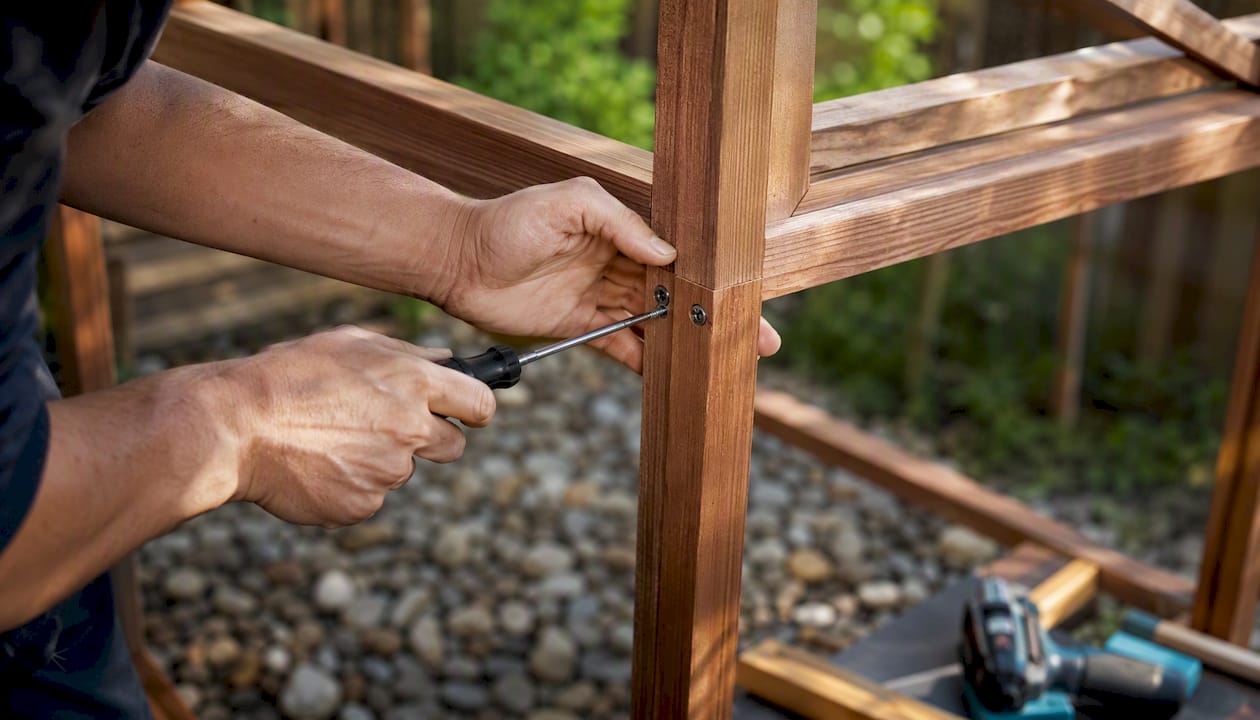
Realistic lifespan for a well-maintained cedar frame runs 15–20 years in a dry climate. In the humid Southeast or Pacific Northwest, expect closer to 10–12 years without consistent maintenance.
A practical maintenance schedule looks like this:
- Annually: Inspect all joints, sill plates, and any member in contact with soil or glazing for soft spots or discoloration.
- Every 2–3 years: Re-apply a water-repellent sealant or exterior-grade paint to all exposed surfaces.
- As needed: Replace any member showing more than surface-level rot before it compromises the frame’s structural integrity.
Flashings at the glazing-to-frame junction are where most wood greenhouse failures begin. Water wicks under the glazing, sits against the wood, and starts the rot cycle. Use aluminum or galvanized flashing tape at every horizontal glazing joint, and caulk with a paintable exterior silicone.
Pro Tip: In high-humidity climates, raise the sill plate off the ground on a concrete or masonry foundation rather than setting it directly on soil. That single detail extends wood frame life by years.
Why aluminum is the practical default for backyard greenhouses
Aluminum is corrosion-resistant and maintains its shape well under normal residential loads. University extension guidance describes it as the most economical long-life framing material, and most ready-to-assemble greenhouse kits reflect that: aluminum extrusions dominate the kit market because they arrive pre-drilled, accept gasketed glazing panels without custom fitting, and can be cut with a standard miter saw and a carbide blade.
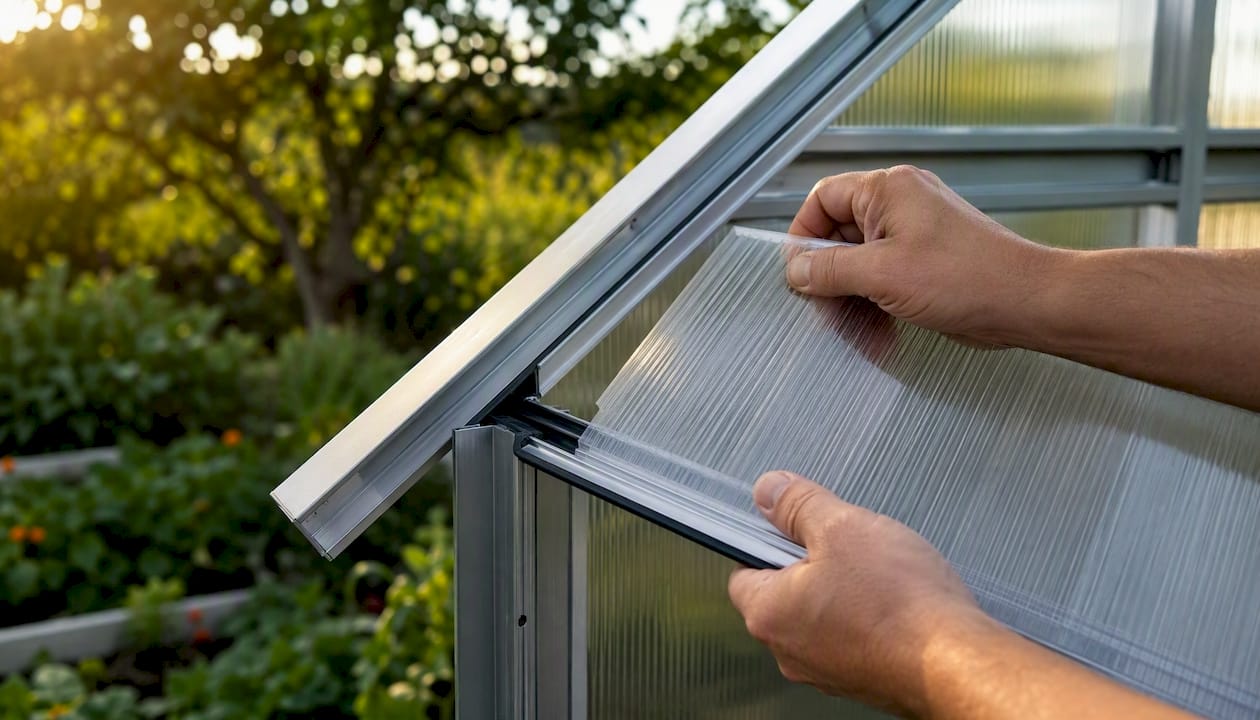
The trade-off is thermal conductivity. Aluminum transfers heat roughly 1,000 times faster than wood, which means every aluminum rafter touching the outside air acts as a small radiator pulling warmth out of your greenhouse in winter. In practice, this thermal bridging effect can meaningfully raise your heating costs in cold climates. The fix is either a thermally broken aluminum profile (a profile with a plastic insert that interrupts the metal-to-metal heat path) or a supplemental thermal curtain that drops across the glazing at night.
For glazing compatibility, aluminum extrusions with factory-cut gasket channels are the cleanest solution. They accept both polycarbonate panels and glass, seal reliably without caulk, and allow panels to be swapped if one cracks. Spans beyond about 12 feet typically need a heavier-gauge extrusion or an intermediate purlin to prevent deflection under snow or wind load.
Galvanized steel frames: when the extra strength is worth it
Steel is the right call when you are building large, when you expect heavy snow loads, or when you want a structure that will outlast everything else on your property. Galvanized steel resists corrosion through a zinc coating that sacrifices itself before the base metal corrodes. Powder-coating over galvanization adds another layer of protection and extends the maintenance interval significantly.
Key structural advantages:
- Handles spans of 20 feet or more without intermediate posts.
- Supports the weight of glass glazing without deflection.
- Resists wind uplift better than lighter aluminum profiles at the same gauge.
The downsides are real. Steel is heavy, which complicates DIY assembly and usually requires more than one person. Cutting steel requires an angle grinder or a metal-cutting blade, and any cut edge needs to be touched up with cold galvanizing compound or rust-inhibiting primer immediately, or corrosion starts at that point within a season.
Thermal bridging from steel is even more pronounced than from aluminum. Metal posts running from the cold outside to the warm inside create cold spots that can trigger condensation on interior surfaces near the frame. In practice, this means plants placed directly against steel posts in winter may experience localized cold stress. Keep a few inches of clearance between plant canopies and steel members in cold-weather operation.
Pro Tip: If you are choosing between aluminum and steel for a backyard greenhouse under 300 square feet, aluminum almost always wins on the total-cost-and-effort calculation. Steel earns its place at larger scales or in regions with extreme snow loads.
PVC and temporary frames: what they can and cannot do
PVC pipe frames are genuinely useful for one specific job: low-cost, temporary, or seasonal hoop houses and cold-frame covers where structural loads are minimal. A simple hoop house built from schedule 40 PVC and covered with polyethylene film can extend your growing season by four to six weeks at either end of the year for a fraction of the cost of a permanent structure.
The limitations are significant. PVC has low structural strength compared to metal, and UV exposure degrades untreated pipe over time, making it brittle. Most PVC hoop frames need support hoops spaced no more than 4–6 feet apart to prevent film sag and potential collapse under even modest snow accumulation.
The most important compatibility warning: polyethylene film deteriorates when it contacts unprimed PVC. The plasticizers in the film react with the PVC surface, accelerating degradation at every contact point. If you are using poly film on a PVC frame, prime the PVC first with a PVC primer, or wrap contact points with foam tape.
PVC is not a good choice for permanent structures, for climates with heavy snow, or for any glazing heavier than lightweight poly film. For anything you plan to use year-round, move up to aluminum or wood.
How do light transmission, diffusion, and insulation actually affect your plants?
Glazing choice comes down to four measurable properties, and understanding them prevents expensive mistakes.
Visible light transmission (VLT) is the percentage of incoming sunlight that passes through the panel. Higher is generally better for fruiting crops.
Light diffusion is different from transmission. A diffusing panel scatters light so it reaches lower leaves and the interior of dense canopies rather than hitting only the top layer. Diffused light reduces hot spots and can actually improve yield in dense plantings, even when total transmission is slightly lower.
Insulation (R-value / U-value) measures resistance to heat flow. A higher R-value means less heat escapes in winter. Single-pane glass has an R-value around 1. Twin-wall polycarbonate typically reaches R-2 to R-2.5. Five-wall polycarbonate panels push higher, though the trade-off is real: a 25 mm five-wall panel transmits notably less light due to its higher insulation versus 83% for a 4 mm double-wall. In a low-sun northern climate, that 23-point drop in transmission can matter for winter crops.
Physical durability covers UV resistance, impact resistance, and how the panel ages. Key factors:
- UV-stabilized panels resist yellowing and brittleness from sun exposure.
- Impact ratings matter in hail-prone regions (polycarbonate far outperforms glass here).
- Cleaning requirements vary: glass tolerates abrasive cleaning; polycarbonate scratches easily and needs soft cloths.
One point that often gets missed: the frame’s thermal bridging reduces the real-world insulation performance of even the best glazing panel. A high-R polycarbonate panel installed in an aluminum frame with no thermal break performs worse in practice than its panel R-value suggests.
Glass greenhouses: when the clarity is worth the cost
Glass delivers the highest visible-light transmission of any common glazing material, and it does not yellow or degrade over decades the way plastics do. A glass greenhouse maintained well can last 30–50 years. That longevity is the core argument for it.
The costs are real, though. Glass is heavy, which means your frame needs to be robust enough to carry it. Aluminum or galvanized steel frames are the standard pairing; wood can work for smaller panes but requires careful engineering at the glazing joints. OSU Extension notes that glass increases structural requirements and upfront cost significantly, and that is before you factor in the cost of breakage replacement.
For glazing variants, tempered glass is the right choice for most residential greenhouses. It is four to five times stronger than standard annealed glass, and when it does break, it shatters into small, relatively safe pieces rather than large shards. Wired glass adds a safety net against complete panel collapse but reduces light transmission slightly. Hammered or frosted glass introduces diffusion, which can benefit dense plantings.
Double-pane glass makes sense when you are heating the greenhouse through a cold winter and your heating costs are a real concern. The insulation improvement over single-pane is substantial. The weight increase is also substantial, and the cost per square foot roughly doubles. For a three-season greenhouse in a mild climate, single-pane tempered glass is usually the better value.
Why polycarbonate is the backyard greenhouse standard
Polycarbonate has become the default glazing for backyard greenhouses because it threads the needle between cost, impact resistance, and insulation in a way no other material does. It is lighter than glass, far more impact-resistant, and available in wall configurations that let you tune the insulation-to-light-transmission trade-off for your climate.
The wall-count options break down practically:
- Single-wall (4 mm): Closest to glass in light transmission, minimal insulation. Best for mild climates or three-season use.
- Twin-wall (4–10 mm): The most common backyard choice. A 4 mm double-wall panel transmits roughly 83% of light and provides meaningful insulation improvement over single-pane glass.
- Multiwall (16–25 mm): Higher insulation, lower light transmission. Best for cold climates where heating costs dominate.
Installation details matter more with polycarbonate than most buyers expect. The channels in multiwall panels must be oriented vertically so condensation can drain out rather than pool inside the panel and grow algae. Seal the top edge of each panel with solid tape and the bottom edge with vented tape to allow drainage while blocking insects. Leave expansion gaps at panel edges (typically 1/8 inch per foot of panel length) because polycarbonate expands and contracts significantly with temperature changes.
Most quality polycarbonate panels carry a 10-year warranty against yellowing and UV degradation. Actual service life with proper installation runs 15–20 years.
Pro Tip: In USDA hardiness zones 6 and colder, go with at least 6 mm twin-wall polycarbonate rather than 4 mm. The insulation difference is meaningful when you are trying to keep a greenhouse above freezing on a January night in the Midwest.
Acrylic and ETFE: when you need more than polycarbonate offers
Acrylic (sold under brand names like Plexiglas and Lucite) offers higher optical clarity than polycarbonate and does not yellow as quickly under UV exposure without coatings. Light transmission for clear acrylic runs close to glass. For a hobby greenhouse where aesthetics matter and you want the visual clarity of glass at lower weight and cost, acrylic is a legitimate option.
The trade-offs are worth knowing. Acrylic is more brittle than polycarbonate and cracks under impact rather than denting. It also has flammability concerns around open-flame or high-heat heaters, which matters if you use a propane heater inside the structure. OSU Extension notes that acrylic’s cost can be prohibitive for many backyard projects, and that UV coatings, while extending life, add to that cost.
ETFE (ethylene tetrafluoroethylene) is a different category entirely. It is an ultra-light fluoropolymer film used in high-performance architectural applications. ETFE transmits light exceptionally well, is chemically inert, and can be formed into curved or irregular shapes that rigid panels cannot achieve. The catch is that ETFE requires a specialized tensioned support system and is not a DIY material. For a standard backyard greenhouse, the cost and installation complexity are hard to justify. It earns its place in custom or architecturally ambitious projects where shape or extreme performance requirements make the premium worthwhile.
Polyethylene film: the economics and the reality
Polyethylene film is the least expensive greenhouse covering by a wide margin, and for hoop houses, seasonal tunnels, and budget-first builds, it is the right tool. The economics are straightforward: low upfront cost, easy DIY installation, and a planned replacement cycle.
The practical picture:
- Lifespan: Standard poly film lasts 1–3 years depending on UV exposure and mechanical stress. The Spruce notes that polyethylene film needs more frequent replacement than other coverings due to wind, hail, and UV degradation.
- UV stabilization: Better-quality films include UV inhibitors that extend service life. A 4-year, 6-mil UV-stabilized film with anti-drip additives provides high light transmission and diffusion suitable for greenhouse use, which is competitive with entry-level polycarbonate.
- Anti-drip treatment: Standard poly film causes condensation to bead and drip onto plants. Anti-drip films cause condensation to sheet down the interior surface instead, reducing disease pressure from overhead moisture.
- Wind and hail vulnerability: Film tears under mechanical stress in ways rigid panels do not. In hail-prone regions or areas with frequent high winds, budget for annual inspection and patch repairs.
When to choose film: temporary structures, hoop houses, season-extension tunnels, or any situation where the structure itself may change or move within a few years. For a permanent backyard greenhouse you plan to use year-round, the replacement cadence and labor cost of film make rigid panels the better long-term value.
How to match frames and glazing without making costly mistakes
Frame and glazing are a coupled system, not independent choices. The wrong pairing creates leaks, accelerated material failure, or structural problems that are expensive to fix after the fact.
Compatibility checklist before you finalize your material selection:
- Weight capacity: Confirm your frame’s rated load per square foot exceeds the weight of your chosen glazing plus expected snow accumulation. Glass is roughly 3–4 lbs per square foot for single-pane; polycarbonate is under 1 lb per square foot.
- Gasket and groove systems: Aluminum extrusions with factory gasket channels are designed for specific panel thicknesses. A 4 mm polycarbonate panel does not seat correctly in a channel designed for 6 mm glass. Verify compatibility before ordering.
- Chemical interaction: Never use polyethylene film on unprimed PVC without addressing the contact points. The film degrades at every point it touches bare PVC.
- Thermal expansion: Polycarbonate and acrylic expand and contract more than glass or metal. Leave the manufacturer-specified expansion gap at every panel edge and use flexible sealants, not rigid caulk, at frame-to-panel joints.
- Ventilation openings: Plan roof vents or ridge vents into the frame design before glazing. Adding ventilation after the fact almost always requires cutting through glazing panels, which weakens them.
Common installation mistakes and how to avoid them:
- Skipping the bottom-edge vent tape on polycarbonate: Insects and moisture enter the channels and degrade the panel from the inside. Use vented tape at the bottom, solid tape at the top.
- Over-tightening fasteners on polycarbonate: Polycarbonate needs room to move. Over-tightened screws crack the panel at the fastener hole within one or two thermal cycles.
- Ignoring anchor points: A greenhouse that is not anchored to a foundation or ground anchors can shift or overturn in high winds. Anchor requirements depend on local wind codes, not just common sense.
How long do greenhouse materials actually last?
Lifespan varies more by installation quality and climate than by material alone, but the ranges below reflect typical real-world performance under residential use.
| Material | Typical Lifespan | Primary Failure Mode | Key Maintenance Task |
|---|---|---|---|
| Cedar / wood frame | 15–20 years (dry); 10–12 years (humid) | Rot at joints and sill plates | Re-seal every 2–3 years; inspect joints annually |
| Aluminum frame | 30+ years | Gasket degradation; fastener corrosion | Replace gaskets every 10–15 years |
| Galvanized steel frame | 20–30 years | Rust at cut edges and fastener points | Touch up cut edges; inspect coating annually |
| Single-pane glass | 25–50 years | Breakage; seal failure at frame | Clean annually; re-glaze cracked panes promptly |
| Twin-wall polycarbonate | 15–20 years | UV yellowing; channel algae | Clean channels; inspect UV coating every 5 years |
| Acrylic | 10–20 years | Brittleness; UV yellowing without coating | Avoid abrasive cleaners; inspect for micro-cracks |
| Polyethylene film | 1–4 years | Wind tears; UV degradation | Inspect after every major storm; patch or replace |
A simple annual maintenance routine covers most of these failure modes: inspect all frame joints and glazing seals in early spring before the growing season, and again in late fall before winter loads arrive. Clean glazing panels with a soft cloth and mild soap to remove algae and mineral deposits that reduce light transmission over time.
Pro Tip: The best time to catch a failing seal or a cracked panel is before it becomes a leak. A 30-minute walk-around inspection in March, before you start heating the space, saves far more time and money than an emergency repair in July.
What does greenhouse construction actually cost by material?
Cost ranges below are ballpark figures for materials only, not including labor or foundation work, and reflect typical U.S. retail pricing for residential-scale projects.
Frame costs (per linear foot of framing material, approximate):
- Cedar lumber: lower cost per linear foot, widely available at lumber yards; total frame cost for a small greenhouse depends heavily on design complexity.
- Aluminum extrusions (kit-based): mid-range cost; most kits bundle frame and glazing together, making per-component pricing less relevant than kit price per square foot.
- Galvanized steel: higher cost than aluminum per linear foot; justified at larger scales where structural requirements demand it.
- PVC pipe: lowest cost per linear foot; appropriate only for temporary or hoop structures.
Glazing costs (approximate ranges per square foot):
- Polyethylene film: the lowest upfront cost of any covering option, though replacement every 1–4 years adds to lifetime cost.
- Twin-wall polycarbonate: mid-range upfront cost; 15–20 year service life makes it cost-competitive over time.
- Single-pane tempered glass: higher upfront cost than polycarbonate; 25–50 year lifespan offsets the premium for permanent structures.
- Double-pane glass: roughly double the cost of single-pane; best justified in cold climates where heating savings are significant.
- Acrylic: comparable to or higher than single-pane glass; shorter service life without UV coatings reduces the value proposition.
The lifecycle math usually favors polycarbonate for most backyard builds. Polycarbonate-panel greenhouses cost more upfront than film but last significantly longer, and the avoided replacement labor and material costs close the gap within the first replacement cycle of film.
For a small backyard greenhouse in the 100–200 square foot range, budget the full project cost across a 20-year horizon rather than comparing only the day-one price. Film looks cheap until you account for three or four replacement cycles.
Why treating frame and glazing as one system changes everything
The most common mistake in greenhouse planning is selecting a glazing panel based on its R-value and treating the frame as a separate decision. Research-backed design guidance is clear on this point:
The practical implication: when you calculate your heating needs, use the whole-envelope R-value, not just the panel spec. Metal frames that run continuously from outside to inside act as thermal bridges that bypass the glazing’s insulation entirely. A single-pane glazing with a well-sealed wood frame and a thermal curtain can match the real-world performance of a twin-wall polycarbonate panel in an unbroken aluminum frame.
Actionable checklist for envelope-level thinking:
- Choose thermally broken aluminum profiles or wood frames when heating costs are a primary concern.
- Seal every frame-to-glazing joint with a flexible, UV-stable sealant rather than rigid caulk.
- Prioritize diffusion over raw transmission for dense plantings; prioritize transmission for fruiting crops in low-sun climates.
- Add a thermal curtain for cold-climate operation regardless of glazing choice.
Which greenhouse materials are the most sustainable?
Sustainability in greenhouse construction involves three overlapping questions: what energy goes into making the material, how long it lasts before replacement, and what happens to it at end of life.
Aluminum has a high embodied energy cost at production, but its 30-plus-year service life and near-universal recyclability make it one of the better long-term choices.
Wood from certified sustainable sources (FSC-certified lumber, for example) has the lowest embodied energy of any structural framing material. The trade-off is that treated lumber, particularly pressure-treated wood with copper-based preservatives, complicates end-of-life disposal and should not be composted or burned.
Polycarbonate is a petroleum-derived plastic, and its production carries a meaningful carbon cost. That said, a 15–20 year service life before replacement compares favorably to polyethylene film, which may need replacing every 1–4 years. More frequent replacement cycles mean more plastic waste over the life of the greenhouse. Some polycarbonate manufacturers now offer panels with recycled content, though availability varies.
Polyethylene film has the highest replacement frequency of any covering, which translates to the most plastic waste per decade of greenhouse operation. UV-stabilized films with 4-year warranties reduce that waste stream compared to standard 1–2 year film, but the material is not widely recycled through residential programs.
Glass has a long service life and is technically recyclable, but greenhouse glass (often tempered or wired) is not accepted by most curbside recycling programs and typically goes to landfill at end of life. Its longevity is its main environmental argument.
For the most sustainable long-term build, the combination of FSC-certified wood or recycled-content aluminum framing with twin-wall polycarbonate glazing balances embodied energy, service life, and end-of-life recyclability better than most alternatives.
Where to source greenhouse materials in the U.S.
Material availability varies more by region than most buyers expect, and sourcing locally can meaningfully reduce shipping costs for heavy materials like glass and steel.
Aluminum greenhouse kits are widely available nationally through online retailers and ship to most U.S. addresses. Lead times for larger kits can run 2–6 weeks, so plan accordingly if you have a planting-season deadline.
Polycarbonate panels are stocked at many home improvement centers (typically in 4x8 foot sheets) and through specialty greenhouse suppliers. Larger panels or specific thicknesses beyond 6 mm often require ordering from a specialty supplier or directly from a distributor. Midwest and Southeast growers generally have better regional distributor access than rural Mountain West locations.
Cedar and redwood lumber for wood frames is readily available in the Pacific Northwest and parts of the Southeast, but can be expensive or difficult to source in the Great Plains and Mountain West. Locally available species like Douglas fir or southern yellow pine can substitute with proper treatment and sealing.
Polyethylene film in greenhouse-grade widths (10 feet and wider) is typically a specialty-order item at hardware stores but is stocked by agricultural supply retailers and online greenhouse suppliers. Shipping costs for large rolls can add meaningfully to the per-square-foot price.
Galvanized steel for custom frames is available through metal suppliers and steel service centers in most metro areas. Pre-fabricated galvanized steel greenhouse kits are less common than aluminum kits but are available through specialty agricultural and commercial greenhouse suppliers.
For types of home greenhouses that match your regional climate and sourcing realities, matching the structure type to locally available materials often saves more money than optimizing purely on paper.
How your material choices affect ventilation and condensation
Ventilation and condensation are not afterthoughts. They are direct consequences of your material choices, and getting them wrong causes plant disease, structural damage, and wasted heating energy.
Glazing and condensation: All greenhouse glazings produce interior condensation when warm, humid air contacts a cold surface. The difference is where and how that condensation forms. Glass and single-wall polycarbonate produce condensation on the interior surface, where it can drip onto plants. Anti-drip coatings on polyethylene film and some polycarbonate panels cause condensation to sheet down the surface rather than drip. Multiwall polycarbonate can trap condensation inside the panel channels if the bottom edge is not properly vented, leading to algae growth that permanently reduces light transmission.
Frame material and cold spots: Metal frames, particularly steel and unbroken aluminum, create cold spots on interior surfaces near the frame members. In humid conditions, these cold spots become condensation nuclei, and in cold climates they can develop frost on the interior frame surface. Wood frames run warmer on interior surfaces and produce fewer condensation problems near the frame.
Ventilation design and material interaction: OSU Extension and The Spruce both emphasize that adequate ventilation is as important as material selection for managing heat and humidity. The glazing material affects how much ventilation you need: a low-insulation single-pane glass greenhouse heats up faster on a sunny day and requires more aggressive venting than a well-insulated multiwall polycarbonate structure.
For a detailed look at siting and ventilation planning that works with your chosen materials, orientation and prevailing wind direction matter as much as the vent size itself.
What most U.S. backyard growers should actually build
The conventional wisdom in greenhouse planning tends to push people toward either the cheapest possible option (poly film on PVC) or the most aspirational one (glass on steel). Neither is the right default for most American homeowners.
For the broad middle of U.S. climates, from USDA zones 5 through 9, an aluminum frame with 6 mm twin-wall polycarbonate is the configuration that holds up over time without demanding professional installation or a contractor’s budget. It handles mixed weather, resists corrosion, and gives you a 15–20 year service life with minimal maintenance. If you are in zones 3–5 and heating through a real winter, add a thermal curtain and consider stepping up to 10 mm triple-wall polycarbonate for the roof panels where heat loss is greatest.
For hot, sunny climates in the Southwest or Southeast, the priority shifts from insulation to ventilation and UV resistance. A diffusing polycarbonate panel reduces heat stress on plants better than a high-transmission clear panel in those conditions. Pair it with ridge vents and shade cloth for summer operation.
Coastal and high-wind locations need frame strength first. Aluminum kits rated for higher wind loads, or galvanized steel for larger structures, are worth the extra cost. Film coverings in coastal wind zones are a maintenance burden that adds up fast.
Gridwise Living’s greenhouse selection is built around exactly this kind of practical thinking: durable materials, real-world sizing, and configurations that work for homeowners who want to grow food reliably without becoming greenhouse engineers.
Gridwise Living greenhouses: built for the way you actually grow
If you have worked through the frame and glazing trade-offs above and want a structure that puts the right combination together without the sourcing headache, Gridwise Living’s greenhouse lineup is worth a look.
The 10x32 ft heavy-duty aluminum polycarbonate greenhouse pairs a corrosion-resistant aluminum frame with 4 mm polycarbonate panels, roof vents for passive ventilation, and swing doors sized for real garden access. It is the aluminum-plus-polycarbonate default this article recommends, assembled into a ready-to-build kit. For growers who want to grow food year-round without building from scratch, it covers the essentials without overcomplicating the decision.
Browse the full Gridwise Living greenhouse collection to compare sizes, check current availability, and find the configuration that fits your yard and your growing goals.
Sources
These sources cover the technical depth behind the recommendations in this article:
- Greenhouse Structures and Coverings | Oklahoma State University
- 4 top considerations when selecting a greenhouse cover | Hortidaily
- Best greenhouse buying guides and coverage (The Spruce)
Recommended
- Types of Home Greenhouses Families Will Love in 2026 – Gridwise Living
- How to Choose the Best Site for Your Backyard Greenhouse – Gridwise Living
- Grow Food Year Round in a Greenhouse: A Practical Plan – Gridwise Living
- [10X32FT] Heavy-Duty Outdoor Aluminum Polycarbonate Greenhouse With Ro – Gridwise Living