

Can You Insure a Tiny House? Yes, Here's How
Yes, you can insure a tiny house in the United States, but the policy you need depends entirely on how the house is built and used. If it’s on wheels, start by asking for an RV or travel-trailer policy, ideally one built for an RVIA-certified unit. If it’s on a permanent foundation, ask about manufactured/mobile-home coverage or a homeowners/dwelling-fire policy, and mention NOAH certification if you have it.
Your next move: gather your title or registration (or building permits if it’s on a foundation), take a full set of exterior and interior photos, and call one mainstream insurer plus one specialty broker to compare quotes.
- Wheels + titled as a vehicle → RV/travel-trailer policy
- Foundation + built to code → manufactured/mobile-home or dwelling-fire policy
- Uncertified DIY build → specialty tiny-home broker
Expect quotes somewhere in the $500 to $1,500 per year range, with the national average landing around $850.
Key Takeaways
Getting a tiny house insured comes down to matching your build type and title status to the right policy category, then documenting everything before you apply.
| Point | Details |
|---|---|
| Policy follows build type | Wheels mean RV/travel-trailer coverage; foundation means manufactured-home or dwelling-fire coverage. |
| Certification lowers cost | RVIA or NOAH certification often unlocks mainstream carriers and better rates. |
| Budget $500 to $1,500 a year | National average runs around $850, with location and certification driving the spread. |
| Never skip transit coverage | A short-term trip endorsement, often near $150, protects your home while it’s being towed. |
| Insure the rebuild cost | Ask for a replacement-cost estimate instead of insuring the original purchase price. |
Table of Contents
- Tiny House Insurance Policy Types and What Each One Covers
- Match Your Build, Title, and Use to the Right Policy
- How to Shop, Quote, and Bind a Tiny House Policy
- What Tiny House Insurance Costs and Why Quotes Vary
- How to Lower Your Premium and Improve Your Odds of Approval
- What Insurers Ask for and How to Speed Up Approval
- Protecting Your Tiny House While You Move It
- Gridwise’s Resources for Tiny-Home Owners Getting Insured
- Ready to Simplify Your Tiny-Home Setup?
- What Actually Matters When You’re Getting a Tiny House Insured
- Sources
Tiny House Insurance Policy Types and What Each One Covers
Standard homeowners insurance generally won’t touch a tiny house. Insurers classify these homes by how they’re built and titled, and that classification determines which product you’re shopping for, according to Progressive.
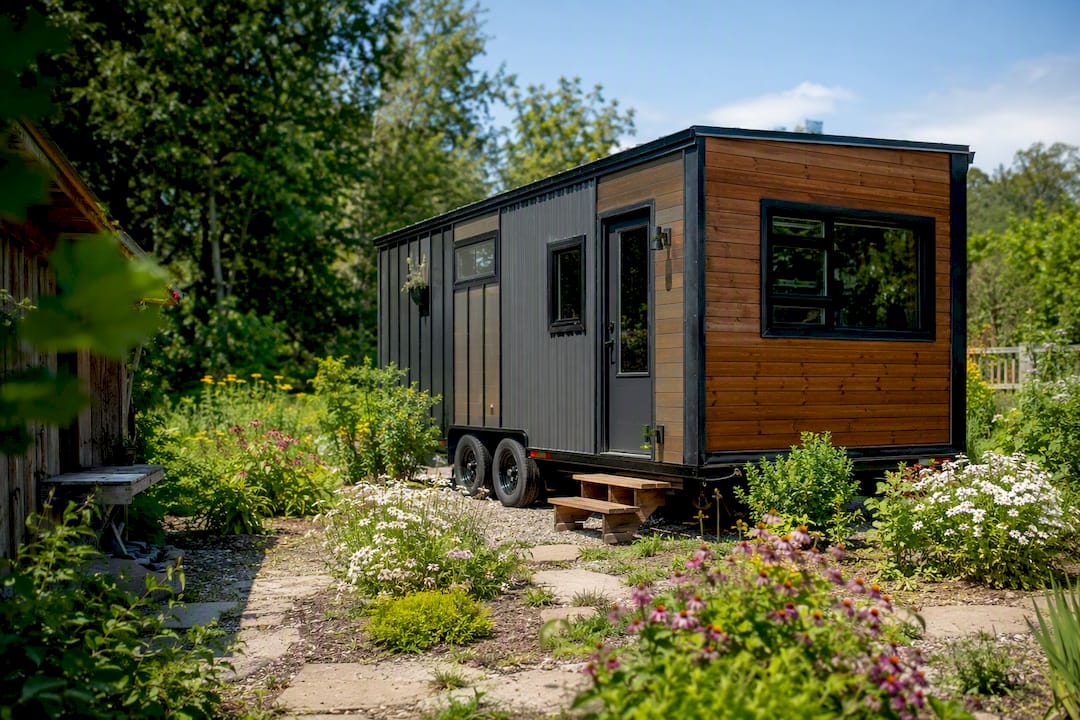
RV and travel-trailer policies fit tiny houses on wheels (THOWs), especially RVIA-certified ones. These typically bundle structure coverage, personal property, liability, and sometimes collision, and many carriers offer a “full-timer” endorsement if you live in it year-round rather than using it for weekend trips.
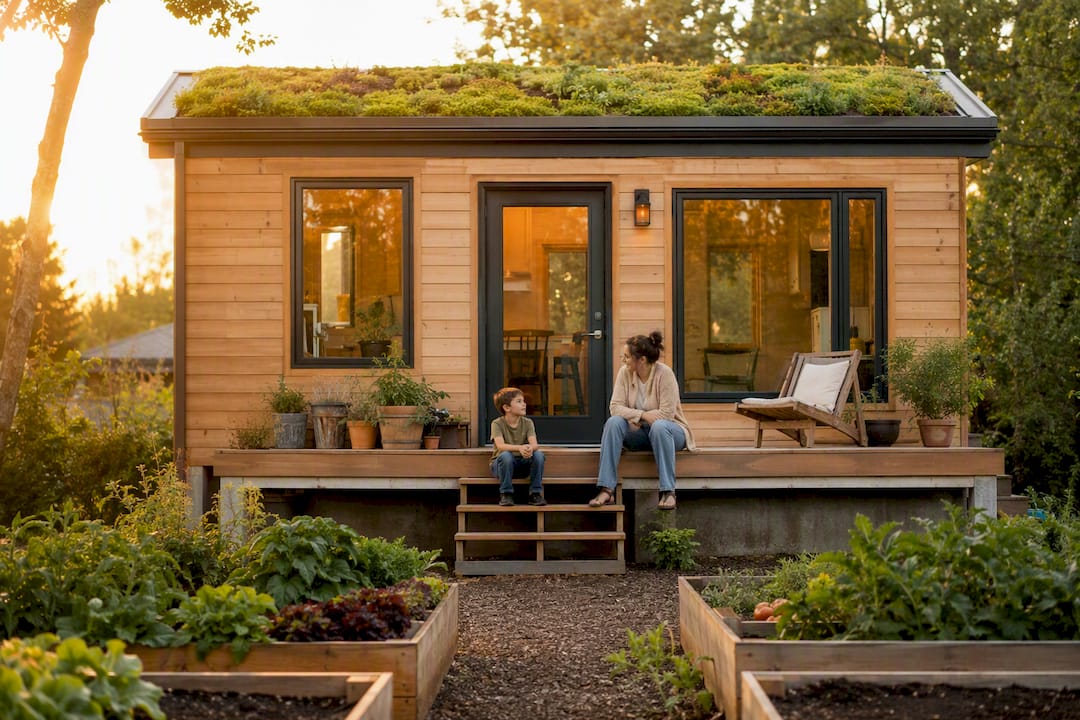
Mobile/manufactured home policies and dwelling-fire policies apply to tiny houses set on a foundation or permanent chassis. These mirror traditional homeowners coverage more closely, with dwelling protection, liability, and often loss-of-use benefits.
Specialty tiny-home policies, written through brokers who work outside the mainstream carrier network, cover uncertified or DIY builds that don’t fit neatly into either category above. Policygenius notes that major carriers will still write RV or manufactured-home policies for tiny homes when certification and use are clear, which is why documentation matters so much.
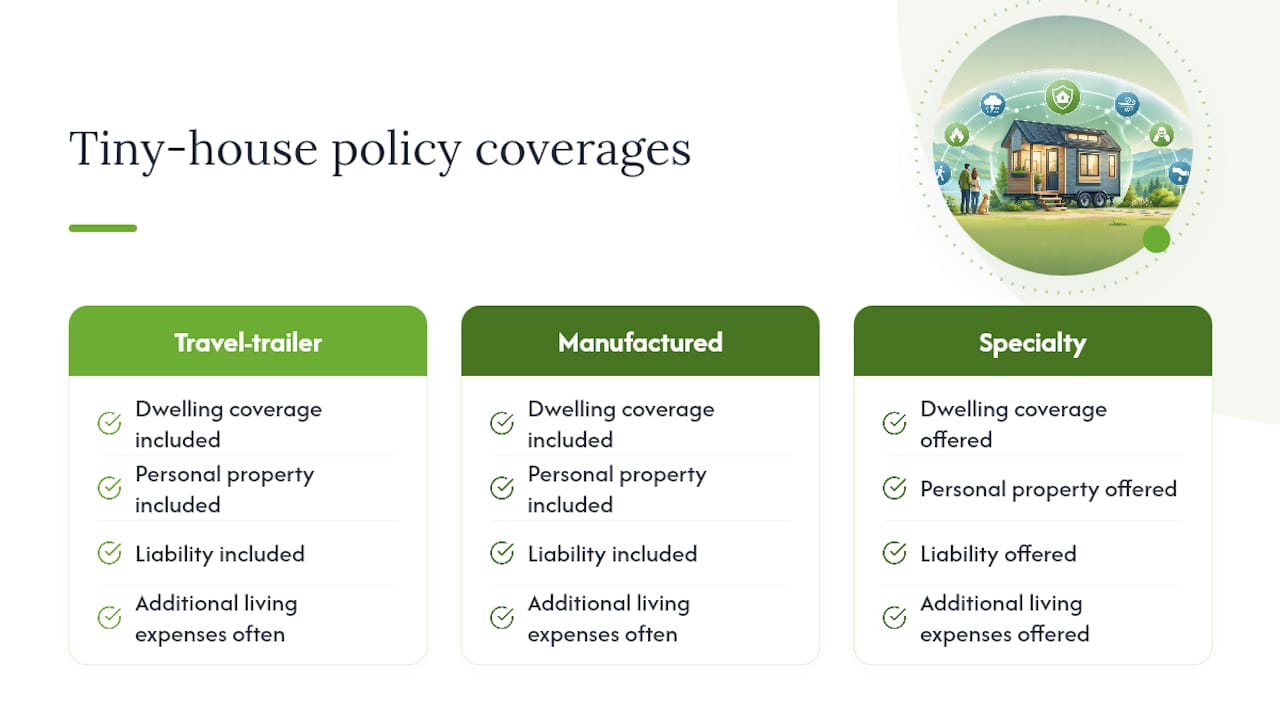
Across all three, expect the same core buckets: dwelling coverage, personal property, liability, additional living expenses if you’re displaced, and (for anything on wheels) a transit or trip endorsement.
Match Your Build, Title, and Use to the Right Policy
Before you call anyone, run through this quick self-check:
- Wheels or slab? If your tiny house has an axle and can be towed, you’re in RV territory. If it sits on a foundation or permanent skids, you’re closer to manufactured-home or dwelling-fire coverage.
- How is it titled? A house titled as a vehicle (with a VIN) needs RV-style coverage. One titled as real property, tied to a deed, needs homeowners or manufactured-home coverage.
- How do you use it? Full-time residence, seasonal getaway, and short-term rental each trigger different underwriting questions and endorsements, particularly around liability and occupancy.
Local code matters here too. A county that classifies your build as an accessory dwelling unit (ADU) may require it to meet residential building code before any mainstream carrier will insure it, while a state that treats THOWs as RVs will route you toward auto-adjacent insurers instead.
Edge cases deserve their own conversation. Bus conversions, off-grid cabins with no grid utility hookup, and owner-built ADUs often fall outside standard underwriting boxes entirely, which is where a specialty broker earns their fee. If you’re weighing where to site or buy your build, a resource like LiveLarge’s buyer’s guide is worth a look before you commit to a location that complicates your insurance options.
How to Shop, Quote, and Bind a Tiny House Policy
Getting quoted efficiently comes down to having the right paperwork ready before you pick up the phone.
- Gather your documents first. Title or registration for wheeled units, building permits and inspection records for foundation units, your builder’s spec sheet, and a complete photo set of the exterior, interior, and utility connections.
- Call the right type of provider. RV insurers or your existing auto carrier for wheeled homes, a homeowners carrier for foundation builds, and a specialty tiny-home broker if your build is DIY or uncertified.
- Ask specific underwriting questions. Does this policy include a full-timer endorsement? Is a transit/trip endorsement available for moving days? Is coverage based on replacement cost or actual cash value (ACV)? What are the additional living expense (ALE) limits if you’re displaced?
- Check lender requirements if you’re financing. Lenders often set minimum coverage limits and may require proof of insurance before closing, so confirm those numbers with your loan officer before you shop.
Pro Tip: Ask for a replacement-cost estimate, not a quote based on what you paid for the house. Insurers increasingly ask for a builder invoice or independent estimate, and insuring the purchase price instead of the rebuild cost is one of the most common ways tiny house owners end up underinsured.
What Tiny House Insurance Costs and Why Quotes Vary
Most tiny house owners land somewhere between $500 and $1,500 a year, with a national average around $850. Certified THOWs on RV policies tend to sit at the lower end, often $500 to $1,000, while foundation homes and uncertified DIY builds routed through specialty brokers trend higher.
A handful of variables explain most of that spread:
- Location. Owners in wildfire, hurricane, or tornado-prone states face higher premiums and tighter underwriting as insurance markets tighten in those regions.
- Certification. RVIA or NOAH certification signals code compliance to underwriters and is often the single biggest lever on price.
- Usage. Full-time occupancy, seasonal use, and rental use each carry different risk profiles and different premiums.
- Replacement cost and deductible. A higher deductible lowers your premium; underinsuring the rebuild cost doesn’t.
Two identical 300-square-foot homes, one RVIA-certified in a low-risk Midwest state and one uncertified in coastal Florida, can easily land quotes that differ by several hundred dollars a year.
How to Lower Your Premium and Improve Your Odds of Approval
Certification is the fastest way to make your tiny house attractive to mainstream carriers. RVIA or NOAH certification often unlocks lower rates fast enough that the certification cost pays for itself within a year for many DIY builds.
Beyond certification, a few moves reliably lower quotes:
- Bundle your tiny house policy with auto or another policy through the same carrier.
- Raise your deductible if you can comfortably absorb a larger out-of-pocket cost.
- Install smoke detectors, a monitored security system, or a fire-resistant exterior.
- Clear brush around the site and confirm proximity to a fire hydrant or station, since insurers weigh both.
Pro Tip: If a mainstream carrier declines your uncertified build, don’t stop shopping. Specialty brokers routinely place risks that standard carriers won’t touch, and they’re the usual path for off-grid or unconventional builds.
What Insurers Ask for and How to Speed Up Approval
Insurers move faster when you hand them a complete file instead of making them chase you for it. Have these ready before you apply:
- Photos of all four exterior sides, the interior, utility hookups, and any attached systems.
- The VIN if your home is on wheels and titled as a vehicle.
- Builder specs, permits, and documentation of electrical and plumbing work, especially for DIY builds without formal certification.
- A replacement-cost estimate or builder invoice rather than the original purchase price, per TinyHouseArena’s cost data.
A NOAH inspection or third-party appraisal often pays for itself by unlocking better rates and faster approval. Common red flags that slow underwriting include missing electrical documentation, no permit trail, and photos that don’t match the stated square footage.
Protecting Your Tiny House While You Move It
Moving day is one of the riskiest single events for a claim, and it’s also the moment most owners realize they’re not covered. A short-term transit or trip collision endorsement, often around $150 for a 30-day window, protects the structure while it’s being towed. Without it, you may have a coverage gap between your tiny-home policy and your tow vehicle’s auto liability.
- Notify your insurer before the move and confirm the endorsement is active.
- Secure loose contents inside the home and double-check all exterior attachments.
- Hire a professional hauler or add the endorsement yourself if you’re towing it.
Gridwise’s Resources for Tiny-Home Owners Getting Insured
Insurance is only half the equation. Zoning, permits, and build quality shape whether an insurer will write you a policy at all, and Gridwise Living has spent years helping owners think through both sides.
- Review Gridwise’s zoning laws checklist before you buy land or a build, since local code determines whether your home qualifies for standard coverage.
- If you’re planning a build, Gridwise’s budget build guide covers the documentation habits that make underwriting smoother later.
- Browse Gridwise’s tiny home collection if you’re still deciding on a build, since factory-built units are often easier to certify and insure than one-off DIY projects.
- When your setup involves off-grid systems, escalate to a licensed agent or specialty broker who understands how solar and water systems factor into replacement-cost estimates.
Ready to Simplify Your Tiny-Home Setup?
A tiny house that’s easier to document is a tiny house that’s easier to insure. Gridwise Living’s factory-built tiny homes come with the kind of build specs and construction records insurers ask for, which can shave real time off your quoting process compared to a fully custom DIY build. If you’re also planning for off-grid power, pairing your home with a solar energy system is worth doing before you apply for coverage, since insurers increasingly want documentation of every major system attached to the structure. Explore the Gridwise tiny homes page to see current builds and start your documentation file early.
What Actually Matters When You’re Getting a Tiny House Insured
Most advice on this topic treats tiny house insurance as one product with one price, when it’s really three or four different insurance categories wearing the same name. That confusion costs owners real money and real time. The owners who get quoted fastest and cheapest aren’t the ones who call the most insurers. They’re the ones who figure out their classification (wheels versus foundation, titled as vehicle versus real property) before they ever pick up the phone.
The conventional wisdom oversells certification as a magic fix. It helps enormously, but it’s not a requirement, and specialty brokers exist precisely because plenty of well-built, well-documented tiny houses never get RVIA or NOAH certified. What actually moves the needle is documentation: clear photos, a builder invoice, permit records if applicable. That paperwork substitutes for certification more often than owners realize.
If you take one thing from this, prioritize your paper trail before you prioritize finding the cheapest quote. A well-documented file gets you better offers from more carriers, which does more for your premium than shopping around ever will.
— Gridwise
Sources
For flood risk, check FloodSmart from the National Flood Insurance Program. For certification standards, review NOAH Certified. For policy comparisons, see Progressive and Policygenius.
- Insurance for Tiny Home — Progressive
- Best tiny house insurance — Policygenius
- Tiny house insurance cost in 2026 — TinyHouseArena
- NOAH certified