

Get 10–15 kWh Backup: Solar Battery Sizing for Homeowners
Most homes need 10 to 15 kWh of battery storage for essential-load backup, 25 to 40 kWh for whole-home coverage, and 40 to 70 kWh to go fully off-grid, and you get there with one formula: gross kWh needed = (daily energy use × days of autonomy) ÷ (depth of discharge × system efficiency). Run your own numbers through that equation, and the worked example and checklist below will do the rest.
TL;DR:
- Most homes require 10 to 15 kWh of battery capacity for essential backup, with larger sizes needed for whole-home or off-grid use.
- Accurate sizing depends on four key inputs: daily energy use, autonomy days, battery DoD, and system efficiency, with the formula best applied carefully.
- Lithium iron phosphate batteries (LFP) typically need about half the installed capacity of lead-acid batteries to deliver the same usable energy, due to higher DoD and efficiency.
- Peak power requirements, especially for surge loads like HVAC or EV chargers, must be matched by inverter ratings, not just total stored energy.
- Climate factors such as cold temperatures and cold weather derating can reduce usable capacity, so add a buffer of 10 to 25 percent for aging and environmental effects.
Table of Contents
- What Is the Solar Battery Sizing Formula, Exactly?
- A Worked Example: Sizing a 10 kWh/Day Home
- How Does Battery Chemistry Change Your Required Size?
- How Much Autonomy Do You Actually Need?
- Converting Kilowatt-Hours to Amp-Hours and Choosing System Voltage
- Why Temperature and Aging Shrink Your Usable Capacity
- Your Step-by-Step Solar Battery Buying Checklist
- Where Do These Sizing Defaults Come From?
- Does Your Climate Actually Change How Big a Battery You Need?
- What Does Battery Size Actually Cost You?
- Why Peak Power Matters as Much as Total Capacity
- How Do Solar Panels and Charge Controllers Fit Into Sizing?
- The Simplest Rule That Actually Works
- Gridwiseliving’s Solar Storage Options for Every Backup Goal
- Sources
What Is the Solar Battery Sizing Formula, Exactly?
Solar battery sizing comes down to four inputs, and getting each one right matters more than any spreadsheet trick. The formula itself is simple: gross kWh required = (daily energy use in kWh × days of autonomy) ÷ (depth of discharge × system efficiency). The hard part is knowing what to plug in.
Daily energy use (kWh) is what your home actually draws, not your theoretical peak load. Most homeowners overshoot here by sizing for total daily demand instead of the energy storage actually needs to cover, which for most setups is nighttime use plus a safety reserve, not around-the-clock consumption.
Days (or hours) of autonomy is how long you want to run without sun or grid power. A single overnight cycle is 1 day. Storm-prone regions often plan for 2 to 3 days.
Depth of discharge (DoD) is the percentage of a battery’s rated capacity you can actually use without damaging it.
System efficiency accounts for round-trip losses in the battery, inverter conversion, and wiring. A realistic default is 0.90 to 0.95 for a well-designed LFP system.
Before you calculate anything, gather these five numbers:
- Twelve months of utility meter readings, or at minimum a recent bill showing average daily kWh.
- A load list of every appliance you want backed up, with wattage and hours of use.
- Peak simultaneous load, especially if you run HVAC, well pumps, or an EV charger.
- Your desired backup duration in hours or days.
- Your home’s typical winter and summer temperature swings, since cold weather cuts usable capacity.
A Worked Example: Sizing a 10 kWh/Day Home
Take a typical home using 10 kWh per day that wants exactly one day of backup autonomy, running on a LiFePO4 bank with standard defaults.
- Step 1: Set the baseline. Daily use = 10 kWh. Days of autonomy = 1.
- Step 2: Apply DoD and efficiency. With 90% DoD and 92% system efficiency, the math is 10 ÷ (0.90 × 0.92) = 10 ÷ 0.828 ≈ 12.1 kWh gross required. That 2.1 kWh gap above your raw daily use is the “invisible cost” of conversion losses and reserved headroom. This exact formula and result align with EnergySage’s calculation method.
- Step 3: Convert to amp-hours. At a 48V system voltage, that’s 12.1 kWh × 1000 ÷ 48 ≈ 252 Ah of usable gross capacity.
- Step 4: Round up and add margin. Battery banks come in fixed module sizes, so you’d round to the nearest available configuration, then consider a 10 to 20% buffer for aging and cold-weather derating, pushing your real-world target closer to 275 to 300 Ah.
That’s the entire process. Change the 10 kWh/day or the 1 day of autonomy, and every downstream number shifts proportionally. If your household runs closer to Gridwiseliving’s worked 54 kWh backup example, the same formula scales up without changing shape.
How Does Battery Chemistry Change Your Required Size?
Depth of discharge and round-trip efficiency aren’t fixed numbers. They shift depending on which battery chemistry you buy, and that shift changes how many kWh you need to install to get the same usable capacity.
That means a lead-acid bank needs nearly double the installed capacity of an LFP bank to deliver the same usable energy. NMC lithium sits in between: better than lead-acid, but generally rated for fewer cycles than LFP at the same depth of discharge.
| Chemistry | Typical DoD | Round-trip efficiency | Typical cycle life |
|---|---|---|---|
| LiFePO4 (LFP) | 90% | 90% to 95% | 3,000 to 5,000 cycles |
| NMC lithium | 90% | 90% to 92% | 1,000 to 1,500 cycles |
| Lead-acid (AGM/flooded) | 40% | 80% to 85% | 300–500 cycles |
A higher usable DoD directly shrinks the gross capacity you need to buy, since more of every installed kWh is actually available to you. That’s the core reason LiFePO4 tends to win on lifetime cost despite a higher sticker price. You’re not just buying more cycles. You’re buying a bank that needs less oversizing to hit the same target.
How Much Autonomy Do You Actually Need?
Autonomy decisions drive capacity more than almost anything else in this process, and most homeowners guess instead of calculating.
Start by listing your essential loads: refrigerator, freezer, well pump, medical equipment, a few lights, and internet gear. Add up their wattage and multiply by expected hours of use per day. That total, run through the sizing formula, tells you what essential-load backup actually requires.
- Essential-load backup (refrigerator, lights, internet, medical devices): typically 10 to 15 kWh, usually one battery unit.
- Whole-home backup (adds HVAC, kitchen appliances, laundry): typically 25 to 40 kWh, usually two to three battery units.
- Off-grid living (no utility connection at all, year-round): typically 40 to 70+ kWh, often three to five units or more.
Capacity is only half the equation. Your inverter has to handle peak power, not just total energy. A whole-home system with central air conditioning or Level 2 EV charging can demand 8 to 15 kW at startup, and an undersized inverter will trip or shut down even with plenty of stored kWh sitting unused. Many installers recommend starting with critical loads first and expanding to whole-home coverage later as budget allows, rather than overbuying on day one.
Converting Kilowatt-Hours to Amp-Hours and Choosing System Voltage
Battery specs are usually listed in Ah, but your energy math happens in kWh, so you need a reliable way to move between the two.
- Apply the conversion formula. Ah = (kWh × 1000) ÷ system voltage. For the 12.1 kWh example above at 48V, that’s (12.1 × 1000) ÷ 48 ≈ 252 Ah.
- Choose your voltage tier. Residential systems above 1 to 2 kW generally run on 48V rather than 12V or 24V, because higher voltage cuts the current needed to deliver the same power, which means thinner cables, less heat, and lower fire risk.
- Plan your wiring configuration. Connecting batteries in series raises voltage while keeping Ah constant; connecting in parallel raises Ah while keeping voltage constant. Most 48V home systems use parallel strings of series-connected cells to hit both the target voltage and target capacity.
- Match your inverter. Confirm your inverter’s input voltage window and continuous power rating cover your battery bank and peak load before you finalize wiring, since a mismatch here is one of the most common self-install mistakes.
Why Temperature and Aging Shrink Your Usable Capacity
Cold weather steals capacity you already paid for. Most lithium batteries lose meaningful usable output below freezing, and manufacturers often restrict charging entirely below certain temperatures. If your battery bank lives in an unheated garage or shed and you’re in a cold climate, add a 10 to 25% buffer to your gross capacity target to cover winter derating.
Aging compounds the problem over time. A battery rated for thousands of cycles still loses a percentage of capacity every year, which means the bank that exactly meets your needs today may fall short in year five. Oversizing modestly upfront buys you years of headroom before performance drops below your minimum requirement.
Pro Tip: Never mix battery chemistries or combine old and new battery banks on the same string. Mismatched cells charge and discharge unevenly, which shortens lifespan and can create real safety hazards. For any system above a small portable kit, get a licensed installer to verify your inverter’s charging specs against your battery pack before you flip the switch.
Your Step-by-Step Solar Battery Buying Checklist
Turning the math into a purchase takes a handful of concrete steps, in order.
- Pull 12 months of utility data or a recent bill to establish your real daily kWh use.
- List every load you want backed up and calculate essential-load and whole-home totals separately.
- Pick your autonomy target (hours for essential loads, days for storm-prone regions).
- Run the sizing formula with LiFePO4 defaults (90% DoD, 92% efficiency) to get gross kWh.
- Convert to Ah at your target voltage, typically 48V for anything above a small kit.
- Add a 10 to 25% buffer for aging and, if applicable, cold-weather derating.
- Confirm inverter continuous and surge power ratings cover your peak simultaneous load.
- Order matched, same-chemistry battery modules and schedule a licensed installer for whole-home or off-grid systems.
| Buying decision | What to check |
|---|---|
| Battery chemistry | LiFePO4 for best DoD and cycle life |
| System voltage | 48V for systems above 1–2 kW |
| Inverter rating | Covers peak surge load, not just average draw |
| Warranty terms | Matches expected cycle life and years of use |
Red flags worth walking away from: sellers who can’t specify DoD or cycle life, inverters rated below your peak surge load, and battery kits mixing modules from different production batches or chemistries.
Where Do These Sizing Defaults Come From?
Gridwiseliving’s calculations track the same methodology used across the solar storage industry, including EnergySage’s sizing formula and calculator tools like Omnisol’s battery capacity calculator. For a deeper walkthrough with real household numbers, see the Gridwiseliving guide to sizing home solar backup, which applies this same formula to a 54 kWh whole-home example.
Does Your Climate Actually Change How Big a Battery You Need?
Location changes your sizing math on two separate fronts: how much energy your battery can deliver, and how much solar generation you have to recharge it.
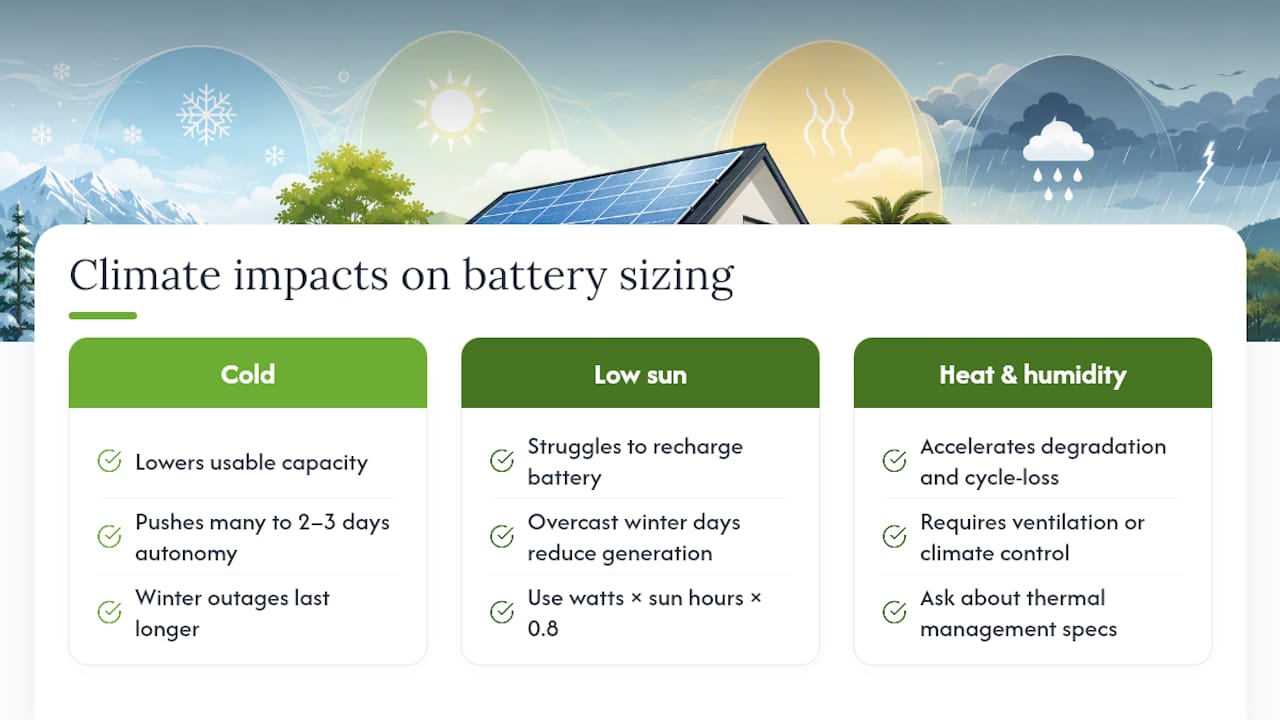
Cold climates hit usable capacity directly, as covered above, but they also extend your autonomy needs indirectly. Winter storms that knock out power tend to last longer in northern regions, which pushes many homeowners in those areas toward 2 to 3 days of autonomy instead of the standard overnight cycle.
Sun-hour availability matters just as much as temperature. A battery sized perfectly for a sunny Arizona rooftop will struggle to recharge fully during a stretch of overcast Pacific Northwest winter days, even though the battery’s rated capacity hasn’t changed at all. When you’re calculating how much solar generation you’ll have to refill your bank, Gridwiseliving’s guide to calculating panel wattage using watts × sun hours × 0.8 shows how local peak sun hours factor into that side of the equation.
Humidity and heat create their own version of the same problem. High-heat climates can accelerate battery degradation and cycle-life loss if the battery bank isn’t properly ventilated or climate-controlled, which is a separate issue from the cold-weather capacity loss discussed earlier but deserves the same attention during installation. If you live somewhere with extreme summer heat, ask your installer about thermal management specs, not just the battery’s rated cycle life on a data sheet.
What Does Battery Size Actually Cost You?
Bigger batteries cost more money, but the relationship isn’t as simple as a straight line, and chemistry choice changes the entire cost curve.
Once you factor in replacement costs from their 300 to 500 cycle lifespan, lead-acid often costs more over a 10 year period than LFP, even though the initial invoice looks cheaper.
For most homeowners planning to stay in their house more than 5 years, LFP’s lifetime cost advantage outweighs the higher sticker price.
Sizing choice compounds this. An essential-load system sized for genuine nighttime and reserve needs, rather than total daily consumption, might need only 10 to 12 kWh gross instead of 20 kWh. That difference in installed capacity translates directly into fewer battery modules purchased, which is real money saved without sacrificing the backup coverage you actually use. Oversizing “just in case” past your calculated buffer adds cost without adding meaningful resilience.
Why Peak Power Matters as Much as Total Capacity
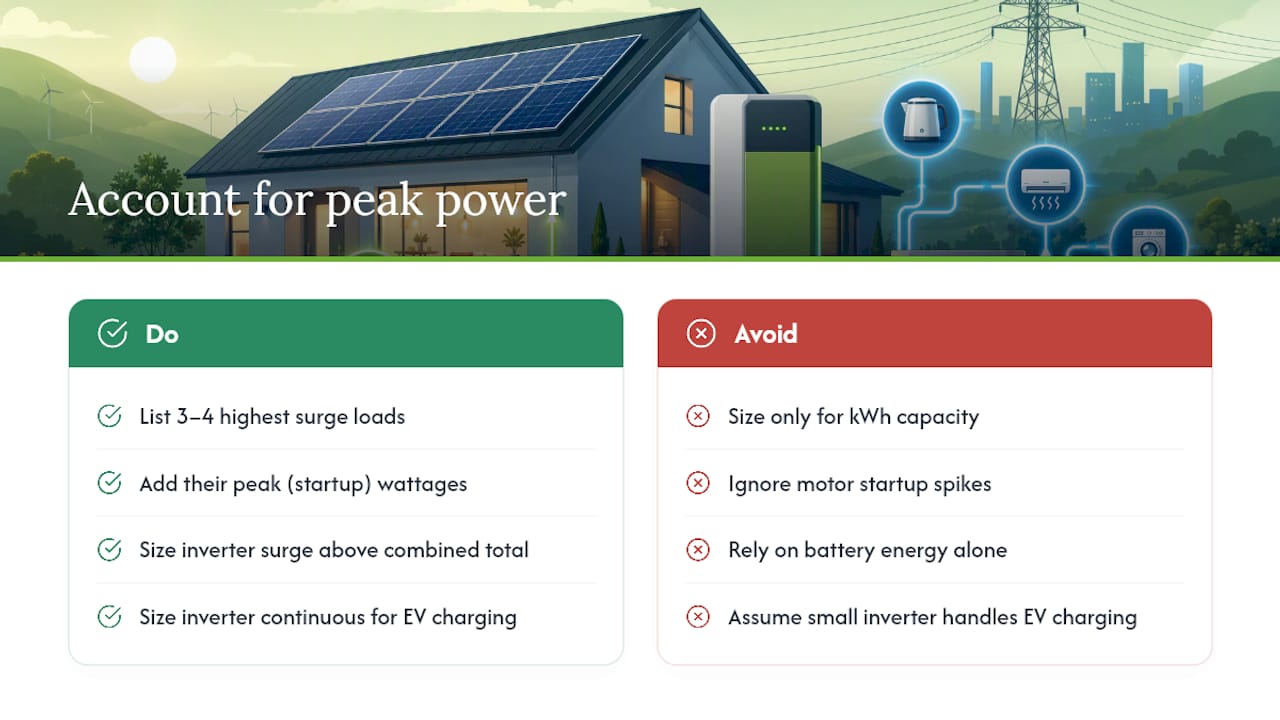
A battery bank sized correctly in kWh can still fail your home if the inverter behind it can’t handle a surge. Total stored energy and peak power delivery are two different specifications, and sizing only for one leaves a gap.
Motor-driven loads like well pumps, refrigerator compressors, and air conditioner compressors draw a surge of current at startup that can run 2 to 3 times their steady-state running wattage. A well pump rated at 1,000 running watts might briefly demand 2,500 to 3,000 watts the instant it kicks on. If your inverter’s surge rating doesn’t cover that spike, even a fully charged, correctly sized battery bank will trip the system.
EV charging adds another layer. Level 2 home chargers commonly draw 7 to 11 kW continuously, which by itself can exceed the continuous output rating of smaller inverters, regardless of how much energy is sitting in the battery bank. If you’re sizing a system that needs to cover EV charging during an outage, size your inverter’s continuous rating around that load specifically, not just around your home’s average draw. Some homeowners handle this by pairing daily solar self-consumption with charging schedules tied to off-peak utility rates, an approach covered in detail for solar EV charging setups.
Before finalizing any battery order, list your three or four highest surge-load appliances, add their peak wattage together (not their running wattage), and confirm your inverter’s surge rating clears that combined number with margin to spare.
How Do Solar Panels and Charge Controllers Fit Into Sizing?
Battery capacity is only useful if your solar array and charge controller can actually refill it. Sizing a battery in isolation from your generation side is one of the most common mistakes in DIY solar planning.
Your charge controller has to be rated for both the voltage and current your solar array produces, and it needs to be compatible with your battery chemistry’s charging profile. LiFePO4 batteries require a specific charge curve; feeding one with a controller programmed for lead-acid absorption and float stages can undercharge the bank or trigger the battery management system to cut off charging entirely.
Array sizing needs to account for real-world recharge time, not just peak wattage on a spec sheet. A 12.1 kWh gross battery target, refilled by a modest rooftop array during a short winter day, might take longer to recharge than expected if the array wasn’t sized against actual daily sun hours in your region. Reducing home energy use before sizing, through efficiency upgrades or smarter appliance scheduling, shrinks both your battery target and your required array size at the same time, an approach worth considering alongside broader home efficiency upgrades before you finalize either purchase.
The Simplest Rule That Actually Works
Start with essential loads, not your whole house.
— Gridwise
Gridwiseliving’s Solar Storage Options for Every Backup Goal
Once you’ve run the numbers, the next move is matching that target capacity to actual hardware, and this is where a lot of DIYers stall out comparing specs across a dozen browser tabs. Gridwiseliving’s Solar Energy Systems collection is organized around the same tiers this guide walks through: compact kits sized for essential-load backup, and expandable systems built to scale toward whole-home coverage without starting over.
If your worked example landed in off-grid territory, 40 kWh or more, the Power Your Off Grid Home page walks through full-system configurations built for that load range, including panel and controller pairings that match the voltage and Ah targets you just calculated. Both pages list specs in the same terms this article used, kWh, DoD, and system voltage, so you can compare your numbers directly against the hardware instead of translating marketing language. Start with your essential-load number, check it against the starter kits, and size up from there.
Sources
- How many solar batteries do I need? | EnergySage
- Battery Capacity Sizing Calculator — Omnisol
- How to Size Your Solar Battery (Step-by-Step) | Dartello