

8–15 Years or Just a Few? LiFePO4 or NMC for Home and RV Power
For most home backup systems, RV setups, and portable power stations you’ll cycle often, LiFePO4 is the better choice. It lasts longer, tolerates heat without the risk of violent failure, and costs less per cycle over time. NMC earns its place only when weight or size is the deciding factor, since it packs more energy into a smaller, lighter cell. The trade-off comes down to longevity and safety versus energy density.
TL;DR:
- LiFePO4 batteries offer significantly longer cycle life, with up to 5,000 cycles compared to NMC’s maximum of around 2,300, making them more cost-effective over time for regular use.
- LiFePO4 cells are safer at high temperatures, with a thermal runaway onset about 100°C higher than NMC cells, reducing fire risk in hot storage or usage environments.
- NMC batteries pack more energy into a smaller, lighter cell, which is advantageous for weight-sensitive applications like drones, ultralight gear, or electric vehicles.
- Cold-weather performance favors NMC slightly, as it retains discharge capacity better in freezing conditions, but proper insulation and heating mitigate LiFePO4’s colder climate limitations.
- Higher upfront costs for LiFePO4 are offset by its lower cost per cycle and longer lifespan, making it more economical for home backup systems cycled frequently.
Table of Contents
- LiFePO4 vs NMC Battery: Specs Side by Side
- Why the Chemistry Itself Drives These Differences
- How Long Each Battery Actually Lasts in Real Use
- Fire Risk and Thermal Safety Compared
- A Buyer’s Checklist: How to Choose Between the Two
- Does Cold Weather Change the Answer?
- Comparing Upfront Cost to Lifetime Value
- We build every recommendation around three priorities: durability, straightforward operation, and long-term value for the household. A product that looks great on paper but demands constant babysitting or fails early doesn’t make the cut.
- Sources
- FAQ
LiFePO4 vs NMC Battery: Specs Side by Side
The two chemistries aren’t interchangeable, and the gap shows up fastest in a spec sheet. Here’s how they stack up across the numbers that actually change a buying decision.
| Metric | LiFePO4 | NMC |
|---|---|---|
| Cycles to 80% state of health | ~3,000–5,000+ | ~500–2,300 |
| Specific energy (Wh/kg) | ~90–205 | ~150–300 |
| Nominal cell voltage | ~3.2V | ~3.6–3.7V |
| Thermal runaway onset | ~270–310°C | ~150–210°C |
| Weight for equivalent energy | Higher | Lower |
Those figures come from engineering comparisons on LiFePO4 chemistry and lithium-ion cell types, and the cycle-life data tracks with what most manufacturers publish.
Translating the table into decisions:
- Home solar backup, run daily or weekly: LiFePO4, because the cycle count carries you through 8 to 15 years of regular use.
- RV or van power, cycled often on the road: LiFePO4, for the same reason plus better tolerance of heat inside a parked vehicle.
- Portable power station used a few times a month: Either works, but LiFePO4 still wins on cost-per-cycle.
- Ultralight backpacking gear or drones: NMC, because every gram matters and cycle count is secondary.
- Long-range EVs: NMC, where range per pound of battery outweighs longevity concerns for most drivers.
Why the Chemistry Itself Drives These Differences
The performance gap starts at the cathode. LiFePO4 uses an olivine crystal structure built around iron and phosphate. That structure holds its shape under heat and doesn’t release oxygen easily, which is the root of its safety edge. NMC uses a layered oxide structure made of nickel, manganese, and cobalt, which packs more lithium ions into a smaller space but destabilizes at lower temperatures.
Voltage tells part of the story too. A single LiFePO4 cell runs around 3.2 volts nominal, while NMC cells run higher, around 3.6 to 3.7 volts. That difference means a battery pack built with NMC cells needs fewer cells in series to hit a given system voltage, which is part of why NMC packs run lighter and more compact.
Some manufacturers now blend in manganese to create lithium manganese iron phosphate (LMFP), nudging LiFePO4’s voltage and energy density up slightly while mostly keeping its safety profile intact. It’s a middle path worth asking about if a vendor mentions it on a spec sheet.

The core trade-off in one line: olivine structure buys you thermal margin and cycle life; layered oxide buys you energy density. Neither chemistry does both well.
How Long Each Battery Actually Lasts in Real Use
Lab cycle counts only mean something once you convert them into years. LiFePO4 commonly rates for 3,000 to 5,000 cycles or more to 80% state of health, while many NMC cells fall somewhere in the 500 to 2,300 range depending on nickel content and how hard the test pushed them.
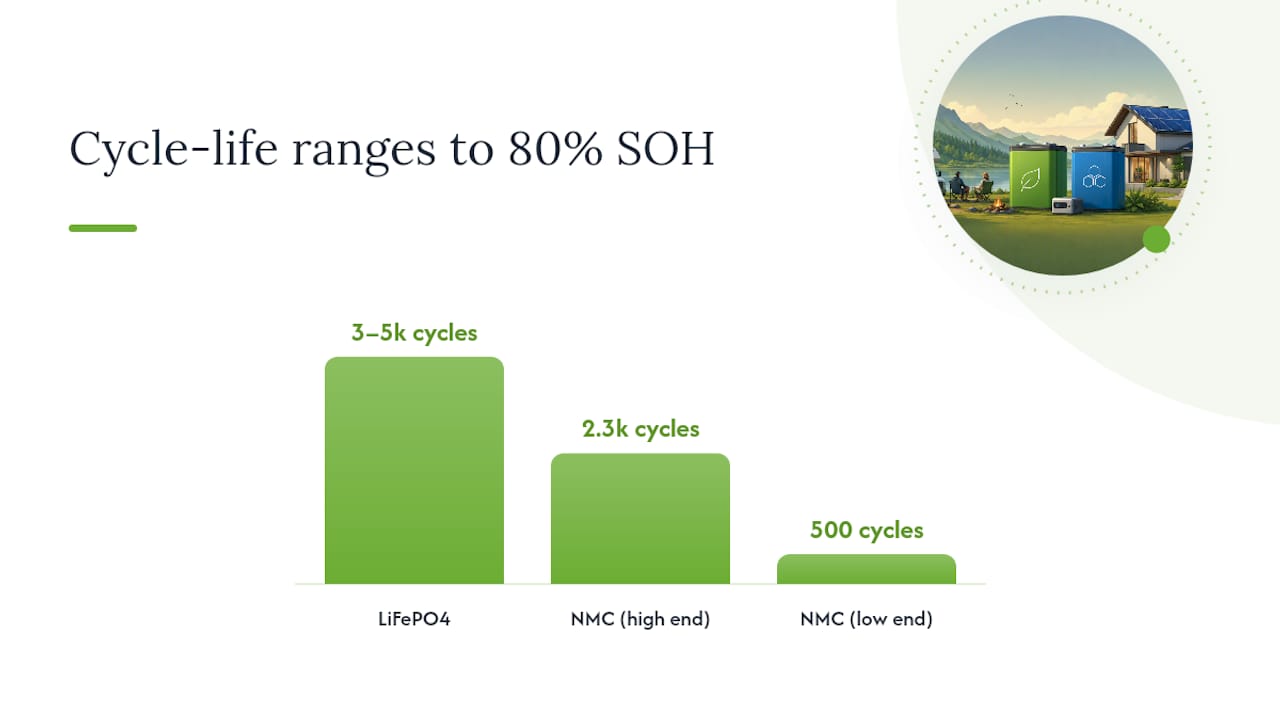
Run the math on a home battery cycled once a day: at several thousand cycles, that’s roughly a decade before it drops to 80% capacity. A high-nickel NMC cell with fewer cycles under the same daily use hits that same 80% mark in a few years. Cycle less often, say two or three times a week for a backup-only setup, and both numbers stretch out considerably.
A few things affect real-world results:
- Depth of discharge matters. Draining a pack to near zero every time shortens life faster than stopping at 20% remaining.
- Heat accelerates calendar aging in both chemistries, but NMC degrades faster at high storage temperatures.
- LiFePO4 typically holds charge longer in storage thanks to a lower self-discharge rate, which matters for a generator or power station that sits unused for months.
Storage tip: keep any lithium battery at 40 to 60% charge for long-term storage, and check it every few months rather than leaving it fully charged or fully drained.
Fire Risk and Thermal Safety Compared
This is where LiFePO4 separates itself most clearly. Its cathode starts breaking down around 270 to 310°C, while many NMC formulations begin decomposing between 150 and 210°C. That 100 degree gap is the difference between a cell that survives a hot garage or a punctured casing and one that doesn’t.
The bigger issue isn’t just heat tolerance; it’s what happens after decomposition starts. NMC’s layered oxide releases oxygen as it breaks down, feeding an internal fire that’s hard to smother. LiFePO4’s phosphate structure stays intact and doesn’t feed the fire the same way, which is why thermal runaway in LiFePO4 packs tends to be slower and less violent when it happens at all.
None of that eliminates the need for good pack design. A poorly built battery management system (BMS), cheap cell balancing, or a pack crammed into an unventilated space can undercut even the best chemistry.
- Keep battery banks in a ventilated space, away from direct sun and extreme heat sources.
- Confirm the BMS handles overcharge, overdischarge, and short-circuit protection, not just charge balancing.
- Avoid charging in temperatures below freezing unless the pack has built-in low-temp protection.
Pro Tip: Ask any vendor for the pack’s UL 1973 or UL 9540A test documentation before buying for home installation. A battery without third-party safety testing on file is a red flag, regardless of chemistry.
A Buyer’s Checklist: How to Choose Between the Two
Match the battery to how you’ll actually use it, not just to the spec sheet’s headline number. Walk through these questions before you buy:
- How many cycles per year will this battery see? Daily solar cycling needs a different answer than occasional backup power.
- How much weight or space can you spare? A rooftop tiny-home install has different constraints than a stationary home battery bank.
- What’s your climate like? Extreme heat or cold changes which chemistry holds up better.
- How often will you recharge, and how deep will you discharge each cycle?
- What does the warranty actually cover, and at what degradation threshold does it kick in?
When you’re comparing spec sheets or talking to a vendor, ask directly:
- What’s the exact cell chemistry and manufacturer, not just “lithium-ion”?
- What test conditions produced the rated cycle count?
- What operating temperature range is the pack rated for, charging and discharging separately?
- How many cycles does the warranty cover, and to what percentage of original capacity?
For a home solar backup system cycled daily, LiFePO4 is the practical answer nearly every time. For a tiny home with a tight roof and weight budget, the calculus shifts toward whichever chemistry gets you the capacity you need without overloading the structure.
Does Cold Weather Change the Answer?
Cold hits both chemistries, but not identically. Standard LiFePO4 cells lose meaningful discharge capacity as temperatures approach freezing, and charging below freezing can permanently damage the cells if the BMS doesn’t cut it off. Some NMC formulations retain discharge capability slightly better in cold conditions, though both suffer compared to room-temperature performance.
Mitigation matters more than raw chemistry here. Insulated battery enclosures, built-in heating pads (increasingly common in higher-end LiFePO4 packs), and simply keeping the battery indoors or in a temperature-controlled compartment solve most of the problem.
- Look for packs with built-in low-temperature charge cutoff and, ideally, internal heating elements.
- Insulate outdoor enclosures, especially for RV and van installations that see winter camping.
- If your use case is genuinely extreme cold with no option to insulate or heat the battery, NMC’s slightly better cold tolerance may tip the decision, but it’s rarely a deciding factor for typical home or RV setups.
Pro Tip: If you’re installing a battery in an unheated shed or an RV underbelly compartment, budget for insulation before you budget for a bigger battery. A well-insulated smaller pack often outperforms a larger, exposed one in January.
Comparing Upfront Cost to Lifetime Value
LiFePO4 usually costs more upfront per kilowatt-hour than a comparable NMC pack. But cost-per-cycle flips the comparison once you run the numbers. A LiFePO4 pack rated for 4,000 cycles at a higher purchase price can work out to a fraction of the cost-per-cycle of an NMC pack rated for 800 cycles, even if the NMC unit costs less on day one.
DOE and NREL storage economics research backs this up at the utility scale: LFP-based storage systems often land at a lower cost per kWh over their operating life than NMC systems, largely because of cycle life and lower material-cost exposure.
- Divide purchase price by warrantied cycles to get a rough dollars-per-cycle figure before comparing two products.
- A longer warranty (8 to 10 years is common for quality LiFePO4 packs) generally signals more manufacturer confidence in the cell’s degradation curve.
- Factor in replacement labor and disposal costs for whichever pack wears out first. A battery you replace twice costs more than the sticker price implies.
We build every recommendation around three priorities: durability, straightforward operation, and long-term value for the household. A product that looks great on paper but demands constant babysitting or fails early doesn’t make the cut.
When you’re comparing generators or solar energy systems, check the product page for the same specs covered in this guide: cell chemistry, warrantied cycle count, operating temperature range, and BMS features. Those four data points tell you more about long-term satisfaction than price alone ever will.
If you’re sizing a home backup system, start with how many kWh your household actually needs before locking in a chemistry, since right-sizing the system changes which battery makes financial sense. A well-matched LiFePO4 setup, sized correctly, tends to outlast and outperform an oversized system built around the wrong assumptions.
— Gridwise
Sources
- What Is LiFePO4? Engineering Guide to Lithium Iron Phosphate Batteries
- Lithium iron phosphate battery
- Lithium-ion chemistries compared
FAQ
Which battery is safer, NMC or LiFePO4?
LiFePO4 is the safer chemistry for home and portable use. Its higher thermal decomposition threshold, around 270 to 310°C versus 150 to 210°C for many NMC cells, along with its lack of oxygen release during breakdown, makes violent thermal runaway far less likely.
Does Tesla use NMC or LFP?
Tesla uses both, depending on the model and market. Standard-range vehicles commonly use LiFePO4 (LFP) cells for cost and longevity, while long-range models typically use NMC or NCA chemistry to maximize driving range per pound of battery.
What are the downsides of LiFePO4 batteries?
LiFePO4’s main downsides are lower energy density and reduced cold-weather performance. It takes up more space and weight for the same stored energy compared to NMC, and standard cells lose discharge capacity as temperatures approach freezing without added insulation or heating.
Which battery is better than LiFePO4?
No chemistry beats LiFePO4 across every category, but NMC outperforms it specifically on energy density, delivering roughly 150 to 300 Wh/kg versus LiFePO4’s 90 to 205 Wh/kg. That makes NMC the better pick only when weight or size is the limiting factor, not for typical home or RV backup use.