

Calculate Your Home's Generator Size: 3 kW Ranges and Hybrid Options
Most homes land in one of three ranges: 5 to 8 kW for essentials only, 10 to 18 kW for a house with central AC or a well pump, and 18 to 22+ kW for whole-home coverage with multiple HVAC systems. The reliable way to confirm your number is a load calculation, adding up running watts, factoring in the highest single starting-watt draw, and padding the total with a safety buffer. The next section walks through that math step by step.
TL;DR:
- Most homes need a generator in the 5 to 22+ kW range, with higher capacity required for multiple HVAC systems or electric heat.
- Load calculations should include startup watts for appliances with motors, such as AC units and well pumps, plus a safety buffer of 10 to 25 percent.
- Generators can often be downsized with tools like soft-start kits, load-shedding panels, or staged startup to reduce costs and capacity needs.
- A professional site survey and confirmation of your panel’s amperage are crucial for complex setups, medical equipment, or high-draw systems.
- Installing a standby generator involves costs for the unit, site prep, fuel hookup, permits, and ongoing maintenance, all requiring licensed professionals.
Table of Contents
- How Do You Calculate the Right Generator Size?
- Which Generator Size Fits Your Home Profile?
- Why Do Two Similar Homes Need Different Generators?
- What Does Installation and Permitting Actually Cost?
- When Should You Call a Generator Professional?
- What Gridwise Has Learned From Tiny-Home and Solar Backup Projects
- What Should You Do With This Information?
- Gridwise Power Solutions Built Around Your Sizing Numbers
- Where Can You Verify Your Numbers?
- Sources
How Do You Calculate the Right Generator Size?
Start by splitting your circuits into priority levels. Level 1 covers what you cannot live without during an outage, refrigerator, well pump, a few lights, medical equipment. Level 2 adds comfort, one AC unit or a portion of your HVAC, the microwave, the garage door. Level 3 is everything else you would like to run if you have capacity left over. This grouping keeps you from oversizing a generator to cover circuits you would gladly skip for a few days.
Next, gather running and starting watts for each item. Nameplates and owner’s manuals list running watts directly. Starting watts matter most for anything with a motor, an air conditioner, a well pump, a sump pump, or a refrigerator compressor, since these can briefly draw two to three times their running wattage. Generac’s sizing guidance notes that appliance mix and motor loads drive real capacity needs far more than square footage does.
Here’s the calculation method that Cummins recommends for homeowners running their own numbers:
- Add the running watts of every appliance and circuit you want powered simultaneously.
- Identify the single highest starting-watt value among those items (you rarely need to stack multiple starting surges at once).
- Add that one starting-watt figure to your running total.
- Apply a 10 to 25 percent safety buffer on top of that sum.
- Round up to the nearest standard generator size, typically 7, 10, 14, 18, or 22 kW.
If your total lands close to a size jump, a soft-start kit on your AC compressor, a load management panel, or staged startup timing can shave enough off the starting-watt spike to keep you in the smaller, cheaper unit. Home Depot’s appliance wattage tables are a solid reference for filling in numbers you cannot find on a nameplate.
Which Generator Size Fits Your Home Profile?
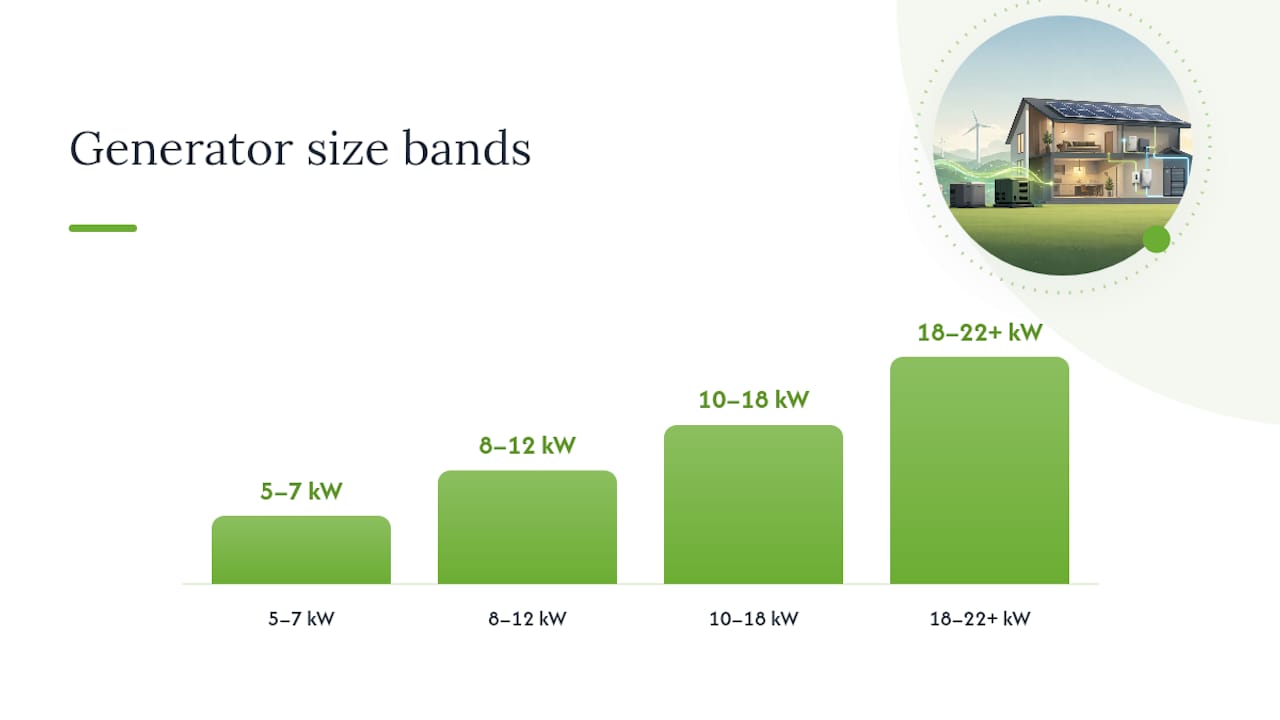
Once you have a rough total, check it against typical home profiles. Homes with a single central air conditioner and a well pump routinely land higher than a homeowner expects, because those two items alone can dominate the starting-watt budget.
Electric furnaces, multiple AC units, and whole-house EV charging all push a household into the largest bands, sometimes past 22 kW. Poweroutage puts the common household range at roughly 5 kW to 20+ kW, with surge wattage as the detail most people underestimate.
| Size band | Typical coverage | Watch for |
|---|---|---|
| 5–7 kW | Refrigerator, lights, phone chargers, sump pump | Skip large motors or run them one at a time |
| 8–12 kW | Adds a window AC or small HVAC, microwave, well pump | Well pump starting watts can eat a big chunk of this band |
| 10–18 kW | Medium home with one central AC, kitchen appliances | A 3-ton AC unit alone can require 15 to 18 kW of starting capacity |
| 18–22+ kW | Whole-home, multiple HVAC zones, electric heat | Electric furnaces and dual AC systems push toward the top of this range |
Why Do Two Similar Homes Need Different Generators?
Starting watts, not running watts, are usually what forces you into a bigger unit. A 3-ton central AC compressor might only draw 3.5 to 5 kW while running, but its startup surge can spike to 15 to 18 kW for a fraction of a second. Size a generator for running watts alone, and you will watch it stall the moment the compressor kicks on.
A few tools change that math in your favor:
- Soft-start kits cut a compressor’s starting surge dramatically, often letting a smaller generator run a full-size AC unit.
- Load-shedding panels automatically drop non-essential circuits when a big motor starts, then restore them once it’s running.
- Staged startup timing (starting the well pump, then the AC, rather than both at once) avoids stacking two surges together.
Fuel choice matters just as much as wattage. Propane and natural gas suit long, automatic runtime for multi-day outages. Gasoline favors portability and short-term use. Diesel handles extended heavy loads well. A solar-battery hybrid setup delivers quiet, clean backup for shorter gaps and pairs naturally with a smaller generator for the rare extended outage.
Pro Tip: Before you buy anything, check your electrical panel’s amperage rating. A generator sized correctly for your loads can still be bottlenecked by an undersized transfer switch or an older 100-amp service panel.
What Does Installation and Permitting Actually Cost?
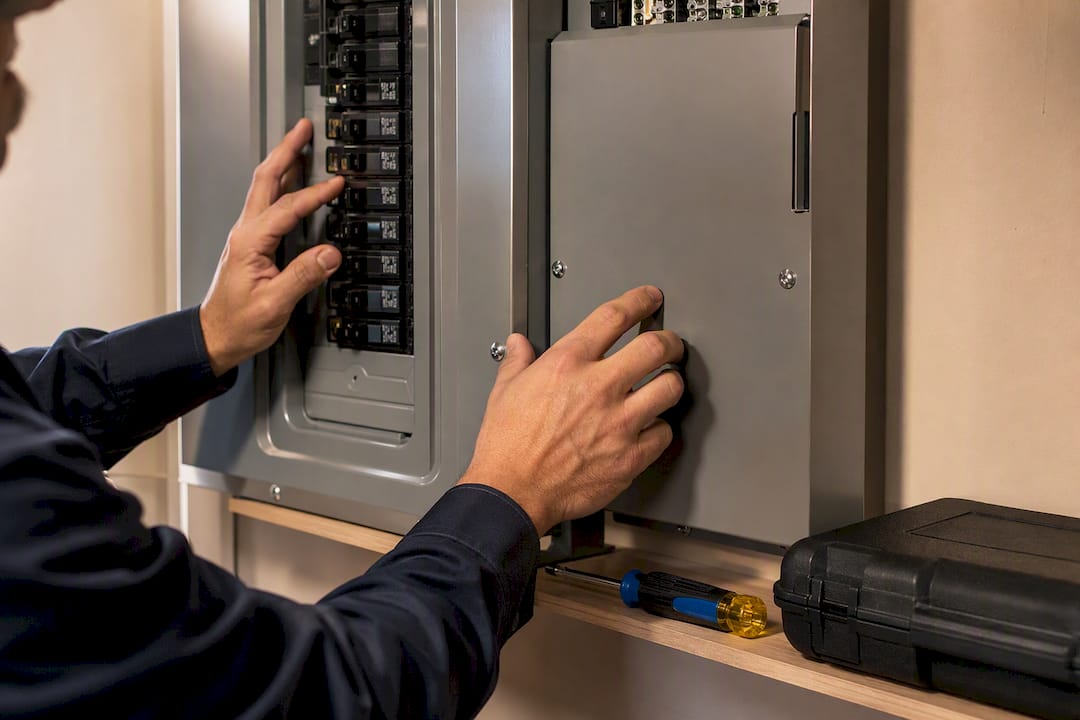
Standby generator installation follows a predictable sequence: site prep and a concrete or composite pad, transfer switch installation, fuel hookup for natural gas or propane units (or fuel delivery logistics for portable gas units), then a final inspection.
Rough cost components to budget for:
- Unit price generally scales with kW size, with larger whole-home units costing significantly more than entry-level standby models.
- Installation costs vary widely by site, panel upgrades, trenching for fuel lines, and electrical work all add to the total.
- Fuel hookup (running a gas line or setting a propane tank) is a separate line item from the generator itself.
- Ongoing maintenance, oil changes, battery checks, annual service, adds a modest recurring cost.
Most jurisdictions require a permit and inspection for standby installations, and the electrical connection needs a licensed electrician. DIY hardwiring into your panel is unsafe and, in most areas, against code. A properly installed automatic transfer switch is what makes the whole system legal and safe to operate.
When Should You Call a Generator Professional?
Some situations are complex enough that a spreadsheet calculation isn’t enough. Call a professional when you’re dealing with medical equipment that cannot tolerate downtime, multiple HVAC systems, whole-home EV charging, an older or nonstandard service panel, or a well system with a high-draw pump.
When you get quotes, ask installers for:
- A full load analysis based on your actual nameplates, not estimates.
- Confirmation of your panel’s service amperage and transfer switch sizing.
- Their proposed generator size and the reasoning behind it.
- A clear fuel hookup plan, timeline, and who handles permits.
- Warranty terms and a maintenance plan going forward.
A dealer site survey catches details a homeowner calculation often misses, like voltage drop over long fuel lines or local code quirks.
What Gridwise Has Learned From Tiny-Home and Solar Backup Projects
Smaller footprints don’t always mean smaller power needs, but they do change the math. Gridwiseliving’s tiny-home guidance generally points toward a 5 to 10 kW generator or a solar-hybrid setup for compact homes without electric heat or multiple AC zones. Pairing solar with battery storage, a 54 kWh setup is one common reference point, reduces how often the generator needs to run at all, which lowers both fuel use and the peak size you need. For well pump specifics, this breakdown covers the starting-watt quirks that catch a lot of homeowners off guard.
What Should You Do With This Information?
Run the calculation before you shop, not after. If your home has multiple HVAC zones, a well, or anything medically necessary, get a site survey rather than trusting a spreadsheet alone. Load management and solar-hybrid setups both let you avoid oversizing. Your checklist: estimate your load, verify nameplates, get two quotes, and ask each installer about their maintenance plan.
— Gridwise
Gridwise Power Solutions Built Around Your Sizing Numbers
Once you know your target kW range, matching it to a product is the easy part. Gridwiseliving’s solar energy systems cover the smaller bands, ideal if your calculation landed in the 5 to 12 kW range and you want quiet, fuel-free backup for essentials. For homes that came out in the 10 to 22 kW range, the Powerhouse Gen 2 whole home generator is built for exactly that load profile, and it pairs with a properly rated transfer switch to keep the installation code-compliant.

If your numbers came out on the lower end but you still want a hybrid option that reduces fuel dependence, the Powerhouse Gen 2 solar generator and transfer switch combines both approaches in one system. And if you’re not sure where insulation or attic ventilation fit into your home’s overall energy load, The Attic Genius offers assessments that can shrink your HVAC demand before you ever buy a generator. Browse the solar energy systems collection to match a system to the kW range you calculated, or start with a smaller portable solar kit if you’re testing the waters before committing to a whole-home setup.
Where Can You Verify Your Numbers?
Run your own math against a second source before buying. The Department of Energy’s generation capacity explainer covers the basics of matching capacity to demand, Cummins’ sizing calculator offers a plug-in tool, and Home Depot’s sizing overview lists appliance wattage tables. Treat these as verification, not a substitute for a licensed installer’s final word.
Sources
- What Size Generator Do I Need? Sizing Guide | Standby Generator | Generac
- Energy
- Home Generator Sizing Calculator | Cummins
- Choosing the right size generator | The Home Depot
- Poweroutage