

What Size Generator Do You Need for a Well Pump?
Most residential 240V well pumps need a 5,000–7,500 W generator to start and run reliably when other household loads are limited. That range covers the majority of 1/2 HP to 1 HP submersible pumps you’ll find in American homes. The exact number depends on three things you can read directly off your pump: voltage, full-load amps (FLA), and locked-rotor amps (LRA).
Before you buy anything, do these three checks:
- Read the nameplate. Your pump’s control box or motor housing lists voltage (almost always 240V), FLA, and sometimes LRA. Those numbers drive every calculation.
- Confirm your voltage. A 240V pump needs a generator with a true 240V outlet, not just a 120V unit.
- Note whether a soft-start is installed. A soft-start device can cut startup surge by roughly 50–70%, which may let you size down significantly.
The single most common mistake homeowners make is sizing a generator to the pump’s running watts and ignoring the startup surge. That surge is typically 3–5× the running wattage and is what actually stalls or trips a generator on startup.
Key Takeaways
| Point | Details |
|---|---|
| Size for starting surge first | Starting watts run 3–5× running watts; the surge rating must exceed LRA × voltage. |
| Read the nameplate | FLA and LRA on the pump or control box give you the exact numbers for accurate sizing. |
| Match voltage | Most residential pumps require a true 240V generator outlet; a 120V unit won’t run them. |
| Use a proper transfer switch | A code-compliant transfer switch or interlock prevents backfeed and protects utility workers. |
| Gridwiseliving whole-home options | The Powerhouse Gen 2 and 50A Automatic Transfer Switch cover standby and hybrid pump setups. |
Table of Contents
- How do you size a generator for a well pump?
- How pump type and installation affect your generator needs
- Which generator type works best for a well pump?
- How to connect a generator to a well pump safely
- Generator placement, fuel options, and how long it will run your pump
- Step-by-step: running your well pump on a generator
- How soft-start devices and load management let you use a smaller generator
- What should you look for when buying a generator for a well pump?
- What most guides get wrong about generator sizing for well pumps
- Gridwise-recommended generators and transfer equipment for well pumps
- Sources
How do you size a generator for a well pump?
Sizing comes down to two numbers: running watts and starting watts. Running watts is what the pump draws continuously once it’s spinning. Starting watts, also called surge or locked-rotor watts, is the spike the motor demands in the first fraction of a second to overcome inertia. That spike is what kills undersized generators.
The formulas are straightforward:
- Running watts = FLA × voltage
- Starting watts = LRA × voltage, or if LRA isn’t on the nameplate, use 3–5× running watts as a conservative estimate
A reliable sizing workflow goes like this: find FLA and LRA on the nameplate, convert to watts, add any other loads you plan to run simultaneously. Then add 20–30% headroom for voltage drop, aging equipment, and unexpected demand.
Worked example: A 1 HP, 240V submersible pump with a 10A FLA and a 50A LRA.
- Running watts: 10 × 240 = 2,400 W
- Starting watts: 50 × 240 = 12,000 W
- Add a refrigerator (700 W running) and a few lights (200 W): total running load = 3,300 W
- Add 25% headroom to running load: 3,300 × 1.25 = 4,125 W continuous
- Generator must handle 12,000 W surge and 4,125 W continuous
That math points to a 5,000–6,000 W rated generator with a surge rating above 12,000 W, or a soft-start device that cuts the LRA demand before you size down.
Quick reference by pump HP:
| Pump HP | Typical Running Watts | Typical Starting Watts | Recommended Min. Generator |
|---|---|---|---|
| 1/2 HP | 1,000 W | 3,000–5,000 W | 5,000 W |
| 3/4 HP | 1,800 W | 5,000–6,000 W | 5,000–6,000 W |
| 1 HP | 2,000–2,400 W | 6,000–12,000 W | 6,000 W |
| — | 3,000 W | 7,500–12,000 W | 10,000 W |
These ranges come from industry sizing tables and assume no soft-start. Add your other loads on top.
Pro Tip: Always size to the starting watts first, then confirm the generator’s continuous rating covers your running load. A generator rated 5,000 W continuous with a 10,000 W surge handles most 3/4 HP pumps. One rated 5,000 W continuous with only a 6,250 W surge will stall on a 1 HP pump every time.
How pump type and installation affect your generator needs
Not all pumps hit the same startup surge, and the differences matter when you’re shopping.
Submersible vs. jet pumps: Submersible pumps sit at the bottom of the well and push water up. Because they’re lifting water from depth, they tend to draw higher starting current than shallow-well jet pumps, which pull water from above. A 1/2 HP jet pump serving a 25-foot well will have a much gentler startup than a 1 HP submersible in a 200-foot borehole.
Voltage: Most residential well pumps run on 240V. Some small 1/2 HP jet pumps run on 120V. Manufacturer specs and wiring guidance make clear that voltage matching is non-negotiable. Running a 240V pump on a generator without a proper 240V outlet won’t just underperform — it won’t run at all.
Well depth and wire run length: The deeper the well, the harder the pump works to start. Long wire runs between the generator and the pump panel also cause voltage drop, which forces the motor to draw more current to compensate. Both factors push starting surge higher.
Pressure-tank cycling: A waterlogged or undersized pressure tank causes the pump to cycle on and off more frequently. Each cycle is a startup surge event. If your tank is in poor condition, fix it before relying on a generator — frequent cycling will trip a generator’s overload protection repeatedly.
Key factors that increase starting demand:
- Submersible pump in a deep well (150+ feet)
- Long wire runs from panel to pump
- Worn or waterlogged pressure tank
- Cold weather (motor windings draw more current when cold)
- Older pump with degraded motor efficiency
Which generator type works best for a well pump?
The three main options are portable conventional generators, inverter generators, and standby generators. Each has a different profile for pump use.
| Feature | Portable Conventional | Inverter | Standby |
|---|---|---|---|
| Surge capacity | High (often 2× rated) | Often limited | High, consistent |
| 240V output | Available on larger models | Rare below 4,000 W | Standard |
| Power quality (THD) | Moderate | Low (clean power) | Low to moderate |
| Automatic start | No | No | Yes |
| Runtime | 10–12 hrs on tank | 6–10 hrs | Continuous (piped fuel) |
| Typical cost | $500–$2,000 | $700–$3,000 | $3,000–$10,000+ installed |
| Best for | Occasional outages | Light loads, sensitive electronics | Frequent/long outages |
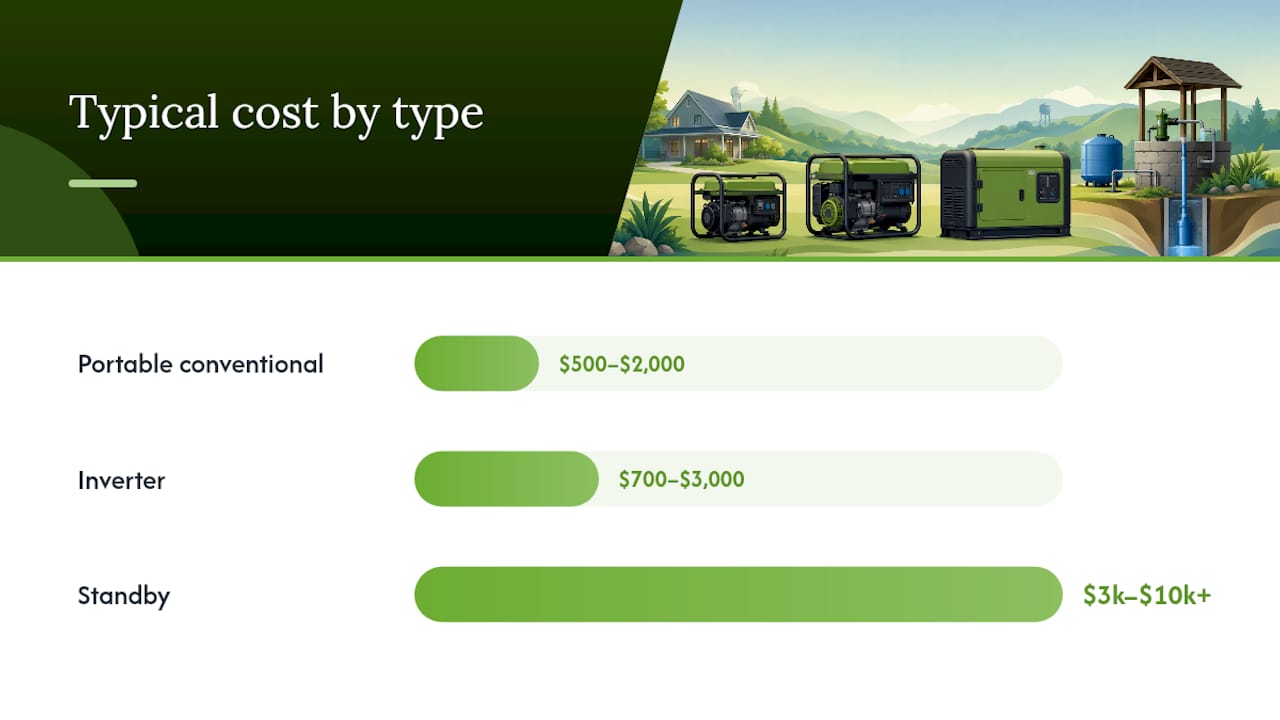
Portable conventional generators are the most common backup for well pumps. A 5,000–7,500 W unit with a 240V outlet covers most residential pumps. The tradeoff is manual setup every time the power goes out.
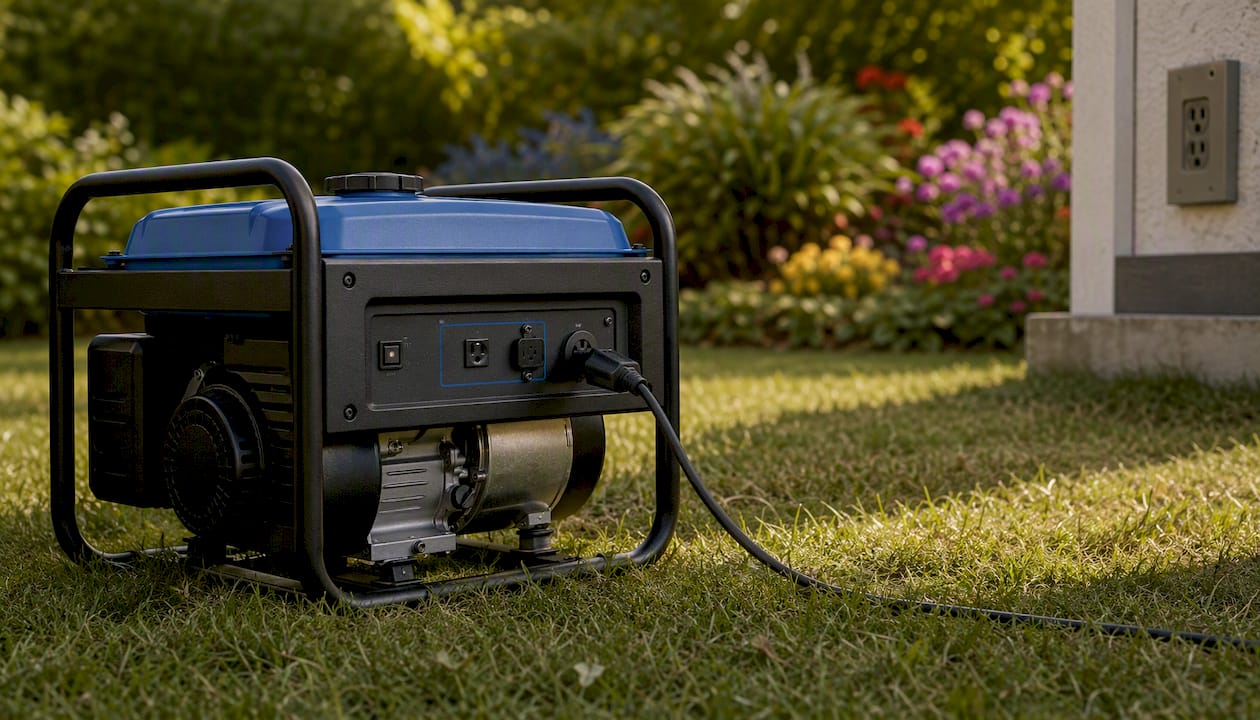
Inverter generators produce cleaner power, which matters if your pump uses a variable-speed or constant-pressure controller. Those controllers are sensitive to power quality (total harmonic distortion, or THD), and a conventional generator’s rougher output can cause controller errors or faults. The problem with inverter units is surge capacity. If you go the inverter route, verify the surge rating explicitly, not just the running watts. A soft-start device (covered in a later section) can make an inverter generator viable for pump use.
Standby generators are the right answer for homes that lose power frequently or for extended periods. They start automatically, run on natural gas or propane, and provide consistent 240V output without any manual intervention. For a household where the well pump is the primary water source, a standby unit paired with an automatic transfer switch is the most reliable setup.
How to connect a generator to a well pump safely
Connecting a generator directly to your home’s wiring without proper isolation is illegal under the National Electrical Code (NEC) and genuinely dangerous. Backfed power can electrocute utility workers on lines you assume are dead. There are three legitimate connection methods.
Transfer switch (dedicated pump circuit): A transfer switch disconnects the pump circuit from utility power before connecting it to the generator. This is the cleanest, safest option for a single-circuit setup. A 50A automatic transfer switch handles the switching automatically when utility power drops.
Manual transfer switch or interlock kit: An interlock physically prevents the main breaker and generator breaker from being on simultaneously. It’s less expensive than a full transfer switch and NEC-compliant when installed correctly. It requires a licensed electrician and a permit in most jurisdictions.
Dedicated generator inlet: A twist-lock inlet installed on the exterior of the house lets you plug a portable generator directly into a specific circuit without running extension cords through windows or doors. Paired with a transfer switch, this is the recommended portable setup.
Immediate safety rules — no exceptions:
- Never backfeed through a dryer outlet or any standard receptacle. It bypasses all protection and can kill.
- Run the generator outdoors, at least 20 feet from any door, window, or vent.
- Carbon monoxide (CO) is odorless. Install a battery-operated CO detector near sleeping areas and never run a generator in a garage, even with the door open.
- NEC Article 702 governs optional standby systems. Permanent transfer-switch installations require a permit and inspection in most states.
Pro Tip: Label your pump circuit clearly at the transfer switch panel. During an outage at 2 AM, you don’t want to guess which breaker controls the well. A piece of tape and a marker now saves real frustration later.
Generator placement, fuel options, and how long it will run your pump
Placement: Set the generator on a level, stable surface. Keep it at least 20 feet from windows, doors, and vents. Use a generator tent or canopy for rain protection, but never enclose it. Never operate indoors, in a garage, or in any partially enclosed space.
Fuel options:
- Gasoline is the most available but degrades in storage. Add a fuel stabilizer if the generator sits unused for more than 30 days.
- Propane stores indefinitely and burns cleaner. Dual-fuel generators give you flexibility when one fuel is unavailable.
- Diesel is more fuel-efficient and better for extended runtime, but diesel generators cost more upfront.
- Solar + battery systems can power a pump for short daily cycles without any fuel. Runtime depends on battery capacity and recharge rate.
If your pump runs intermittently, say 1 hour of actual pumping spread across a day, fuel consumption for the pump itself is modest. The generator will burn more fuel idling between pump cycles than actually running the pump. A 5-gallon tank gets you through a full day of intermittent pumping with fuel to spare. For current gasoline and diesel price data to estimate your actual fuel costs, the U.S. Energy Information Administration publishes weekly national averages.
Carbon monoxide safety callout: CO poisoning from generators kills dozens of Americans every year. The Consumer Product Safety Commission consistently identifies generator-related CO as one of the leading causes of non-fire CO deaths. Keep the generator far from the house, point the exhaust away from any structure, and test your CO detectors before every storm season.
Step-by-step: running your well pump on a generator
For a portable generator:
- Check fuel level and engine oil before starting. A generator that runs dry under load can damage the engine and drop voltage suddenly, which can harm the pump motor.
- Place the generator at least 20 feet from the house, on a level surface, exhaust pointed away from openings.
- Connect the generator to the dedicated inlet or transfer switch using the correct gauge extension cord or inlet cable. For 240V pumps, use a 10-gauge or heavier cord rated for the amperage.
- Start the generator and let it warm up for 2–3 minutes. Check that voltage stabilizes around 120/240V before connecting any load.
- Engage the transfer switch to isolate the pump circuit from utility power.
- Turn on the pump circuit. The pump will start and pressurize the tank.
- Monitor for the first 60 seconds. If the generator bogs down or trips a breaker, the surge demand exceeded capacity. See troubleshooting below.
For a standby system with automatic transfer switch: Verify the ATS is in automatic mode and the generator’s fuel supply is adequate. The system handles the rest. Run a monthly test cycle (most standby units have a built-in test schedule) to confirm the pump starts correctly under generator power.
Troubleshooting common startup problems:
- Pump hums but won’t start: The generator is supplying voltage but not enough surge current. Check the generator’s surge rating against the pump’s LRA. A soft-start device is the fix if the generator is otherwise adequate.
- Generator trips the breaker on pump start: Classic surge overload. The startup demand exceeded the breaker or generator capacity. Reduce other simultaneous loads, or install a soft-start.
- Voltage droops on startup: The generator is undersized for the surge. Voltage drop during startup can damage the pump motor over time. Size up or add a soft-start.
- No water after generator runs: Check that the transfer switch actually switched, the pump circuit breaker is on, and the pump is primed (jet pumps can lose prime during extended outages).
How soft-start devices and load management let you use a smaller generator
A soft-start device limits the inrush current when the pump motor starts by ramping voltage up gradually instead of applying full voltage instantly. The result is a startup surge that’s roughly 50–70% lower than the uncontrolled locked-rotor current. That reduction can mean the difference between needing a 7,500 W generator and getting by with a 4,000 W unit.
Types of soft-start solutions:
- Dedicated soft-starter modules: Installed in the pump’s control box, these are the most common retrofit option for submersible pumps. Brands like Franklin Electric offer compatible control boxes with built-in soft-start.
- Variable frequency drives (VFDs): More sophisticated than a basic soft-starter, a VFD also controls pump speed for constant pressure. They require clean generator power (low THD), so pair them with an inverter generator or standby unit.
- Constant-pressure controllers: Many modern pump systems already include soft-start functionality in the controller. Check your existing control box before buying a separate device.
Load management strategies:
- Stagger heavy loads. Don’t start the pump at the same moment as a refrigerator compressor or well heater.
- Run the pump in a dedicated window (early morning, for example) when other loads are minimal.
- Avoid running the dishwasher, washing machine, or electric water heater simultaneously with pump startup.
Pro Tip: A soft-start module typically costs $100–$300 installed. A generator upgrade from 5,000 W to 7,500 W costs $300–$800 more upfront, plus the soft-start pays dividends in motor longevity. If your pump is already installed and you’re retrofitting, the soft-start is almost always the better investment.
What should you look for when buying a generator for a well pump?
Use this checklist before you commit to any generator or transfer equipment.
Generator specs:
- Surge (peak) watt rating exceeds your pump’s LRA × voltage, plus other loads
- Continuous watt rating covers your total running load plus 20–30% headroom
- True 240V outlet (NEMA L14-30 or L14-50 for most residential pumps)
- THD below 5% if your pump uses a variable-speed or constant-pressure controller
- Fuel type matches your storage and availability situation
Transfer equipment:
- Transfer switch or interlock kit rated for your generator’s output amperage
- Dedicated generator inlet on the exterior of the house
- Compatibility with your existing panel layout (confirm with an electrician)
Decision matrix:
- Occasional outages (a few times per year, under 12 hours): A portable 5,000–7,500 W conventional generator with a 240V outlet and a manual transfer switch covers most residential pumps without overspending.
- Frequent or extended outages: A standby generator with an automatic transfer switch is worth the installation cost. You won’t be outside in a storm connecting cables.
- Off-grid or hybrid solar setup: A solar-plus-generator hybrid with a battery bank handles daily pump cycles on solar and reserves the generator for high-demand or cloudy periods.
Always check the pump nameplate for FLA and LRA before finalizing your generator choice. If the nameplate lacks LRA, use the 3–5× multiplier from industry sizing guides and add headroom. For any permanent transfer-switch installation, consult a licensed electrician. The permit and inspection process exists to protect you, your neighbors, and utility workers.
Including generator and pump maintenance in your seasonal home maintenance checklist is one of the simplest ways to avoid discovering a problem during an actual outage.
What most guides get wrong about generator sizing for well pumps
The standard advice online is to look up your pump’s horsepower, find it in a wattage table, and buy the generator that matches. That approach works until it doesn’t, and when it fails, it fails at the worst possible moment.
The tables are averages. Your pump’s actual LRA depends on its age, the depth of the well, the length of the wire run, and the condition of the pressure tank. The table doesn’t know that. Your nameplate does.
The second thing guides understate is the value of a proper transfer switch. Homeowners routinely skip it to save $200–$500 and connect generators through extension cords or improvised hookups. Beyond the legal and safety issues, an improvised connection means the pump circuit isn’t isolated from utility power. When the grid comes back on, the voltage interaction can damage both the generator and the pump motor simultaneously.
The third overlooked point: inverter generators are genuinely better for pumps with variable-speed controllers, but most inverter units sold in the 2,000–3,000 W range simply don’t have the surge capacity to start a 240V submersible pump. The clean power is irrelevant if the generator stalls on startup. Check the surge rating, not just the watts.
Size for the surge. Isolate the circuit properly. Verify the nameplate before you buy anything.
Gridwise-recommended generators and transfer equipment for well pumps
Water security during an outage isn’t a luxury. Gridwiseliving offers a range of generator and transfer-switch options sized specifically for residential well-pump use cases, so you’re not guessing at compatibility.

For whole-home standby coverage, the Powerhouse Gen 2 Whole Home Generator delivers the consistent 240V output and surge capacity that submersible pumps demand, with automatic operation so your water supply restores without you lifting a finger. Homeowners who want to reduce fuel dependence can pair the Powerhouse Gen 2 Whole Home Solar Generator with their existing solar energy systems for extended runtime on renewable power. The 50A Automatic Generator Transfer Switch handles safe, code-compliant circuit isolation for either setup. The 1200W PS50/DB5010 is part of the Gridwiseliving lineup but is too small for most 240V well pumps. It suits emergency lighting or phone charging, not pump backup.
Browse the full generator and transfer-switch lineup at Gridwiseliving and consult a licensed electrician to confirm the right configuration for your pump’s nameplate specs and your home’s panel layout.
Sources
Cross-check your sizing math with these resources before you buy.
- Well Pump Starting Watts Guide | Size My Generator
- Backup Generator for Well Pump | Complete Guide | Easy Guide
- Powering Well Pumps: Special Considerations for Rural Generator Installations
- Well Pump Backup Power Calculator
- What Size Generator Runs a Well Pump? Your Wattage and Horsepower Checklist - Water System Wiki
Always verify your pump’s nameplate specs against any calculator output, and have a licensed electrician review your transfer-switch installation before connecting to utility power.