

Stop No Starts: One Page Generator Maintenance Schedule for Homeowners
A layered schedule keeps most generators ready when you need them: weekly visual checks, a monthly exercise run under load, quarterly or semi-annual inspection and maintenance of filters and belts, and one annual full service with a load bank test. Standby units run on the calendar; prime and continuous-duty units run on the clock, typically every 250 to 500 hours. Skip the loaded runs and you’re setting up the three failures that sideline generators most often: dead batteries, degraded fuel, and an engine that’s never actually proven it can carry a real load.
TL;DR:
- Regular load bank testing, including annual full-load runs, verifies generators can meet actual capacity and prevents engine wet-stacking.
- Fuel sampling, water separator draining, and fuel polishing every six to twelve months are crucial to avoid microbial growth and injector clogging.
- Scheduled maintenance should follow a strict calendar or hour-based interval, with annual full service, including battery load testing, to reduce failure risks.
- Weekly inspections focus on visual signs of leaks, unusual noises, and vent obstructions, which help prevent unexpected outages.
- Homeowners should handle simple weekly and monthly checks, but complex tasks like fuel system work require licensed technicians for safety and accuracy.
Table of Contents
- Generator Maintenance Checklist: The One-Page Version
- What Should a Weekly Walkaround and Monthly Exercise Run Cover?
- How Often Should You Service a Generator Beyond the Monthly Run?
- Standby vs. Prime: Which Clock Runs Your Schedule?
- Why Load Bank Testing and Fuel Care Prevent the Failures That Matter
- DIY vs. Professional Service: Where’s the Line?
- The Gridwise Take on Homeowner-Scale Generator Care
- Ready to Simplify Your Backup Power Setup?
- Where This Schedule Comes From
- Sources
Generator Maintenance Checklist: The One-Page Version
Print this, tape it inside the generator enclosure, and check it off. It won’t replace a full service plan, but it catches the failures that actually happen.
Weekly (5 minutes):
- Walk around the unit, check for fluid spots under the slab, listen for anything unusual.
- Confirm the exhaust path is clear and nothing’s blocking intake vents.
Monthly (30+ minutes):
- Run the generator under at least 30% of rated load for a minimum of 30 minutes, per the standard cited in most generator maintenance checklists.
- Log voltage, frequency, oil pressure, and coolant temperature, plus confirm the automatic transfer switch (ATS) engages and releases cleanly.
Quarterly / Semi-Annual:
- Inspect and replace air and fuel filters if due.
- Check coolant level and condition.
- Inspect belts and hoses for cracking or glazing.
Annual:
- Full service: oil and filter change, battery load test, alternator check.
- Load bank test to verify true capacity under full load.
- File the signed service report with your maintenance log.
Whichever threshold comes first, calendar date or run hours, governs the interval. A generator that’s only run 40 hours this year still needs its annual calendar service. Safety note: never run a generator in an enclosed space or near open windows; carbon monoxide has no smell and kills quickly at high concentrations. Keep exhaust at least five feet from any structure opening.
What Should a Weekly Walkaround and Monthly Exercise Run Cover?
The weekly walkaround takes five minutes and catches problems before they become outages. Walk the unit slowly. Look for fluid stains under the slab, since a small puddle almost always means a seal or gasket is starting to fail, and it’s the cheapest catch you’ll ever make on this machine. Listen for rattles, grinding, or a fan that sounds off. Smell for fuel or burnt rubber. Check that the exhaust path is unobstructed and the enclosure vents aren’t blocked by leaves, snow, or storage boxes someone stacked against it.
The monthly exercise run is where most of the real diagnostic value lives:
- Start the unit and let it warm up normally.
- Transfer to at least 30% of rated load, not an unloaded idle. Idling without load is part of why engines wet-stack.
- Run for a minimum of 30 minutes, matching the monthly inspection standard used by regulated facilities.
- Record voltage, frequency, oil pressure, coolant temperature, and ATS transfer time. A note that says “ran fine” won’t satisfy an insurer or a warranty claim; numbers will.
Homeowners can safely handle terminal cleaning (a wire brush and a little baking soda paste on corroded battery posts) and topping off coolant or oil between services. Don’t open the fuel system, adjust valve components, or work near the alternator while it’s running.
Pro Tip: Keep a cheap spiral notebook or a phone note zipped to the same three questions every month: did it start on the first try, did the ATS transfer cleanly, and what were the four readings? Six months of that data will tell you more about your generator’s health than any single inspection.
How Often Should You Service a Generator Beyond the Monthly Run?
Quarterly and semi-annual service is where a technician earns their invoice. Oil and filter changes generally follow whichever comes first: a calendar interval (often every six months for standby units that rarely run) or an hours-based interval for units that see real use. Air filters get inspected every service visit and replaced when they show restriction; fuel filters typically go on a similar cadence, though dusty or high-use sites shorten that window.
Coolant needs a visual and chemical check twice a year, since degraded coolant loses its ability to prevent corrosion in the block long before it looks obviously bad. Batteries are the single most common cause of no-start events, so a proper visit includes a load test, not just a voltage check with a cheap meter. Most starting batteries hold up for a few years before capacity drops enough to risk a failed start. Belts and hoses get a physical inspection for cracking, glazing, and soft spots. The alternator and ATS contacts get checked for wear.
A few numbers worth knowing:
- Prime and continuous-duty units are commonly serviced every few hundred hours, per widely used preventive maintenance guidance.
- Facilities that skip scheduled load tests and fuel checks report a disproportionate share of outage-triggered failures tied to neglect rather than mechanical age.
Ask for a written report after every visit: date, hours logged, readings taken, parts replaced, and a technician signature. That paper trail matters more than most homeowners realize until an insurer or warranty department asks for it.
Standby vs. Prime: Which Clock Runs Your Schedule?
Figure out your generator’s duty class first, because it decides whether the calendar or the hour meter drives your intervals.
- Standby (Emergency Standby Power, ESP): Runs only during utility outages. Service on the calendar, since a unit that logs 20 hours a year still needs an annual service regardless of hour count.
- Prime (Prime Power, PRP): Runs regularly as a primary or supplemental power source with variable load. Service by hours, typically every 250 to 500 hours depending on load and manufacturer specs.
- Continuous (Continuous Operating Power, COP): Runs at a steady, constant load nonstop. Tightest hour-based intervals of the three, often shorter than standard prime cycles.
Most homes and small facilities run standby units, which makes the calendar the dominant clock. If your generator also handles brownout backup, load shedding, or regular scheduled runs beyond monthly testing, you’ve effectively drifted into prime territory and should switch to hour-based tracking.
Environment shortens every interval regardless of duty class. Dusty sites clog air filters faster and warrant quarterly instead of semi-annual filter checks. Coastal or humid climates accelerate corrosion on electrical contacts and battery terminals. High-heat installations stress coolant and oil chemistry faster, which is why some manufacturers recommend cutting standard oil-change intervals by a third in consistently hot climates.
Why Load Bank Testing and Fuel Care Prevent the Failures That Matter
A load bank test applies a controlled, resistive load to the generator, often well beyond what monthly exercise runs provide, to confirm the unit can actually deliver its rated capacity. NFPA 110 guidance calls for annual full-load testing on regulated systems, frequently for a sustained two-hour run, and the test report should show voltage stability, frequency stability, and temperature behavior under that load. Skipping this step means you’re trusting a generator that’s never proven it can do the one thing you bought it for.
Wet-stacking is the mechanical problem load bank testing exists to prevent. It happens when an engine runs underloaded or idles for extended periods, leaving unburned fuel and carbon to accumulate in the exhaust system instead of burning off cleanly. Monthly loaded runs at 30% or higher help burn off that buildup, and an annual full-load test clears anything the monthly runs missed.
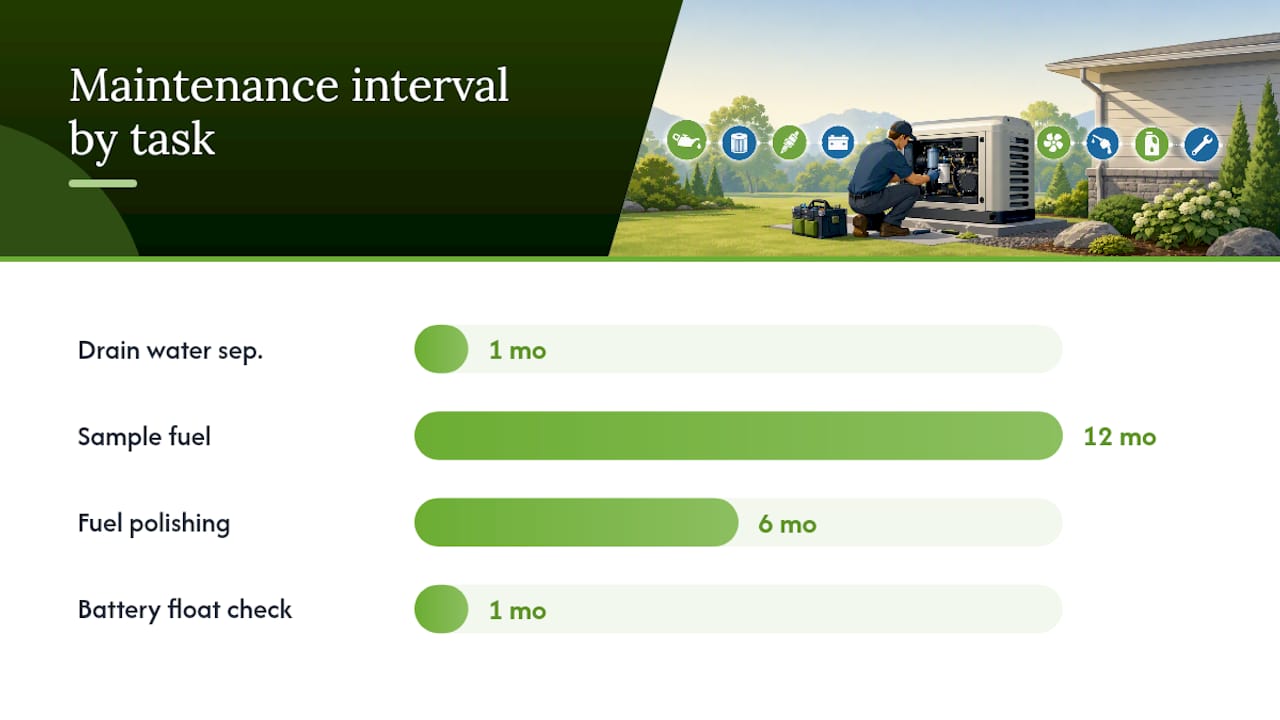
Fuel care is the other half of the equation for standby units:
| Task | Frequency | Why it matters |
|---|---|---|
| Drain water separators | Monthly | Water settles fast and feeds microbial growth |
| Sample and test fuel quality | Annually | Diesel oxidizes and degrades even in sealed tanks |
| Fuel polishing (filter and recirculate) | Every six months | Removes sludge and contamination before it clogs injectors |
| Battery float voltage check | Monthly | Confirms the charging system is maintaining the battery, not slowly killing it |
Diesel stored for a standby unit can develop microbial contamination within six to twelve months if left untreated, which is exactly why fuel sampling belongs on the annual list even for generators that barely run.
Pro Tip: If your unit sees heavy or continuous use, ask your technician about oil analysis at every change. A lab test on used oil often flags internal wear from rising iron or copper levels months before it shows up as a performance problem.
DIY vs. Professional Service: Where’s the Line?
Homeowners can safely handle the weekly walkaround, battery terminal cleaning, topping fluids, and running the monthly exercise test. Anything involving fuel system components, load bank testing, alternator work, or valve adjustments belongs to a licensed technician.
Before signing a service contract, ask for these in writing:
- Exact scope of work and which intervals it covers (quarterly, annual, or both).
- Reporting format: will you get signed logs with readings, or a vague “serviced” note?
- Parts and labor coverage, plus expected emergency response time if the unit fails during an outage.
Stop and call a pro immediately if you see: fuel or coolant leaking, unusual smoke color, the ATS failing to transfer during a monthly test, or a battery that won’t hold a charge after a fresh terminal cleaning.
The Gridwise Take on Homeowner-Scale Generator Care
Most no-start failures we see traced back aren’t mechanical age. They’re skipped monthly runs and batteries nobody tested until the power actually went out. That’s the gap a simple schedule closes.
We build products like the Powerhouse Gen 2 Whole Home Generator with transfer switch integration specifically to make that monthly test easier to run and log consistently. Pair a weekly glance and a monthly loaded run with one annual professional visit, and print the checklist above. It’s the cheapest insurance your system will ever get.
— Gridwise
Ready to Simplify Your Backup Power Setup?
If you’re piecing together maintenance around an aging portable unit, the math often favors starting fresh with hardware built for easier upkeep from day one. The Powerhouse Gen 2 Whole Home Generator pairs with the 50A Automatic Generator Transfer Switch to automate the transfer step that trips up so many monthly tests, and for households wary of fuel storage and polishing schedules altogether, the Powerhouse Gen 2 Whole Home Solar Generator skips the fuel system maintenance entirely.
Whatever route fits your home, size the generator and the maintenance plan together. A unit that’s oversized for your panel just means more fuel to manage and more hours to log for no real benefit. Browse the full generator lineup and compare specs against your actual load before you buy.
Where This Schedule Comes From
This schedule draws on NFPA-aligned testing intervals, monthly inspection standards for regulated systems, and general homeowner maintenance checklist practices applied to backup power systems specifically.
Sources
- Generator maintenance checklist
- Monthly emergency generator inspection checklist (TCEQ)
- UFM 3-540-07 (2026) — typical inspection and maintenance schedules