

3+ Strings: Homeowners and Installers' Solar Combiner Box Checklist
A solar combiner box is a weatherproof enclosure that aggregates output from multiple PV strings, giving each one its own overcurrent protection, a shared DC disconnect, and surge protection before the current heads to the inverter. You typically need one once your array has three or more strings tied to a single inverter input, once DC wire runs get long, or when your inverter’s documentation calls for external fusing. Below three strings, most inverters handle protection internally and a combiner becomes optional rather than mandatory.
TL;DR:
- A solar combiner box is necessary when an array has three or more strings or when long DC wire runs require a centralized overcurrent and surge protection point.
- Key specifications include DC fuses rated under IEC 60269-6, Type 2 DC surge protection devices, and an enclosure rated for the installation environment.
- Proper placement near the array, correct torque on connections, and regular maintenance of SPD indicators and fuses are crucial for longevity and safety.
- Compliance with NEC codes, UL 1741 listing, and accurate fuse sizing based on the 156% rule are essential for code approval and system safety.
- Retrofitting becomes necessary when adding strings, replacing a failed SPD, or accommodating updated code requirements, always with professional assistance.
Table of Contents
- How Does a Solar Combiner Box Work?
- What Components and Specs Should You Check?
- What Types of Combiner Boxes Are There?
- When Do You Actually Need a Combiner Box?
- What Code and Safety Checks Matter Most?
- How Should You Install and Maintain a Combiner Box?
- Which Combiner Box Specs Should You Compare Before Buying?
- Gridwise Living’s Take on Sourcing Combiner Components
- When Should You Retrofit an Existing Combiner Box?
- Gridwise Living: Where to Start on Solar Components
- Sources
- FAQ
How Does a Solar Combiner Box Work?
Each PV string lands on its own fuse holder or DC-rated MCB inside the box. From there, the positive and negative conductors from every string join on shared busbars, and the combined current exits as one DC feed to the inverter. That per-string fusing matters more than most homeowners realize: if one string develops a fault, its fuse blows and isolates the problem before backup current from the other healthy strings can flow backward through it and damage the panels or the inverter.
The combiner sits at a specific point on the system’s single-line diagram, between the array and the inverter, and placement isn’t arbitrary. According to RatedPower, designers typically locate combiners near the physical center of a panel cluster to minimize wire length and resistive loss.
A working combiner box performs five distinct jobs:
- Parallels multiple DC strings into one feed
- Protects each string with individual overcurrent devices
- Absorbs surge energy through an integrated SPD
- Provides a load-break disconnect for the array
- Offers a grounding tie point for the whole assembly
That combination, drawn from the Trilpeak solar combiner box guide, is what separates a combiner from a basic splice box.
What Components and Specs Should You Check?
Not every combiner box on the market is built the same way, and the differences show up fast once something goes wrong. A few specs are worth checking before you buy or sign off on an installer’s parts list.
- Fuse type: look for gPV DC fuses rated under IEC 60269-6, not generic DC-rated MCBs pulled from another application.
- SPD rating: the surge protection device needs a Type 2 DC rating, with its Ucpv rated at or above your system’s open-circuit voltage.
- SPD performance targets: according to SurgePV, a nominal discharge current (In) of at least 20 kA is typical, paired with a let-through voltage (Up) suited to your system voltage class.
- Isolator and busbar ratings: confirm the load-break DC isolator and internal busbars carry a continuous current rating above your array’s expected output, with margin.
- Grounding bar: a dedicated PE ground bar should be present and sized to code.
- Enclosure rating: match the NEMA or IP rating to where the box will live, and check that the cable glands fit your conductor sizes.
One detail installers sometimes skip: DC-specific SPDs need certification under IEC 61643-31, not the AC-only IEC 61643-11 standard, because clamping behavior and follow-current handling differ between AC and DC surge events.
What Types of Combiner Boxes Are There?
Combiner boxes aren’t one-size-fits-all, and picking the wrong family for your setup usually shows up as a permitting headache later.
- Standard DC combiner: fuse inputs, an integrated SPD, and a basic isolator. This covers most residential and small commercial arrays.
- Disconnect combiner: adds a load-break switch rated for service work, letting utility crews or firefighters de-energize the array quickly.
- AFCI combiner: built-in arc-fault detection, required in many residential jurisdictions where rooftop wiring runs through occupied space.
- AC combiner: combines inverter outputs rather than DC strings, and it’s a different animal from a DC solar panel junction box even though the enclosures look similar.
- Hybrid junction units: smaller combiner/junction hybrids that suit compact systems with only two or three strings and modest budgets.
Confusing a combiner box vs junction box is common. A junction box just splices conductors; it carries no fusing, no SPD, and no disconnect function.
When Do You Actually Need a Combiner Box?
The clearest trigger is string count. Once you have three or more strings feeding a single inverter MPPT input, per-string overcurrent protection generally becomes necessary rather than optional, a threshold both Trilpeak and RatedPower point to directly.
A few other situations push you toward a combiner even below that threshold:
- Your inverter’s manual doesn’t include integrated string fusing, meaning protection has to happen upstream.
- DC runs from the array to the inverter are long enough that a combiner near the array reduces voltage drop and gives you a closer point for lightning and surge protection.
- Your local authority having jurisdiction (AHJ) or the manufacturer’s install manual specifically mandates per-string overcurrent devices or an external disconnect at the array.
If none of those apply and you’re running two strings into an inverter with built-in fusing, you may not need a separate combiner box at all.
What Code and Safety Checks Matter Most?
Solar wiring solutions live or die on a handful of code references, and skipping them is the fastest way to fail an inspection. Pull up NEC 690.8 for maximum circuit current calculations, 690.9 for overcurrent protection requirements, 690.11 for arc-fault protection, and 690.15 for disconnect requirements. Any combiner box you install should also carry UL 1741 listing through a Nationally Recognized Testing Laboratory (NRTL), not just a manufacturer’s own claim of compliance.
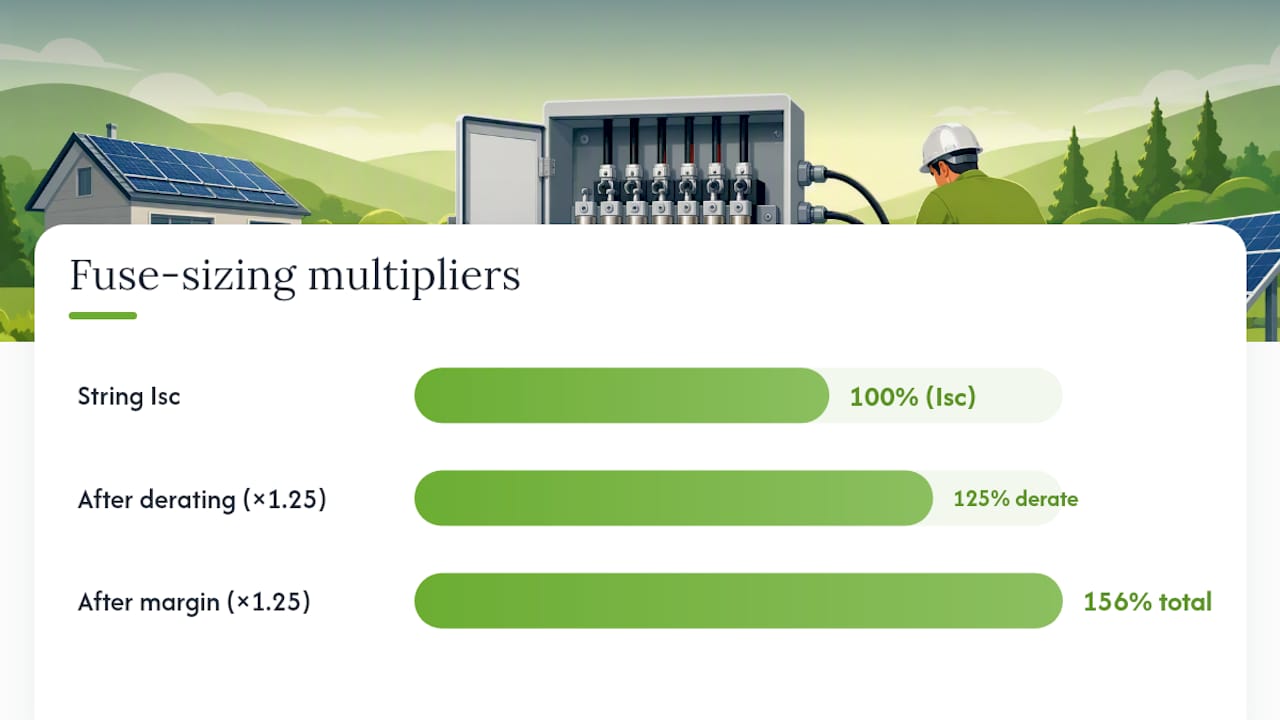
Fuse sizing commonly uses the 156% rule: multiply the string’s short-circuit current (Isc) by 1.25 twice to account for derating and margin, then round up to the next standard fuse size. That’s the math behind Solar Permit Solutions’ fuse-sizing guidance, and it’s non-negotiable if you want the box to pass plan review.
Pro Tip: Print the fuse-sizing worksheet and keep it with your permit paperwork. AHJ reviewers ask for it more often than installers expect, and having the math ready saves a callback.
Before signing off, run through this checklist:
- Confirm SPD status indicators show green or “OK,” not a fault or discharge signal.
- Verify every fuse holds continuity under a multimeter check.
- Check torque settings on busbar and terminal connections.
- Confirm labeling matches the single-line diagram and disconnect location rules.
- Inspect grounding continuity from the combiner to the main grounding electrode.
How Should You Install and Maintain a Combiner Box?
Placement affects lifespan more than most buyers expect, so consulting experts on solar-powered security camera installation can help when integrating auxiliary loads near the array. Mount the box near the array but out of direct sun where possible; a shaded, ventilated spot cuts internal heat buildup that shortens component life. For coastal or high-humidity sites, an enclosure with a NEMA 4X rating handles corrosion far better than the NEMA 3R minimum typically specified for standard outdoor use, per SurgePV’s commercial design guidance.
Follow this sequence during installation and ongoing upkeep:
- Route conductors through properly sized cable glands, checking ampacity against temperature derating tables rather than a flat rating.
- Torque every terminal connection to the manufacturer’s spec, then log the values for future inspections.
- Schedule a semiannual check of SPD indicators, fuse continuity, and enclosure seals for condensation or corrosion, a routine RatedPower’s maintenance guidance backs up as sufficient for most residential systems.
- Watch string-level output data if you have it. A sudden drop on one string while others hold steady almost always points to a blown fuse rather than a panel failure.
Larger commercial arrays benefit from more frequent digital monitoring; Viox’s guidance on fuse nuisance tripping recommends string-level monitoring above 500 kW so blown fuses get caught without manual inspection rounds.
Which Combiner Box Specs Should You Compare Before Buying?
Shopping for a PV combiner array often comes down to comparing spec sheets side by side, and a short checklist keeps you from missing something a vendor glossed over.
- String capacity: size the box for your current string count plus 10 to 15% spare capacity, and confirm the max system voltage rating covers your array’s Voc under cold-weather conditions.
- Fuse and busbar math: verify the fuse or MCB type matches gPV or DC-rated standards, confirm the 156% sizing calculation, and check that busbar and isolator continuous ratings clear your expected current with room to spare.
- SPD credentials: confirm the SPD is Type 2 DC rated for your system voltage, with adequate In and Up values and a visible status indicator you can check without opening the enclosure.
- Enclosure and paperwork: match the NEMA rating to your climate, and ask the vendor directly for NRTL/UL listing documentation rather than taking a spec sheet at face value.
For systems scaling past 500 kW, SurgePV notes that fewer, larger combiners built around 1500 V components often lower total system cost even when each unit costs more upfront.
Gridwise Living’s Take on Sourcing Combiner Components
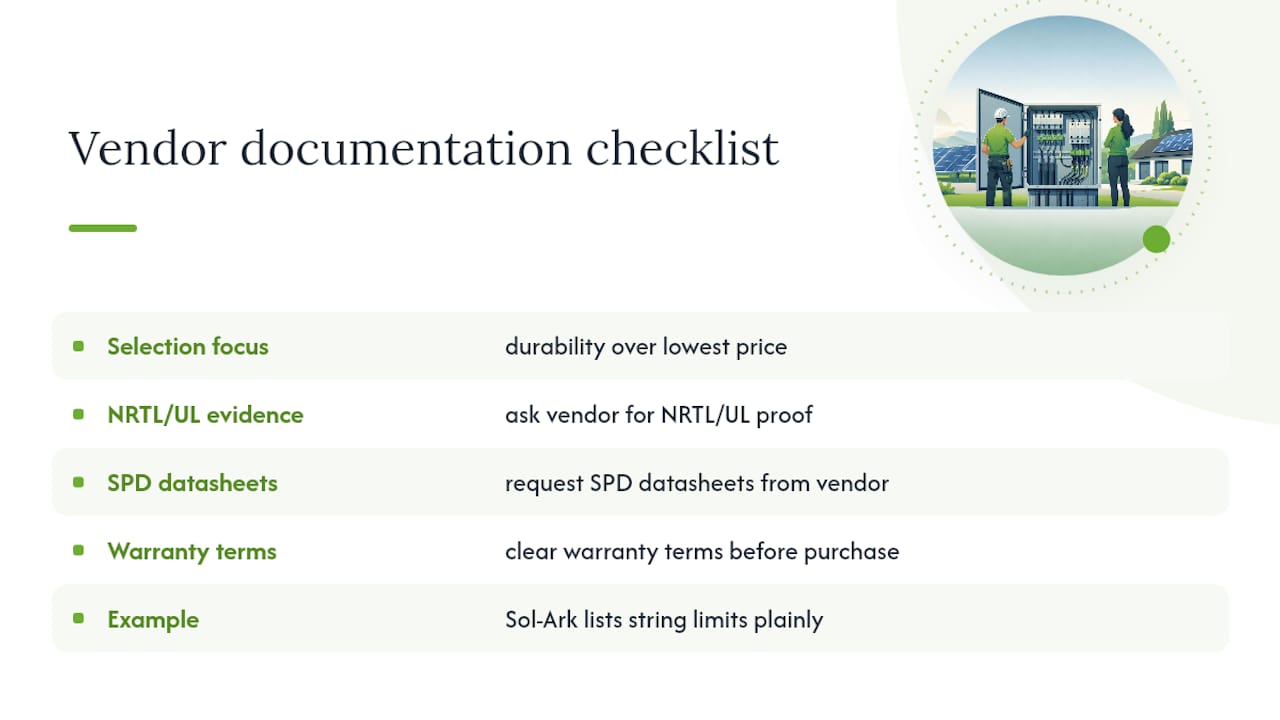
The company curates solar energy systems and inverters chosen for durability rather than the lowest sticker price. When you’re comparing combiner boxes or full kits, ask any vendor for NRTL/UL evidence, SPD data sheets, and clear warranty terms before you buy. A Sol-Ark hybrid inverter is a good example of documentation done right, listing string limits plainly in its spec sheet.
When Should You Retrofit an Existing Combiner Box?
Adding strings to an existing array, a failed SPD, or a code update from your AHJ are the three most common reasons to retrofit. Start by checking whether your inverter’s internal protection already covers the new load before designing a combiner around it. For any DC-side modification, bring in a licensed solar electrician. Reverse-current mistakes on live DC circuits are not a beginner’s repair job.
— Gridwise
Gridwise Living: Where to Start on Solar Components
If you’ve read this far, you already know a combiner box is one piece of a larger system, and getting the rest of that system right matters just as much. Gridwiseliving’s solar energy systems category is built around the same durability standard this article just walked through: parts with real documentation, sized correctly, and backed by support if something doesn’t fit your setup.

Pairing solar with battery backup is common enough that it’s worth checking Gridwiseliving’s generators category too, especially if you’re planning a hybrid system with a transfer switch. If you’re unsure whether a specific inverter or combiner will match your string count and voltage, reach out before you buy. Compatibility questions are far cheaper to answer over email than after a failed inspection.
Sources
For code language, keep NEC Article 690 and its subsections (690.8, 690.9, 690.11, 690.15) on hand, along with confirmation of UL 1741 / NRTL listing on any equipment you buy. The Solar Permit Solutions fuse-sizing guide and SurgePV’s commercial combiner design breakdown are worth revisiting during permit prep or vendor comparisons.
- Solar Combiner Box: Complete DC & PV Guide (2026)
- What is a solar combiner box and why is it used in photovoltaic designs? — RatedPower
- Solar Combiner Box: Function, Wiring & Selection Guide
- Combiner Box Design for Commercial Solar 2026 | SurgePV
FAQ
What Does a Solar Combiner Box Do?
It aggregates DC output from multiple PV strings onto shared busbars while giving each string its own fuse or breaker, a surge protection device, and a load-break disconnect. That protects the array and inverter from single-string faults without shutting down the whole system.
Does a Solar Combiner Box Increase the Voltage?
No. A combiner box adds string currents together in parallel; it doesn’t step up voltage the way a transformer would. Voltage stays at whatever the string configuration produces, while total current increases as more strings join the busbar.
How Much Does a Solar Combiner Box Cost?
Pricing varies widely based on string count, SPD rating, and enclosure material, and current models and pricing are available through Gridwiseliving’s solar energy systems collection. Commercial units built around 1500 V components typically cost more per unit but can lower overall system cost on larger arrays.
What Is the Best Way to Connect Multiple Solar Panels?
For arrays with three or more strings feeding one inverter input, routing each string through a combiner box with individual fusing is the standard approach. Two-string systems paired with an inverter that has built-in protection can often skip the combiner and wire directly, provided the inverter documentation confirms it’s rated for that configuration.