

Match Your Well Water Filtration to Lab Results for Homeowners
There is no single best well water filter. The right approach starts with a certified lab test, then a correctly sequenced, properly sized multi-stage whole-house system built around what that test actually finds, with a reverse osmosis unit added at the kitchen sink when drinking water needs extra polish. Skip the guessing and skip the one-size-fits-all cartridge sold at the hardware store.
TL;DR:
- Your well water test should include pH, hardness, iron, manganese, hydrogen sulfide, bacteria, nitrates, arsenic, and PFAS for accurate media sizing.
- A standard whole-house system involves multiple stages in a specific order, starting with sediment filtration and ending with UV disinfection, tailored to your water chemistry.
- Different contaminants require specific media, with sediment pre-filters being essential for any downstream treatment to work effectively and last longer.
- For dissolved contaminants like arsenic or nitrates, installing point-of-use reverse osmosis after whole-house filtration provides necessary final purification.
- Always size treatment equipment based on your lab results, household flow rate, and post-installation testing to ensure proper performance and avoid systemic issues.
Table of Contents
- What Should Your Well Water Filtration Test Include?
- How Does a Whole-House Well Water Filtration System Work?
- Which Filter Actually Removes Each Well Water Contaminant?
- How Do You Choose and Size the Right System?
- Do You Need Reverse Osmosis for Drinking Water Too?
- Why Gridwiseliving Values Durable, Low-Maintenance Water Systems
- Get Started With Gridwiseliving’s Well Water Filtration Options
- Where to Verify Well Water Testing and Treatment Guidance
- Sources
What Should Your Well Water Filtration Test Include?
Before you buy a single filter, get your water tested at a certified laboratory. Test strips tell you almost nothing useful for sizing equipment. A real lab report gives you numbers in ppm and grains per gallon (GPG), and those numbers determine what media you need and how much of it.
Public health guidance is consistent on this point: test private well water at a certified lab before you make any treatment decisions, and the CDC recommends testing annually for bacteria and periodically for chemical contaminants depending on your region and well history.
A solid baseline panel should cover:
- pH and hardness (measured in GPG)
- Iron and manganese (in ppm)
- Hydrogen sulfide, which causes the classic rotten-egg smell
- Coliform bacteria and E. coli
- Nitrates, especially near farmland or septic systems
- Arsenic and PFAS, if your region has known groundwater issues
Rust stains on fixtures, blue-green corrosion on plumbing, cloudy water, or a sulfur smell are all clues worth noting, but they only tell you where to look. The CDC’s guidance on private well safety points homeowners toward their state health department or an accredited commercial lab for accurate results. Your county extension office often has a list of approved labs too.
How Does a Whole-House Well Water Filtration System Work?
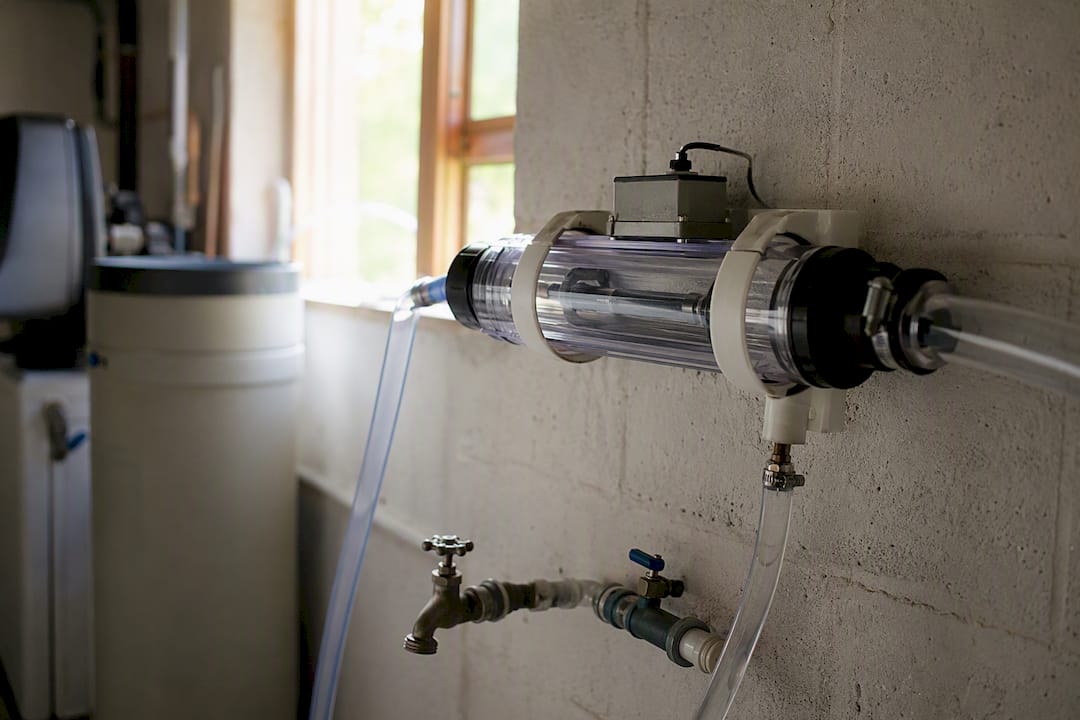
A complete whole-house well water filtration setup isn’t one box. It’s a sequence of stages, each doing a specific job, and that order isn’t arbitrary. Install them out of sequence and you’ll shorten the life of expensive components or leave contaminants untreated.
The standard stack, in order:
- Pressure tank regulates flow from the well pump before water hits any treatment.
- Sediment filter strips out grit, sand, and rust particles first.
- Iron and sulfur oxidation (media tank or air-injection unit) converts dissolved iron and hydrogen sulfide into filterable solids.
- Acid neutralizer raises low pH before it corrodes downstream fittings.
- Water softener handles hardness minerals that would otherwise scale every appliance in the house.
- Carbon filter polishes taste, odor, and residual chlorine or chemical byproducts.
- UV disinfection provides a final microbial barrier once the water is clear.
Sediment always goes first because grit fouls valves, clogs media beds, and clouds water enough to reduce UV light effectiveness. This recommended stage order shows up in nearly every professional installation guide for a reason.
Pro Tip: Size your system to your home’s sustained flow rate, not your fixture count. A typical home running multiple fixtures simultaneously needs sufficient sustained flow capacity, and undersized media beds will bypass untreated water during peak demand.
Chemical injection (like chlorine) handles heavier bacterial loads or iron levels that overwhelm oxidation media, but it adds a contact tank and more maintenance than UV. UV is simpler and chemical-free, provided the water reaching it is already clear and low in hardness.
Which Filter Actually Removes Each Well Water Contaminant?
Different contaminants need different technology. There’s no universal cartridge that handles iron, bacteria, and dissolved arsenic equally well, and buying the wrong media for your specific problem wastes money and leaves the actual issue untouched.
- Sediment: cartridge filters in Big Blue housings, rated by micron size (typically 5 to 20 microns). Swap cartridges every 2 to 3 months depending on sediment load.
- Iron and sulfur: oxidation media or air-injection oxidizer (AIO) units convert dissolved metals into particles a backwashing filter can capture. Katalox Light and similar media handle moderate iron loads well but lose efficiency once iron concentrations climb past a few ppm, which is where a dedicated oxidizer earns its keep.
- Tannins: anion exchange resin, similar in design to a softener, pulls the organic compounds that turn well water a tea color.
- Hardness: salt-based softeners deliver true soft water through ion exchange; salt-free template-assisted crystallization (TAC) conditioners prevent scale buildup without removing the minerals, which matters if you’re on a sodium-restricted diet or a septic system sensitive to salt discharge.
- Low pH: calcite neutralizers raise pH by slowly dissolving calcium carbonate into the water stream. They need periodic media refills as the calcite depletes.
- Bacteria: UV disinfection is highly effective, but only when turbidity is already low. Heavier contamination sometimes calls for chlorination instead.
- Arsenic, nitrates, and PFAS: whole-house media rarely handles these reliably. Point-of-use reverse osmosis or specialized adsorption media is usually the only dependable route.
Sediment pre-filtration isn’t optional in any of these setups. Every downstream media bed, softener resin, and UV chamber performs worse and fails sooner when it’s fed cloudy, grit-heavy water.
How Do You Choose and Size the Right System?
Match equipment to your lab numbers, not to a generic package deal. Start with your pH, hardness, and iron readings, then work outward: pick the stages that address what’s actually elevated, size the flow rate to your household’s peak demand, and confirm your plumbing and electrical setup can support what you’re adding.
- Interpret your lab report first, then select only the stages your water actually needs.
- Size for sustained GPM and backwash requirements. A softener that regenerates while someone’s showering will cause pressure drops.
- Confirm electrical access near the install point if you’re adding a UV sterilizer or chemical feed pump.
- Budget for cartridge changes, media replacement, and annual UV lamp swaps as ongoing costs, not one-time expenses.
Cost ranges vary widely based on media volume and installation complexity. A basic sediment plus carbon setup runs far less than a full stack with iron oxidation, a softener, and UV, and homes with high iron or low pH need larger, more specialized tanks that add real cost.
Pro Tip: Retest your water 30 to 60 days after installation. If iron or hardness readings haven’t dropped close to expected levels, the system is either undersized or a stage is out of sequence, not defective.
Watch for red flags like water pressure that drops noticeably after installation, a return of rust stains within weeks, or a persistent odor. Incorrect sequencing is the most common cause of a system underperforming right out of the gate.
Do You Need Reverse Osmosis for Drinking Water Too?
Even a well-built whole-house system usually won’t touch dissolved contaminants like arsenic, nitrates, or PFAS at a level you’d want in your drinking glass. That’s the gap point-of-use reverse osmosis fills. RO membranes strip dissolved solids down to a fraction of their original concentration, giving you a final layer of protection specifically for water you drink and cook with.
- Install the RO unit after your whole-house sediment and carbon stages, never before. Feeding an RO membrane untreated well water shortens its life dramatically.
- Choose tankless designs for faster refill and a smaller footprint, or tanked units if your household draws large volumes at once.
- Replace pre-filters roughly every 6 to 12 months and the membrane every 2 to 3 years, depending on feed water quality.
Pairing whole-house treatment with point-of-use RO covers both the plumbing that protects your home and the water you actually consume.
Why Gridwiseliving Values Durable, Low-Maintenance Water Systems
Self-reliant homeowners don’t want equipment that needs constant babysitting. Gridwiseliving leans toward systems with serviceable valves and media that lasts, favoring passive stages like calcite neutralizers over complex chemical dosing whenever the water chemistry allows it. Durability beats complexity every time your well is the only water source you’ve got.
— Gridwise
Get Started With Gridwiseliving’s Well Water Filtration Options
Once your lab results tell you what you’re dealing with, the next step is sourcing equipment built to last through years of well water use, not a season. Gridwiseliving’s water filtration collection covers point-of-entry protection for sediment, iron, and pH issues, along with point-of-use RO options for households that want an extra layer of confidence at the kitchen tap.
If your test came back with elevated iron or sulfur, start with a targeted whole-house stage sized to your flow rate. If arsenic, nitrates, or PFAS showed up, prioritize an RO unit at your primary drinking source first. And if your property runs on well pump power during outages, it’s worth checking that your backup power setup, including generator sizing for your well pump, can keep your treatment system running when it matters most. Browse the collection, match products to what your lab report actually shows, and order the pieces that fix your specific water, not someone else’s.
Where to Verify Well Water Testing and Treatment Guidance
- CDC guidance on private well testing
- Rhode Island DOH on filtration and treatment
- Mid Atlantic Water’s installation guide
Sources
- Filtration and Treatment of Private Well Water | Rhode Island Department of Health
- Private Water Systems and Public Health | CDC
- Guidelines for testing well water | CDC
- What to Install for Well Water: Order, Setup & Cost (2026 Guide) – Mid Atlantic Water
- Best Water Filters for Well Water: Complete Guide by Contaminant Type