

Only Add Wind If Site Averages 8–10 mph, Off Grid Hybrid Solar and Wind
A hybrid solar wind system makes sense when your site has usable wind and you’re prepared for extra mechanical upkeep. If either condition is missing, solar-only is usually the smarter build. Where both check out, combining sources genuinely improves reliability and cuts the battery bank you’d otherwise need. Gridwiseliving sells integrated kits built for exactly this decision.
TL;DR:
- Wind turbines only justify their cost and maintenance if your site averages above 8 to 10 mph wind speed at hub height.
- A hybrid system requires an MPPT charge controller with independent channels for solar and wind, along with a diversion feature.
- Proper site assessment involves real wind data collection and obstacle analysis to ensure turbine efficiency before investing.
- Hybrid systems are most beneficial in windy, shaded, or high-latitude locations and less advantageous on open, sunny sites in the Sun Belt.
- Proper sizing focuses on your actual daily energy needs, with battery capacity for three to four days of autonomy and turbine support as a supplement.
Table of Contents
- How A Hybrid Solar Wind System Actually Works
- Key Components And How They Work Together
- The Real Trade-Offs Of Going Hybrid
- Is A Hybrid System Right For Your Site? A Practical Checklist
- Sizing And Cost: A Working Example
- Installation And Long-Term Maintenance
- Gridwise Living Solutions For Real Homeowner Setups
- Your Next Steps Before Buying Anything
- Real-World Hybrid Setups Worth Knowing About
- Where The Conventional Advice Gets This Wrong
- Get Your Hybrid System Sized Right With Gridwise Living
- Sources
How A Hybrid Solar Wind System Actually Works
The core idea behind a hybrid solar wind system is timing. Solar panels produce during daylight and go flat at night or under heavy cloud cover. Wind doesn’t follow that clock. It often blows hardest at night, during storm fronts, or in overcast weather when your panels are barely producing anything. Put the two on the same battery bank and you smooth out the dead zones that plague single-source setups.
That complementary timing is the whole engineering argument for going hybrid. Combining solar and wind reduces intermittency and can lower the battery capacity a system needs compared with running either source alone. Instead of oversizing your battery bank to survive a five-day cloudy stretch, a modest turbine can keep trickle-charging through exactly the conditions that stall your panels.
That said, the benefit has limits:
- Below roughly 8 to 10 mph average wind speed, a turbine’s contribution often isn’t worth the maintenance it demands.
- Sites boxed in by trees or neighboring rooflines rarely see enough clean airflow to justify a tower.
- Once your solar array already covers your load with margin, adding wind mostly adds cost and moving parts, not reliability.
- The sweet spot is a site with decent wind AND daily cloud or shading that regularly cuts into solar output.
Homeowners in genuinely windy, partly shaded, or high-latitude locations get the most out of a hybrid setup. Homeowners in the Sun Belt with an open, unobstructed roof usually don’t need to bother.
Key Components And How They Work Together
A working hybrid wind solar kit is really five parts that have to agree with each other, not five parts bolted together and hoped for the best.
- Wind turbine. Check the cut-in speed (the wind speed at which it starts producing), rated power, and required tower height. Small residential turbines are almost always horizontal-axis (HAWT), which are more efficient at steady, unobstructed wind, while vertical-axis (VAWT) units tolerate turbulent, direction-shifting wind better but generally produce less per dollar of hardware.
- Solar array. For a hybrid build, panel choice matters less than mounting. Ground-mount or pole-mount arrays near the turbine tower simplify wiring runs and let you add panels later without touching the roof.
- Hybrid charge controller. This is the part people underestimate. Solar and wind have completely different voltage and current curves, so the controller needs independent MPPT channels for each input to track them separately rather than forcing one algorithm onto both. It also needs a dump-load or diversion feature, since a spinning turbine with nowhere to send excess power can overspeed and damage itself.
- Battery bank. Lithium iron phosphate (LFP) is the standard choice for hybrid off-grid setups because it tolerates deep, frequent cycling far better than lead-acid and holds a stable voltage as it discharges.
- Inverter. Size it to your peak simultaneous load, not your average load, and leave headroom for motor starting surges from well pumps or refrigerators.
Well-designed systems also run on priority logic: the controller checks battery state of charge and routes power accordingly, favoring whichever source is producing and diverting the surplus once the battery bank is full.
Pro Tip: Ask any vendor for the controller’s actual spec sheet before you buy anything else. If it doesn’t show separate MPPT channels for wind and solar plus a diversion load rating, keep shopping.
The Real Trade-Offs Of Going Hybrid
Adding a turbine to a solar setup is not a free upgrade. It’s a genuine trade, and it’s worth seeing plainly before you commit.
- Reliability gain: Two independent generation sources mean one failing or underperforming doesn’t take down your whole system.
- Maintenance cost: Wind turbines have gearboxes, bearings, and blades that wear. Reviews of hybrid systems consistently flag added mechanical complexity as the main downside versus solar-only, which has essentially no moving parts.
- Permitting friction: Towers tall enough to matter often trigger height restrictions, HOA objections, or noise ordinances that solar panels never run into.
- Shared infrastructure: One battery bank and inverter serving two sources is more cost-efficient than running two separate systems, which partly offsets the tower expense.
- When solar-only wins: Sunny, unobstructed, low-wind sites with straightforward permitting. Adding a turbine there is spending money to solve a problem you don’t have.
Is A Hybrid System Right For Your Site? A Practical Checklist
Before you spend a dollar on hardware, answer these in order.
- Get real wind data for your exact location and hub height, not the nearest airport reading. Local terrain and buildings can suppress wind speeds significantly compared to open mesoscale maps, and a year of on-site measurement, or at minimum a few seasonal cycles, beats any regional average.
- Check tower height against nearby obstructions. Wind speed and turbulence near trees, rooflines, or hills can differ sharply from a spot even fifty feet away, and mounting above nearby obstacles is the single biggest lever you have over turbine output.
- Know your cut-in threshold. Most small residential turbines need roughly 2 to 2.5 m/s (about 4.5 to 5.6 mph) sustained wind before they produce anything meaningful, though some micro-turbine designs are tuned to start lower at the cost of peak output.
- Confirm permitting and setback rules with your county or HOA before you budget for a tower, since a rejected permit after purchase is the most expensive mistake in this whole process.
Pro Tip: If your only wind data is a regional average from a weather app, treat it as a starting guess, not a design number. Site-specific analysis is what separates a turbine that pays for itself from one that spins uselessly in your backyard’s dead air pocket.
Sizing And Cost: A Working Example
Sizing a hybrid solar wind system starts with your daily load, not the hardware catalog.
- Calculate daily load in kWh. Add up every appliance’s watt-hours per day. A modest off-grid cabin might land around 8 to 12 kWh/day; a full-time home with a well pump and refrigeration can push past 20 kWh/day.
- Convert to solar array size. A rough rule of thumb: divide your daily kWh need by 4 to 5 (average sun hours in most US regions) to get required PV kW, then add 20 to 30% to cover cloudy days and panel degradation.
- Size the turbine as a supplement, not the primary source. Oversizing a turbine to fully cover your load on its own usually wastes money, since wind is intermittent enough that you’d still need full battery backup anyway. Most hybrid designs treat wind as recharge support that reduces how deep the battery cycles on low-sun days.
- Size the battery bank for days of autonomy. A common approach targets 3 to 4 days of usable autonomy with LFP chemistry at 80% depth of discharge, with inverter headroom to handle surge loads. For a 10 kWh/day load, that’s roughly 37 to 50 kWh of usable battery capacity at conservative DoD assumptions.
Cost drivers stack up fast: the tower and turbine hardware, the battery bank (often the single largest line item), the hybrid controller, and installation labor for the foundation and electrical tie-in. Battery sizing decisions built around loss-of-power-supply risk and life-cycle cost tend to outperform simple rules of thumb once you have real site data to plug in, so treat the math above as a starting estimate, not a final design.
Installation And Long-Term Maintenance
Hire a licensed electrician or installer for the tower foundation and any grid-adjacent electrical work. A turbine tower carries real structural loads, and getting the footing wrong is not a mistake you get to fix cheaply later.
- Inspect turbine blades, bearings, and guy-wire tension at least twice a year, more often in high-wind regions.
- Clean PV panels on a simple seasonal schedule. They need far less attention than the turbine.
- Check the hybrid controller’s dump-load resistor periodically. If it fails silently, your battery bank can take overcharge damage without any obvious warning sign.
- Expect turbine bearings and blades to be the parts you eventually replace. Well-maintained small turbines commonly run 15 to 20 years, but moving components wear faster than static solar cells ever will.
Pro Tip: A hybrid controller that logs charge history is worth the extra cost. Catching a battery bank that’s been chronically overcharged for six months is a lot cheaper than replacing it two years early.
Gridwise Living Solutions For Real Homeowner Setups
Not every home needs the same rig. Here’s how Gridwiseliving’s lineup maps to the situations homeowners actually face.
- Tiny homes and small cabins: A 100-Watt portable briefcase solar kit covers light loads like lighting and device charging, and it’s built to travel if the home does too.
- Cabins and small off-grid homes: The 800-Watt off-grid solar panel kit scales to cover refrigeration and small appliance loads, a common jump point once a briefcase kit isn’t enough.
- Whole-home backup: The Powerhouse Gen 2 Solar and Wind Generator is built as an integrated hybrid unit for homeowners who want solar and wind feeding one system without stitching components together themselves.
Each product page lists its own specs and warranty terms, worth reviewing directly before you commit to a tier.
Your Next Steps Before Buying Anything
- Log your actual daily kWh usage for at least a week, ideally a month across different seasons.
- Walk your property and mark obstructions near any spot you’d consider for a tower, then pull local wind data for that exact location.
- Ask any vendor directly about MPPT channel count, dump-load capacity, battery chemistry compatibility, and what’s actually included in installation scope versus billed separately.
- Set a timeline and financing plan before you shop, since battery banks and towers are the expenses that most often blow past a homeowner’s first estimate.
Real-World Hybrid Setups Worth Knowing About
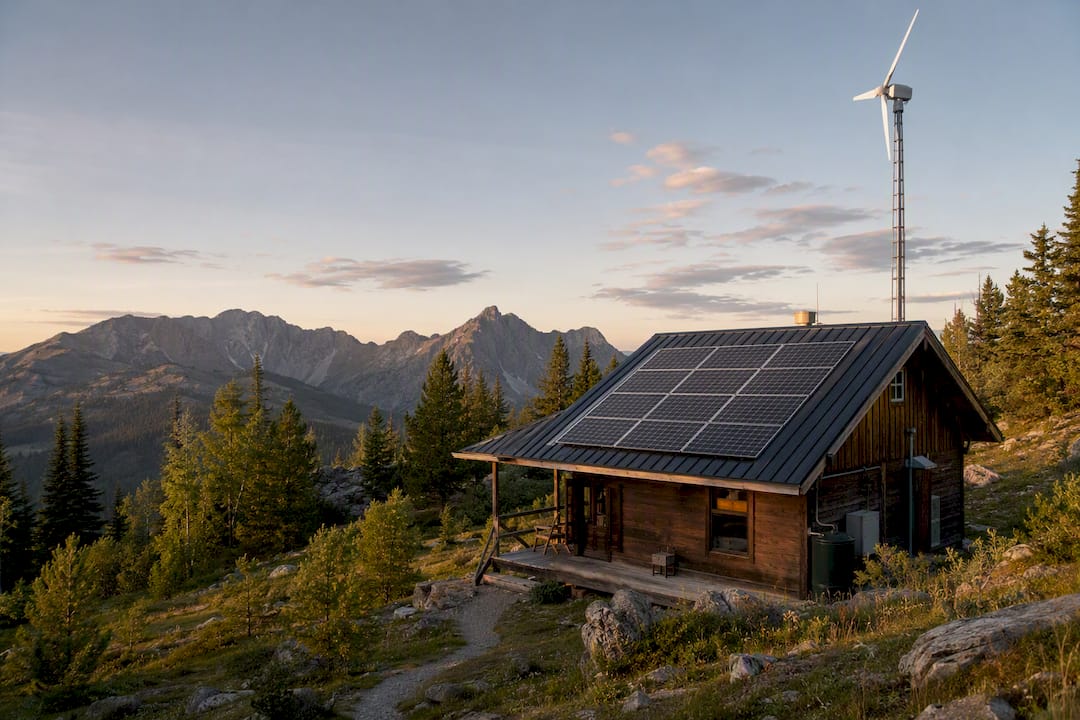
Off-grid homesteads in the Great Plains and mountain West are the most common real-world fit, since they combine strong average wind with enough elevation change to place a turbine well above surrounding obstructions. A cabin at 7,000 feet with consistent ridge wind can lean harder on its turbine through winter, when snow load cuts solar output but wind often picks up.
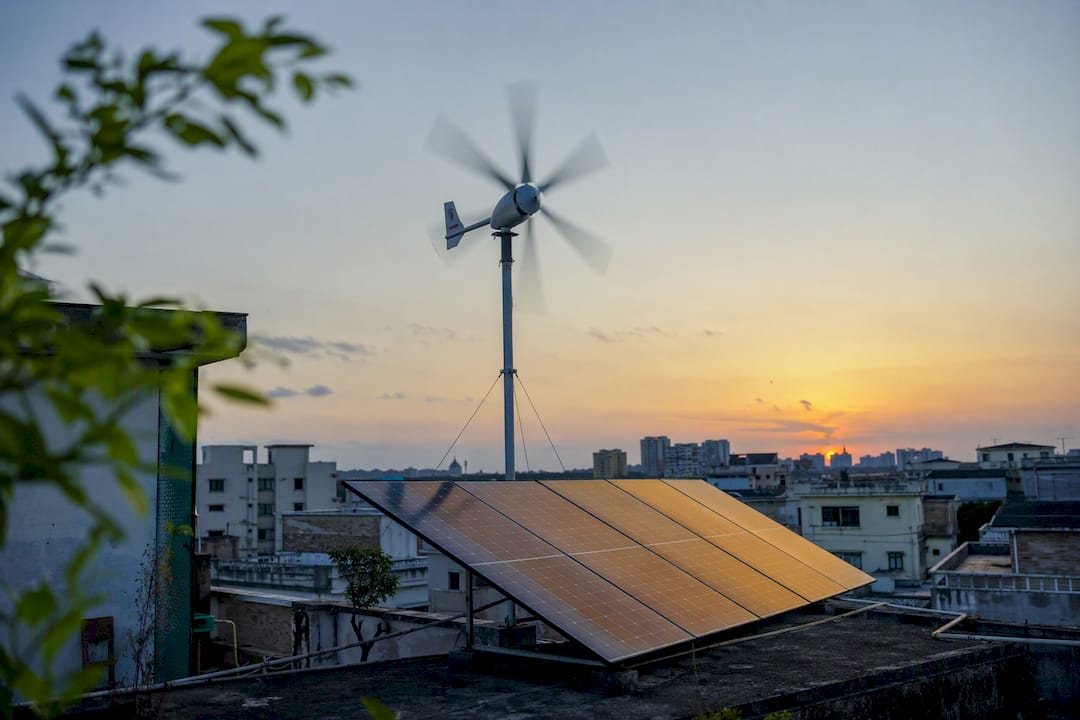
Compact urban and suburban hybrid installations tell a different story. Experimental rooftop designs that pair a small turbine with PV have shown an unexpected side benefit: airflow from the spinning turbine can cool the panels beneath it, and lab tests found this cooling effect raised PV efficiency by roughly 8 to 10% in certain compact layouts. That’s a narrow use case, since it depends on turbine placement relative to the array and a wind range the design was tuned for, but it’s a real illustration of how tightly integrated a hybrid system can get.
Tiny-home owners on wheels or foundations near open farmland represent the middle ground. They rarely have room or permitting patience for a full-height tower, so many settle for a solar-first build with a small turbine added later once they’ve confirmed the site’s wind pattern justifies it.
Where The Conventional Advice Gets This Wrong
Most guides treat “add a wind turbine” as a straightforward upgrade to any off-grid solar setup, as if more generation sources automatically means more reliability. That’s backwards. The research consistently points to controller intelligence and battery sizing as the variables that actually determine whether a hybrid system performs, not the raw kilowatts of turbine hardware you bolt to a tower.
The bigger gap in conventional advice is site assessment. Plenty of homeowners buy a turbine based on a regional wind map, install it, and discover their actual hub-height wind speed sits below the cut-in threshold half the year. That’s not a hardware failure. It’s a planning failure that a year of real, local measurement would have caught.
Prioritize in this order: confirm your wind resource is real, choose a controller with independent MPPT and diversion load, then size batteries for honest autonomy needs. Skip straight to buying a turbine because it sounds efficient, and you’re gambling on assumptions the engineering literature says you shouldn’t be making.
— Gridwise
Get Your Hybrid System Sized Right With Gridwise Living
You’ve seen the math: a hybrid solar wind system only pays off when your site has real wind resource and you’re sizing the controller and battery bank correctly, not guessing. Gridwiseliving builds that decision into its product lineup instead of leaving you to stitch mismatched parts together from three different vendors.

The Powerhouse Gen 2 Solar and Wind Generator comes pre-integrated with the MPPT and diversion logic this guide walks through, so you’re not left verifying spec sheets from separate suppliers. If your load is smaller, cabins and tiny homes scale down cleanly to the 800-Watt off-grid solar panel kit or the 100-Watt portable briefcase kit for lighter, mobile setups. Browse the full solar energy systems collection to compare capacity against the daily kWh number you already calculated, and request a quote based on your actual site data rather than a catalog guess.
Sources
- PV–wind hybrid systems: how to balance intermittent generation
- A review of hybrid renewable energy systems: Solar and wind-powered solutions: Challenges, opportunities, and policy implications
- Design and laboratory testing of a hybrid renewable energy system using commercial off-the-shelf components
- Design and the Operation Analysis of a Hybrid Solar Wind System for Sustainable Urban Energy